The Inclusivity and Belonging Report
Throughout my talk I referred to a recent UX project at the University of York, entitled Inclusivity and Belonging. The report was written for use within the University and it wouldn’t be appropriate to share all of it - however, below are some highlights, with the quotes from participants removed.
Executive Summary
Our spaces help shape the daily experiences of our users, and should reflect the communities that use them as far as possible. This project originated from the need for better data on the library experiences of students from smaller, under-recognised demographics. We have consistently prioritised diversity in participant recruitment for previous User Experience (UX) projects, but rarely have we made that diversity the focus of the project itself; while we have made good strides in specific areas relating to inclusivity, there are many groups outside the ‘typical’ York student, who face barriers to service use which we could potentially remove. In particular we wanted to focus on the experiences of first-in-family students and ethnically minoritised students, and to make the library a more trauma-informed service, as part of this project. There was intersectionality here among our participants, both in terms of class and race, and in terms of neurodiversity.
Key findings and observations
The Library is widely regarded as an inclusive environment, but this perception is carried by the interpersonal skills of our staff, our communication online, and specific initiatives (such as the Sensory Rooms or Family Study Room) - rather than the building itself.
Staff are a key part of inclusion. Students frequently praised the approachable and welcoming nature of library staff, especially in the Customer Services Team. In general, the library's approach to inclusion and belonging is actively noticed, and appreciated.
Elements of the physical environment - often beyond the library's control - actively work against inclusion. Several safety features required by the University - such as the turnstiles, high-intensity lighting, and glass-fronted study rooms - act as signals of exclusion for marginalised groups. In contrast, spaces like the Spring Lane Building are perceived as more inclusive despite being unstaffed: this is attributed to the absence of turnstiles, more thoughtful lighting, and flexible furniture configurations. However, those spaces do not foster a sense of belonging in the same way the library does.
Louder study spaces are important. Students from marginalised groups often feel exposed or scrutinised as they move through University spaces. Silent or very quiet study areas heighten this feeling of hyper-vigilance, whilst louder, Studious Buzz areas help to reduce the exposure, helping students feel more at ease. (This is a key reason one of the outcomes of this project, the Ethnically Minoritised Author Showcase Space, is located in the Fairhurst rather than the Morrell.)
Students from marginalised groups experience information gaps. We know from the 'York Risks' work from the No Gaps Project that 'Without a sense of belonging, students may feel isolated, excluded and marginalised, leading to lower engagement in learning, support and university life.' Students from working-class or ethnically minoritised backgrounds often operate under a constant state of "decoding" the university environment. This cognitive overload leads to missed opportunities within the library - such as students unnecessarily purchasing books, failing to seek help, or overlooking available services.
Outcomes and recommendations
This report details findings across 8 key themes and offers 19 recommendations. Rather than waiting for the publication of this report to take action, we adopted an iterative approach. As a result, over half of the recommendations are already complete or well under way.
Methodology: a UX-led approach
User Experience
As with all major projects, we based our approach around User-Experience (UX) methodologies. The best way to hear from students is not through focus-groups or surveys but through one-to-one conversations. The data we get from a semi-structured interview is so rich that only a small sample size can yield incredibly useful - and actionable - insights.
Project Overview
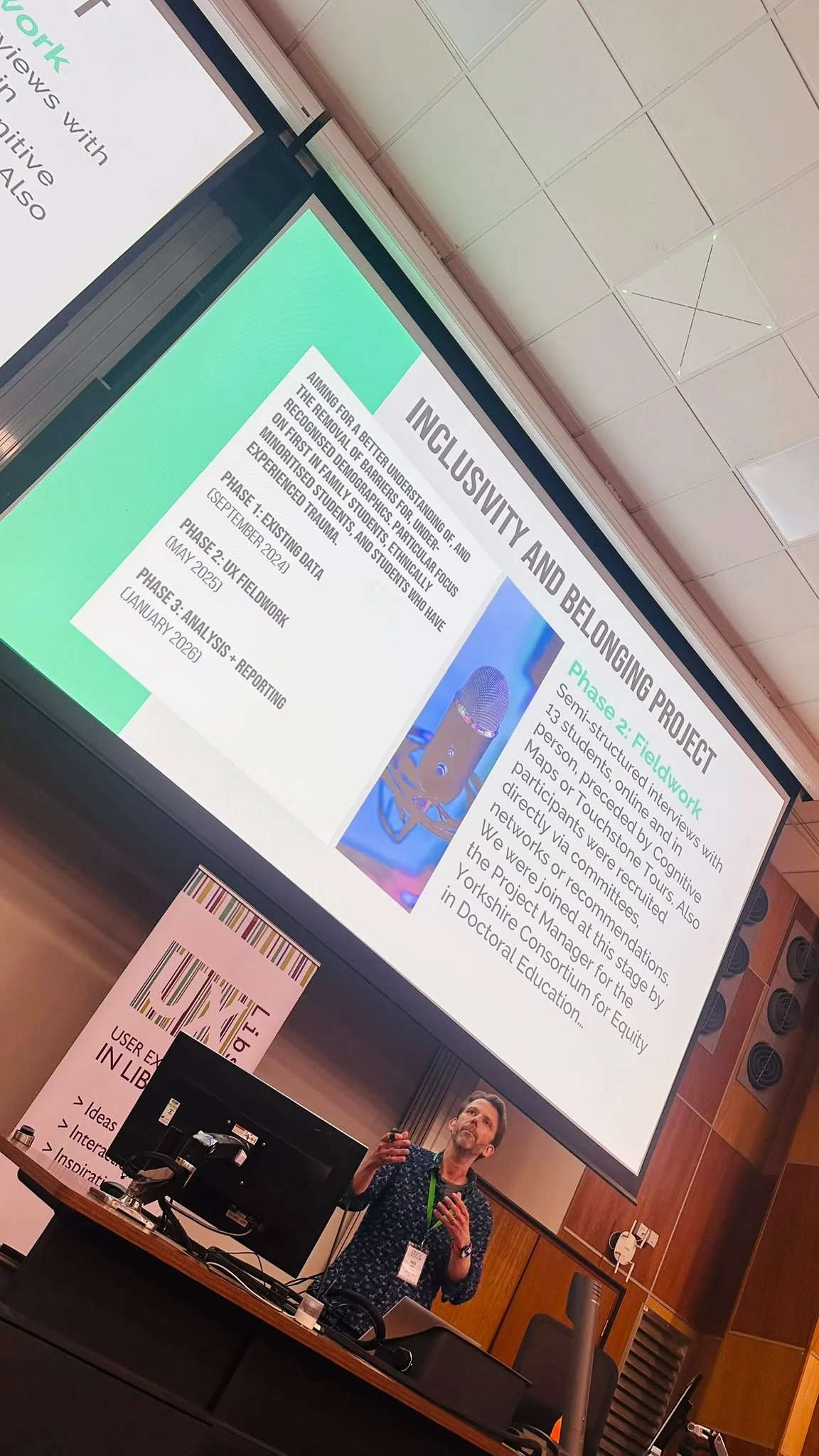
The project began in September 2024. Phase 1 focused on existing data: we met with around 10 staff from around the University to assemble perspectives and documentation from related studies. Phase 2 was the UX fieldwork, beginning in May 2025 and running until January 2026; we spoke to 13 students recruited directly, via channels such as Step Ahead or recommendations from relevant staff. Phase 3 - thematic analysis and reporting - began in January and ended in April 2026.
The project group consisted primarily of Ned Potter, Clare Ackerley, Martin Philip and Olivia Else, all from the Faculty Librarian Team, and we benefited from three later additions to the group. Raj Mann (who was at the time Project Manager for the Yorkshire Consortium for Equity in Doctoral Education) joined us for two months of the project, bringing invaluable expertise on many pertinent areas including providing a safe environment for interviewing students on potentially traumatic subjects, and introducing us to the term Trespasser Syndrome (more on which below).
Sarah Lapacz and Emanuela Buizza from the Customer Services Team joined up after most of the fieldwork was conducted, to help with thematic analysis and recommendations. Having their perspective and fresh eyes on the data was really valuable, and I'd recommend this approach of involving new people at the analysis stage for future UX projects going forwards.
A note on terminology
We use the term under-recognised groups rather than under-represented groups, which is the phrase we typically see used in the University. Even though it is almost always not intended this way, there is an implication with the latter term that the onus is on the marginalised person to represent themselves better, whereas of course the reasons for under-representation are systemic and institutional.
We use the term ethnically minoritised students rather than BAME or Black, Asian and Minority Ethnic students, based on advice from specialists in Diversity, Inclusion, Equity and Belonging. This framing highlights the fact that Black and Asian students' minority status at the University is an active, systemic process, rather than a static identity. Talking about 'BAME students' also risks implying a homogonisation of very diverse experiences.
We use the term Trespasser Syndrome where the University often used the term Imposter Syndrome. Imposter Syndrome individualises suffering: it’s not something being done to you; it’s something you ‘have’, a personal flaw that comes from within. But students from marginalised groups are made to feel like outsiders by the University - that comes from without. To quote Dr Arin N Reeves: "People from under-represented groups are not afraid that they are imposters; they are afraid that the majority groups won’t see them for who they are and won’t welcome them if they do see them. These fears are not the fears of imposters; they are the fears of trespassers."
Findings
1) Standard library environments can be exclusionary to marginalised students.
Large, bright, open study areas (such as Morrell Floor 1 or the Burton) are perceived as overwhelming and high-pressure spaces.
It was notable that this was the one area in which ethnically minoritised students, first in family students, students who have experienced trauma, and neurodivergent students all reported similar experiences and issues: the discomfort that comes from feeling observed ("it's just eyes and heads"), or 'taking up someone else's space' in an environment in which they already feel like a trespasser.
2) Bright fluorescent lighting is a source of overstimulation, especially for neurodivergent students. We know from previous UX projects that students want controllable lighting (such as desk lamps) or dimmer zones within the library - this was further confirmed in the fieldwork here. The natural light from windows is appreciated, but strong internal lighting is not.
3) There is a demand for semi-enclosed "micro-spaces". Students want the comfort and privacy of a "little house" while remaining in a public study environment rather than in an isolated area where they feel vulnerable.
Student needs are not as straightforward as wanting to study in busy areas, or quiet areas, or secluded areas. They require different combinations of good sight-lines, whilst not being overlooked; being private whilst not being isolated; feeling not just more scholarly but more inspired than they would at home.
4) The Hidden Curriculum causes financial stress in the library context. The hidden curriculum a wider issue across the University, but in the library it manifests in students not knowing that textbooks are available for free or that online copies exist, leading to unnecessary financial worries. There is also a lack of understanding around borrowing, returning and requesting books which is exacerbated for any students who feel othered or like they don't belong, as they're less likely to seek out help for their problems.
5) The lack of a quiet, segregated prayer space within the library is a functional barrier to long-term study for Muslim students. We know there are many reasons why a prayer room is not currently possible in the Library - however it continues to be raised in the research, every time we speak to students, even if we don't ask about it. Any student needing to pray during their study faces a stark choice - the discomfort of public, overlooked prayer in the library, or losing time (and potentially their study space within the building) by needing to travel to a prayer room elsewhere on campus.
6) Inclusion and belonging can come from exhibitions and events in the library. When we asked what could make the library more inclusive, several students talked about events or exhibitions as being key to seeing themselves (and those of other cultures) in the space.
7) The library is considered a diverse space. The majority (though not all) of ethnically minoritised students we spoke to considered the student body who use the library to be relatively ethnically diverse.
However it was notable that working class students are keenly aware of how many private school educated people are in the wider University. Several mentioned feeling othered by this.
8) Library staff are considered open, helpful and approachable. Many students report positive interactions with library staff, including ethnically minoritised students who have not had positive experiences elsewhere on campus. This is a real strength in the library which we should continue to build on.
For many of our participants, asking for help at all is significant. We need to continue to encourage and reward help-seeking behaviour at all times, and to foster non-direct forms of communication - students told us they'd prefer to DM on Instagram than speak to a member of staff face-to-face when seeking help, for example.
As mentioned in the executive summary, it is my belief that the staff of the library go a long way towards mitigating the more exclusionary aspects of our buildings and services, and are a key part of why we are widely considered to be a very inclusive space within the University.
Recommendations
There were 19 recommendations, many of which are complete. A selection are mentioned below.
Ethnically Minoritised Author Showcase Space (completed): This collection was suggested by Raj Mann as a way to celebrate ethnically minoritised authors and make the library a more inclusive environment. It began with the purchase of around 500 books, and rather than selection being driven by the library each item was a recommendation from students or staff at the University. To ensure these books remain accessible throughout the library, we purchased dedicated copies specifically for this room rather than moving existing stock. There is a QR code in the room where students and staff can suggest additional purchases for the collection: these are reviewed twice a year in Collections Community.
Add tags to study spaces in LibCal to aid students affected by trauma in choosing where to work (completed): The LibCal booking system now has additional checkable boxes when searching for study spaces. These allow you to filter the spaces and, for example, show only spaces with good sightlines, or spaces where you're seated with your back to the wall.
Add blinds to study rooms to allow privacy for prayer (completed): we have had bespoke blinds fitted to two Morrell bookable study rooms (on Floors 1 and 2) to allow students privacy to pray
Offer bespoke Library Tours for relevant Student Communities particularly First in Family groups
Introduce more cultural event programming within the Library buildings. We will also explore offering LFA/144 as a safe, warm, well-lit event space for EDI+B related events at evenings and weekends, for student groups and societies.
Better promotion of money-saving and no-cost services in the Library ideally in collaboration with Central Comms channels where possible
Expand the glossary of library terms (in progress): our current glossary is focused on library terminology: we want to expand this to cover more colloquial and idiomatic territory, to help those adapting from other countries. Will include English and Yorkshire based expressions, as well as the usual definitions of library jargon such as 'quartos'.
Conclusions and future work
This project has taken a year and half to explore the experiences of several communities, and this has been extremely successful. However, in the future we aim to undertake smaller UX projects with specific communities to understand their needs better. This more agile approach would see us undertake three projects (interviewing 5 participants each rather than 15) each year, focusing on one group at a time.
The Library must continue to be an exemplar across campus in investing in, and genuinely believing in, inclusivity. The user voice is key to this, and this project has shown how valuable it is to continually undertake research directly with the student (and staff) population to inform our decisions.
We need to work to mitigate some of the systemic issues beyond our control. We can't solve all the problems we identified, but our experience from previous UX projects has shown people really appreciate any efforts to reduce the impact of the issues - see for example providing blankets because we don't have the ability to make our buildings warmer. What are the blanket equivalents for the issues identified in this project?
We need to ensure that designing for the typical York user doesn't become a proxy for exclusion. When budgets tighten, services often shrink to fit the needs of the majority: when we design for those with the fewest barriers and the most flexibility we can inadvertently sideline marginalised groups with complex needs. UX projects like this one are an essential tool for equity, elevating diverse perspectives and ensure our library remains an inclusive, authentic spaces for everyone.
Ned Potter, April 2026