
Library Futures

Bravery based librarianship is the (only) future

Fearless man  

In recent months I've been fortunate to meet a few people  I admire. Stephen Abram, Terry Kendrick, Andy Woodworth, and Jim Neal* are all people whose ideas about librarianship I've been inspired by.

I'm really interested in a common theme, one which the SLA2011 conference really hammered home for me. All of them have talked about the need for for a little chaos. They've all talked about the need to build in the potential for chaos into the fabric of librarianship and the libraries we work in - to deal with what Stephen calls the "asynchronous, asymmetrical threats" libraries are facing. He believes the only way to deal with this is through pattern disruption (and incidentally, points out that pattern disruption is a lot easier to achieve with people than it is with buildings or books).  In other words, mixing things up. Not just plodding along the same old route.

I think that chaos - deliberate, sanctioned chaos - is very, very hard to engineer. The whole thought of engineered chaos is almost oxymoronic anyway. You can only build in the potential for chaos but you can't be completely sure you'll be able to decide what that chaos will be. So you have to be really brave.

I think that bravery based librarianship is the only future we have. At some point, we have to disrupt the patterns and set a new path. Many libraries are doing this already - our profession is, of course, much more responsive to change than most people realise. But fear-based librarianship, or at least caution-based, still seems prevalent. Many a decision is made in order not to upset the minority, rather than to potentially please a whole new majority. In many cases, this approach is taken with good reason. But we're talking about the survival of our profession, here.

But what strikes me is how often I hear about bravery-based librarianship that goes well. There were loads of these at SLA2011. So many times when libraries take the plunge on some decision or other, the outcomes are positive. I know failure is less likely to make it into the public eye, but even so enough people are trying interesting things and discovering that - hey, guess what - the world DIDN'T end and the earth DIDN'T swallow them up, and in fact everything carried on, but slightly better. So we should learn from them.

So many great ideas get bottlenecked by trying not to upset people. We are at a time when we need to inspire people, not protect their delicate sensibilities. Merely not failing is no longer enough. We have to succeed in such a way that the odd failure happens too - otherwise we're not speculating enough to accumulate sufficiently. And I'm not talking about whole libraries, I'm talking about the ideas which drive them. Can we get ourselves into a collective mindset where we don't fear chaos?

If you have an example of bravery-based librarianship, either succeeded or failing, I'd love to hear it in the comments.

Andy Priestner, another librarian for whom I have much admiration, is a good example of someone who has reached a senior position and still innovates, forward-thinks, and generally terrorises the establishment. (He's even employed a Special Projects Officer who has the freedom to make chaos happen, in a good way, because they're not tied in to the daily grind of the library. This is, thus far, the only clear example I've seen of what Jim Neal advocates - to build in to your organisation at least one position with real freedom to innovate, react with agility, focus on new ideas and so on.) What Andy does at Cambridge works!  Bravery-based librarianship really can be done.

- thewikiman

* I didn't actually meet Jim Neal in the end. He did a talk at my previous institution, and it was amazing - I queued to meet him but ahead of me in the queue were all the really senior people in the organisation, including my boss and the librarian etc. So I thought they'd think I was out of place, and he probably wouldn't want to be bothered, so wussed out and left. Later, I found out he knew who I was because of the Movers and Shakers thing, and wanted to meet me. Moral of the story - if you get the chance to meet someone inspirational, just take that chance and filter out all the things which might cause you to leave instead! Don't let caution get the better of you; bravery FTW. :)

Why I’d quite happily never read another comparison between Google and Libraries ever again

Image of a girl kicking one of the 'o's in Google I’m a huge fan of Phil Bradley, and a recent very eloquently written post of his added to the canon of information professionals who have compared Google unfavourably with What We Do. However, I’d really be very happy not to read any more such comparisons hereafter. Here’s five reasons off the top of my head

  1. It’s not a fight we will ever win. Ever. Unwinnable fight = this.
  2. However valid our arguments are for libraries or librarians being ‘better’ than Google, we are not powerful or loud enough for them to stick. It’d be like a minor royal saying he’d be better on the throne than the Queen – that may well be, but no one is listening and in any case, it’s the frigging Queen. She is literally bolted down onto the throne.
  3. It’s really hard to become popular by slagging something else off. You have to be really likeable to make this approach work; it reminds people too much of politicians who only ever talk about how bad the opposition party is. From a marketing point of view, librarians saying Google is bad is a disaster, because everyone loves Google – it’d be like goldfish trying to make a comeback as a popular pet with a ‘Kittens are bastards’ campaign.
  4. It’s hypocritical. Lots of librarians love Google. I love it – I use it every single day almost a bajillion times. I use it for work, in my library. I know some people don't love it and use Bing etc, but really there isn't a web user in the world who doesn't get some kind of good use out of search engines.
  5. See number 1, again. .

All we can do is help people to use it better, and emphasise that we provide access to information which Google cannot find. To step up to Google and try and compete for the same market is a waste of energy.

-   thewikiman

Average is no longer enough? Noted. Now let's move on.

Picture of a spoon A lot is being made of the fact that in librarianship, Average is No Longer Enough. Was average enough at some point previously? Possibly; it doesn't matter. What matters is that there are enough librarians in the profession who love it enough that they don't want to be average, rather than reluctantly excelling themselves because they've been told to do so at a conference or by a blog post.

I predict that the total number of information professionals (in the current understanding of the word) will shrink at a fairly steady rate during my career. The Average will probably be the first to go (the Really Bad being, in my experience, remarkably stubborn). It'll be a Darwinian process - the people that really love this will probably be strong enough to survive, because they're the ones likely to be enthusiastic about embracing new challenges.

In a job market where there are far more qualified professionals than there are professional posts, the whole idea of trying to turn the drifters into yet more super-librarians is perverse anyway. The people who think average is enough are probably never at the kind of events where people say it isn't. Let's stop telling each other what we already know, take the non-existence of THE SPOON as read, and use our time in conferences and on social media to talk about something more useful - like specifically HOW to find your 'extra' rather than just the fact that you need to.

- thewikiman 

p.s Please use the Comments section for all puns about what mean-spirited post this is. :)

Libraries are about people - so where's the personality?

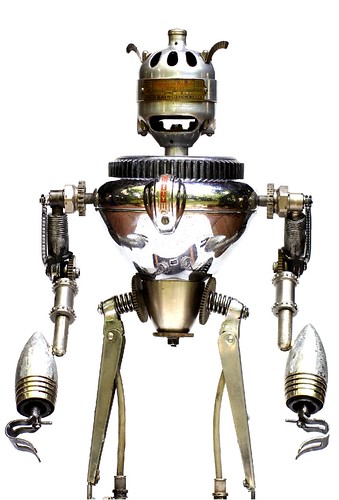
Picture of a lovely robot I think we can all accept that people have become very important in librarianship. It is the people who make the difference between the library and the internet, the people who add the value which makes libraries more than a warehouse full of books, it is the people who teach and educate and train users, it is the people whose visions inform the new directions libraries are taking.

At SLA2011, a lot of people said “There are loads of presentations, across loads of chapters and divisions – but it’s the people who that you really want to focus on. The value lies with the individuals.” The tweets emerging from ALA11 seemed to indicate the same things - @JustinLibrarian saying “What I learned at #ala11: sure, exhibits and panels are great, but the true power of the organization is in people” for example.

I think that while we can accept this as true, it doesn’t seem to have penetrated the deeper professional psyche as to what libraries are, and what they are for. When there are grants or external funding, they seldom get spent on people. When there are marketing campaigns, they rarely feature the people. (Library marketing books often talk about The Four Ps of marketing. Guess what - none of them are People.) When there are cuts, it’s often the people who go first.  It’s still the resources which are king in libraryland, and I’m not sure this will work as well in future.

At his spotlight session during SLA2011, Stephen Abram said the key thing about all the new tech changing the way we all work is not the technology itself, but about representing our role (as information professionals) within that technology. Which is to say, we’re the people who can make it work for our patrons and customers. We need to remind people more explicitly that the value lies with us - each particular 'us' that works at each specific library. Stephen later pointed out to me that automated process are increasingly common, so eventually we could keep libraries open but get rid of almost all staff - but they will find it a lot harder to do that to us if we can successfully  emphasise more clearly the role of the individuals. We know that our value lies in our expertise, but does our approach to marketing, funding, finances etc really reflect that? We're still promoting books and databases most of the time.

So if we position ourselves as experts in new trends and technologies per se (rather than just, for example, a guru in a certain area such as micro-blogging) then when the technology goes mainstream, people will know to come to us for help and further information. It’s not about saying “Hey the library is an expert in FourSquare!” – it’s about saying “The librarians know about new trends and technologies, come to us and we’ll guide you through it!” and then when FourSquare (or any other geolocational social media app, or anything else) goes mainstream, our patrons and customers already have as in mind as potential experts. Like so much of what I write about on here, it’s about positioning ourselves successfully within the wider global narrative.

A more personality driven approach to promoting librarians, as opposed to just libraries, is needed.

- thewikiman

Librarians are horizontal; libraries are vertical

Picture ogf the earth I'm ensconced in the Special Libraries Association's massive annual conference in Philadelphia. It's fantastic. This is the first of probably a few posts picking up on key themes.

The Pulitzer prize winning author and controversial New York Times journalist Thomas Friedman opened the conference with his keynote on Sunday. Whatever you think of his politics, writing style, fee and so on, I'm really pleased that (as is always the case with SLA) a non-librarian was opening the event, and indeed a non-librarian will close it too. A key part of breaking out of the echo chamber is for us to go to non-library events, and to have non-librarians at ours.

Friedman is the author of  The World Is Flat, and he talked about how internet technology has flattened the world, brought companies and people together side by side, and interconnected them. This horizontal communication has, of course, revolutionised the way we work. He also talked about how vital the notion of 'upload' was - enabling people to participate in the web, not just consume it, and how much this increases involvement and excitement and commitment to the cause.

It strikes me that librarians are pretty good at this, for the most part. We live in this horizontal world, we are interconnected, we use web  2 tools to talk to each other, we upload. We are horizontal, and our wold is flat. Libraries, on the other hand, struggle with this a lot more. Libraries are vertical. Libraries' content is often hidden behind catalogues or databases which aren't fully interoperable with the rest of the web, which thwart the interconnectivity. Furthermore, we find it very difficult to encourage 'upload'. We are so used to protecting our collections, that the notion of giving people an active role and allowing them ownership is hard to come to terms with. We're trying, I think, but it's hard to empower people in the kinds of ways that makes them excited, passionate, and consequently advocates. People tell their friends about stuff they can claim ownership of, it's partly why there are so many web 2 success stories; we in libraries are still at the stage where we gasp at the idea of allowing tagging on our catalogues.

It's a tricky issue - but we have to address it sooner or later...

- thewikiman