Presentations

A book about Prezi

  the cover of the book

Mastering Prezi for Business Presentations, by Russell Anderson-Williams, has just been released by Packt Publishing.

I have an interest in this, because I served as one of the two Technical Reviewers for the book. Check it out, I even get a little bio in there!

A bio, of me


About the book

As the name suggests the book is aimed at people giving business presentations - but basically all of it is applicable to anyone wishing to progress their Prezi skills to the next level. What I really like about it is it's written by someone from a proper design background, so there's a lot of technical stuff which is really handy if, like me, you quite like designing multimedia things but have no real idea what you're doing. The sections on using audio and video are really good, and Russell certainly knows a lot of tips and tricks which were new to me. He really gets to grips with the potential of the software, and it's very engagingly written.

About being a technical reviewer

The way the process works with this particular publisher, is that they send you each chapter basically as soon as it has been written. You're encouraged to use the comments facility of Word to go into as much detail as you can, suggesting changes and improvements or highlighting the bits you think work really well. There's also a questionnaire for each chapter, which includes questions like 'what do you think the next chapter should be' and so on. You send back the chapter and the questionnaire, they pass it on to the author along with the other reviewer's comments, and then you get sent the next one or two chapters once they're done.

It's an odd process because you want to be doing a good job as a reviewer and actually making constructive suggestions, so you want to add as many comments as possible - but at the same time you don't want to be finding fault where there is none, and the fewer comments you make the more complete the chapter is already, which is a good thing. So the balance is a hard one to find.

I was doing this around the same time I was finishing off my own book, and I have to say I would have found it very difficult to work like this - showing people what I'd done as I went along. I'm the kind of person who likes to have anything creative more or less complete before showing anyone - and that includes having all the chapters drafted, for context! Facet asked for one chapter early on in the writing process (to check I could actually write) but then let me get on with it thereafter till it was a completed draft. At this point they said they could send it off for proofing, indexing etc - or they could get it reviewed. I asked for it to be reviewed, and specifically asked if Antony Brewerton could review it; I'm really glad I did as the extremely helpful comments he came back with led me to actually restructure the book quite significantly, moving content around and adding some stuff in.

All in all reviewing this Prezi book was enjoyable. Sometimes I found it hard to turn around the work in the time the publisher wanted, and I never really had a sense if what I was doing was actually useful - I asked for feedback but I was told they'd be in touch if there were any problems, so hopefully that means there weren't any. The best part of it was definitely getting to read a great book! There are loads of really useful tips I've adopted, and my recent Prezis are much better than my earlier ones because of it.

One thing is certain - I much prefer this kind of reviewing than critical reviewing for publication, and when I get asked to do that I always suggest someone else to take it on. Knowing what goes into writing a book means I could never really criticise anyone else's knowing they might read that criticism, so a review from me is of no use to anyone...

 

Good presentations matter

Last week I was involved in a CPD session at our staff festival, aimed at people interested in presenting at events and writing for publication. My colleague Julie Allinson did the publications part - she recommended Mike Ashby's guide to writing a paper (PDF). I did the presentations bit, and it was based on a mixture of a recent LibMarketing slideshow on making good PowerPoints, and advice about public speaking that I'd previously written or read. It's worth a look particularly if you haven't already seen 'Good Slides Matter', because it refers to some research behind what works and what doesn't in multimedia learning, and advises how to build presentations accordingly. There's also some SUPER-ADVANCED MEGA TIPS at the end... :)


Thanks to @girlinthe for drawing my attention to the multicolor search engine - a brilliant tool! Try experimenting with putting in the two main colours of your library brand - you can then do away with templates entirely.

- thewikiman

A guide to networking for new librarians

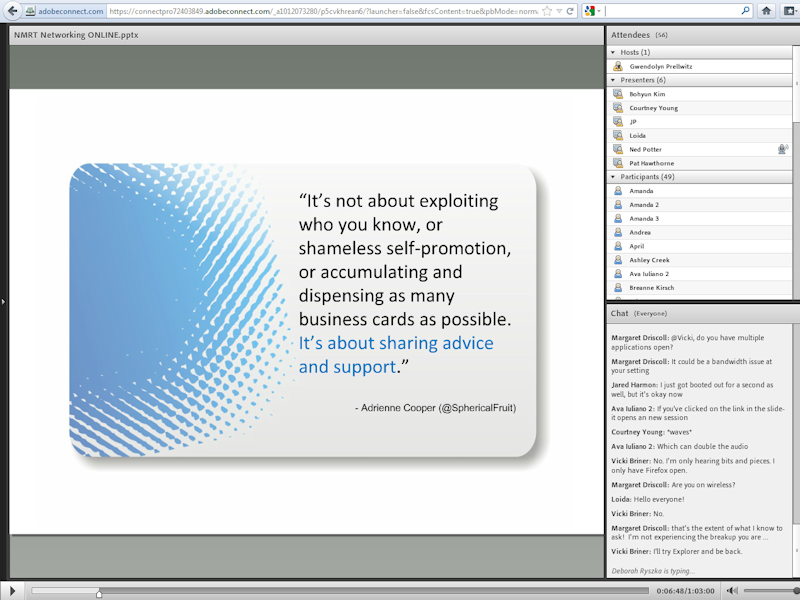
I was really pleased to take part in the Annual programme for the ALA's New Members Round Table, last week - it was a webinar and the whole thing was recorded. You can watch and listen to it online here (it opens in Adobe Connect) - I talk about the 'What' of networking (starting around the five-and-half-minute mark) and finish things off with the 'Why' (around 42 minutes) - in between the How, Who, Where and When are covered by Loida Garcia-Febo, Courtney Young, JP Pocaro and Pat Hawthorne respectively. A screengrab from the webinar

Huge thanks to Bohyun Kim for inviting me to present - it was nice to take advantage of the technology to do something with the ALA without having to be at the conference in the US, and I enjoyed the webinar a lot. Appropriately, I made a few connections at the event and found it to be good networking experience.

Being forced to define networking for the purposes of the talk, and take a step back and look at what it means and involves, was a revealing experience, in particular because it made me realise how much of what I think about having a brand can apply to networking. In particular:

  • Networking, like developing a brand, is a means to an end and that end is opportunities to do interesting or fun things - you meet and connect with people who expand your horizons, expose you to new ideas, and collaborate with you to do cool stuff. (Unlike brand networking is also an end in itself - it's just fun to talk to nice people.)
  • If developing a brand is a natural byproduct of pursuing your professional interests in as networked a way as possible, then developing a network is a natural byproduct of the same thing, really.
  • Related to the above: in my experience it's easiest to develop a network by positioning yourself as part of the dialogue in librarianship and contributing, than for example saying 'I'm going to make X connections' and actually setting out specifically to develop a network or market yourself .

I find my network (essentially: you lot) to be THE single most useful thing in my professional life, and in the webinar I reflected on a clear delineation (marked by the 2009 New Professionals Conference) of pre-networked-Ned and networked-Ned - all the interesting things have happened in the latter period. I could neither have written my book nor got my current job without my network. So a: thank you! And b: if you're wondering about taking the plunge and networking more, it's worth it. Becoming part of something bigger is a great thing.

- thewikiman

You already have a brand! Here are 5 ways to influence it... (#CILIPNPD12)

Yesterday I presented at possibly my favourite library event of all, CILIP's New Professionals Day. I love it because it gets so many people fired up and energised, and there's so much enthusiasm about the place. I was honoured to do the first talk of the day, and my presentation was about two things: firstly the fact that you don't have to be a super-librarian to get on in your career, and secondly that we all have a personal brand so if you do want to try and build that brand, there are steps you can take to do so positively.

I wanted to dispel some myths (particularly that we all have to aspire to be like the really well-known, uberlibrarians), following on from this blog post about whether or not we really have to market ourselves at all, which explains a lot of the stuff I talked about yesterday.

Here's the presentation (works best on full-screen):

Introducing the Library Marketing Toolkit website!

Months in the planning, the library marketing toolkit website is finally live! It can be found at www.librarymarketingtoolkit.com. A screengrab of the Library Marketing Toolkit website

What's on it?

The site is essentially designed to give you lots of practical advice on how to market your library - be that public, academic, special or archive. There are tools and resources, lots of useful links, new case studies which will be added to on an ongoing basis, and there's info about the Library Marketing Toolkit book and its contributors.

There's also a blog, which will give tips and aim to highlight the best (and sometimes the worst) marketing from libraries around the world. The first post is Marketing libraries with new technologies: what you need to know, and what to do next and features this presentation, which I gave yesterday at an Academic and Research Libraries Group conference on new technologies in libraries:

(Works best on full-screen mode)

What's coming up next?

The next post on the site will be a fantastic case study from the Bodleian library at Oxford, about their amazing smartphone app which has had everyone from Stephen Fry downwards swooning over it's amazingness.

There's also some additional case study material which I couldn't fit into the book, and several other brand new case studies including stuff from the UnLibrary in Crouch End, high-level tips on crowd-sourcing from JISC's Ben Showers, and a brilliant how-to on social monitoring from Andy Burkhardt.

Subscribing etc

I'd love it if you subscribed to the new blog - you can subscribe by clicking here - and there's a Twitter account too, @libmarketing, which you can follow here. If you want to spread the word about the new website on Twitter (for which I'll love you forever!) here's a ready made click-to-tweet link to it.

About The Library Marketing Toolkit book itself

The Library Marketing Toolkit will be published by Facet Publishing this Summer (probably 20th of July in the UK, and slightly later in the US / Canada. Stateside it will be distrubuted and marketed by Neal-Schuman, who've just been bought by the ALA). It is aimed at public libraries, special libraries, academic libraries and archives, and is extremely practical in nature - ideas you can apply right away to market your library more succesfully.

The best part is, it has 27 fantastic case studies from really amazing people and libraries from the UK, the US, Canada, New Zealand, Australia and Singapore. Contributors include organisations like the British Library and the National Archive, New York Public Library, University of Cambridge, JISC - and amazing individuals too: see the Contributor's page of the Toolkit website for details of all of them.

You can order it direct from Facet, or via Amazon UK, Amazon US, Amazon Canada etc. As mentioned in the previous post, a free chapter is available for download, here (PDF).

We have one advance-copy review so far, a great one from Nancy Dowd, the vertiable QUEEN of marketing libraries!

Ned Potter's  book will help any library succeed in creating a community that is aware and engaged in its library. He has written an easy to follow tool kit targeted at the specific marketing needs of librarians that is sure to become a favourite resource for anyone involved in marketing a library. There are case studies from libraries around the world that will inspire you no matter whether your library is large or small. You'll love this book!’ - Nancy Dowd, Author of ALA's Best Selling Book, Bite-Sized Marketing

- thewikiman