Professional Development

A competition to benefit everyone in libraries, not just the winners

LISNPN, the New Professionals Network, has just announced it's first ever competition and I am really excited about it.

A scree-grab showing the LISNPN competition blog post

You can read all about it on the network itself, but the short version is this: we want people who have entered the profession in the last decade or so to create a piece of library advocacy. It could be an article, a video, a slide-deck, an essay, a piece of art, a project, a campaign - literally anything that doesn't pre-date the competition. The only criteria is that it gets some pro-library ideas to people who wouldn't normally engage with libraries at all. The idea is to indulge in a bit of stealth advocising - to package up some library advocacy in something so intrinsically awesome that it reaches new audiences. Doesn't even have to be particularly stealthy - just reach new people.

The first prize is a full pass to Umbrella, CILIP's biennial conference which takes place in July this year. We're working with CILIP on this competition so thank you very much to CEO Annie Mauger for agreeing to be part of this - the prize is worth up to £500 (based on what the pass would cost to buy; it'd be slightly cheaper if you are a CILIP member already) and includes refreshments, social activities and the Gala Dinner. Attendance at such a conference is usually out of the reach of New Professionals due to the cost, so we're really hoping the competition sparks loads of interest and is entered by people who would love to attend but couldn't normally. Not only that but there is a second prize of attendance at the New Professionals Conference this year! This has kindly been donated by the Career Development Group. Full details of this year's NPC are still to be decided, but it'll take place in June, somewhere other than London. You can read about last year's conference here to get an idea of what it's all about.

We'd really encourage as many people as possible to enter, whether it will be your first attempts at library advocacy, or if you're a veteran. You can read the full Terms and Conditions on LISNPN. (And thank you muchly to the LISNPN admin team for spending ages with me working those out!)

Apart from the great prize, and it being another step forward for the network, there's another reason I'm thrilled about this. Every single entry should benefit the library community, whether it wins or not. Many competition entries are inward-facing rather than out-ward facing - an essay about why you want to win, only ever seen by the judges, for example. That's fine, but this is different. Because every single entry to this competition will be a little piece of library advocacy, a small effort to raise awareness about the profession and the industry. The beauty of a competition format like this is that one prize inspires multiple efforts - to actually commission 10 or 20 or 50 people to create advocacy would cost a fortune, whereas here we only 'pay out' once, or rather twice as we have a second prize. So lots of innovation is (hopefully) catalysed. When this happened in the air-travel industry, with the Orteig prize in 1927, it moved things on by years in a single leap! Not saying that will happen here, but I'm still excited at the prospects of what we can do.

You can read more about the Orteig Prize and how we can use the method to advance the library profession, in the unofficial part 2 of this blog post, here. It's a really interesting story!

- thewikiman

Everyone should read this article! Then maybe write their own...

Librarianship was yesterday featured in the Guardian's Beyond the Job Series. The article was entitled Beyond books: what it takes to be a 21st century librarian and was written by Emma Cragg and Katie Birkwood. Screen grab of the Guardian article on libraries

I am so happy about this article! For loads of reasons.

First of all, this is a brilliant piece. Here is a quote - I originally highlighted three paragraphs I really liked in order to copy and paste them, but realised that would basically be quoting half the article... Here is one bit I liked, but I liked all of it, and you should go read the whole thing.

"Books are only one aspect of what libraries and librarians are about. Librarianship is a people profession; a librarian's job is to connect people with the information they are seeking, whatever format that may take. At their heart, all library jobs have a central purpose: to help people access and use information, for education, for work, or for pleasure. In all library roles customer service and communication skills are important. If anyone ever thought they'd become a librarian because they liked books or reading, they would be sorely disappointed if they did not also like people too."

The article says all the things you'd want it to say, as a library professional, and all the things you'd need it to say, as someone curious about entering the field and needing to know the reality of it.

Second of all, it is in the Guardian. It will be read by thousands and thousands of people, all of whom will be educated about what librarianship consists of even if they don't go on to try and become one. It is a proper bonafide Echo Chamber escape. I believe the genesis of the idea came from this post on Emma's blog, and the comments that followed.

Thirdly, it mentions the Library Routes Project. Laura and I wanted to break this resource (which, if you're unfamiliar with it, documents librarians' roots into the profession and their routes through it) out of the echo chamber but have been unable to do so, really. I actually contacted the Guardian to propose an article about it, but didn't get a response. Emma and Katie have found just the right medium in which to mention it, and they got in lots of references to Bobbi Newman's Library Day in the Life Project too (you can see my video contribution to that project, here). Perfection! Since the article was published around 24hrs ago, the Library Routes wiki has been viewed hundreds of extra times - finally by some non-librarians, I hope.

Fourthly it mentions me! And this slide-deck:

I sought to get this slide-deck seen outside the echo chamber as much as possible, and although that certainly happened this will really add to it - in fact Emma commented that they were going to try and link to it from a Guardian article way back then, now it has finally come to fruition. It's really kind of Katie and Emma to include a link to this, so thank you to them. As a Guardian reader since literally aged 12 (yes, I know...) and someone who literally loves the paper and the institution, being mentioned by a Guardian article is definitely (literally) pretty fabulous!

So the question is, can any of us repeat this success elsewhere? Emma and Katie are presumably forbidden from reproducing their work in other publications, but there is nothing to stop the rest of us finding avenues for writing a guide to librarianship and getting it published in neutral, non-library places. Are you up for the challenge?

- thewikiman

VIDEO: Library Day in the Life

Library Day in the Life is a bi-annual initiative to document what library professionals really do these days, insitgated by Bobbi Newman. I've taken part in previous rounds with normal blog posts but frankly nobody ever really reads them - this time I wanted to do something a bit more interesting and a bit more visual. So I've created a video of one day in my library life - the effort-to-end-product ratio of this is all out of sync as it took fricking ages! But anyway, here it is, I hope people like it.

In case anyone is interested, I used a Logitech webcam, my iPhone, my wife's fairly ancient digitial camera, and BB Flashback Express screen-recording software to record it - and Windows Movie Maker to edit it all together. Music is by Mint Royale.

A couple of the best bits just would not work in Movie Maker. They play fine on their own, but they froze when I stuck them into the film. No idea why, it's not done that to me before - so I'm afraid a screen-grab about LIFE-SHARE is gone, and a bit about #buyalib is gone too. I had waaaaaaay too much footage, too... Note to self: no need to film the entire commute. :)

- thewikiman

Echolib / LISNPN / Advocacy: New Year's Round Up

A quick catch-up post for all the stuff I've not mentioned in previous posts but which has happened in the last couple of months.

The Echo Chamber

Lots of echolib stuff has been happening recently. The article I wrote a while ago for Library & Information Update has finished its embargo and so now can be made available - I've been displaying it on the Echo Chamber Netvibes page, but you can also download it in PDF format, here.

Continuing the Stealth Advocising theme from a few weeks back, I created a video version of my If you want to work in libraries... slide-deck. It has some funky hip-hoppy latin music in it that I wrote when I was about 17! Woof. Here it is - as ever, in the interests of spreading the messages far and wide, feel free to use this however you like, embed it wherever, etc etc.

The Slideshare version of this has now been viewed more than ten thousand times, so surely LOADS of those people must be outside the echo chamber, right..?

I also wrote an article for PostLib, the journal for retired librarians! I was really pleased to be asked to do this, I like to see the divide between senior and new professionals being bridged whereever possible. The resultant article is now available: Statistics, the Media and the Library Legacy (PDF) - and owes a big debt to Ian Clark [Thoughts of a Wannabe Librarian] who read it over for me and gave me his approval to use some of his ideas! It mentions the echo chamber in passing - but really the main thrust of it is to note that, if you take combined footfall and internet usage stats, public library use in the UK is actually UP over the last couple of years (quite considerably), contrary to popular reports.

Laura and I will present a new version of the Echo Chamber presentation in Cambridge in a couple of days, to an audience of 200 or so people - the biggest we've spoken to yet, so we're really excited about that.

LISNPN

There's also a couple of articles I wrote about LISNPN, the New Professionals Network, available elsewhere. They're both on CILIP platforms but both are freely available to all - Moving forward together opens Library  Information Gazette in digital form, and The LIS New Professionals Network takes you to CILIP's Information & Advice blog.

Look out for a BIG competition on LISNPN later this month, with a library-related-prize worth literally hundreds of pounds and well worth winning.

Library Routes Project

Remember Library Routes? It's still going! And there's plenty of great entries that have come in in recent months - there's now over 150 contributions from Information Professionals about how they got into librarianship, and their path through the profession. Check it out if you haven't already, or if you've not done so for a while. The project homepage has more than 25,000 views now, so maybe some of those will be from people outside the Echo Chamber too.

Gazette Profile

I was really pleased that Debby Raven featured me in the last but one edition of Gazette, following up on the Essential Careers Advice for New Professionals post. You can read the interview, again via the Digital Gazette magazine platform, here. Incidentally the permanent, to-be-added-to, and containing the wisdom of the people who've commented on the original, version of the Essential Careers Advice post is here on its own page of the blog - check it out and tell if there's anything that needs adding to it. What do you know now that you wish you'd known earlier?

All of these articles are available together on the Papers & Presentations page of my website.

And finally...

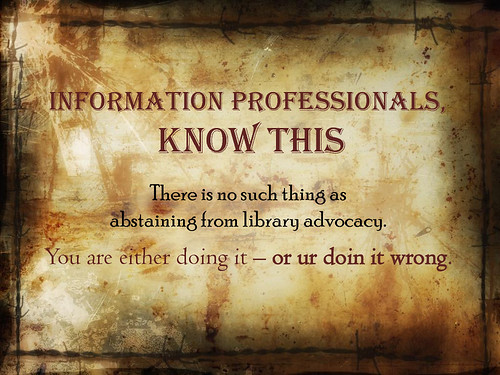
I created a hectoring advocacy poster a few weeks back - it's deliberately harsh and provocative, but I do think there is an underlying truth to it.

Poster that says there's no such thing as abstaining from library advocacy

Phew!

- thewikiman

Everything you need to know about technology to work in libraries

I've given a couple of talks on technology in libraries recently. Here's roughly what I said. (Or, more accurately, roughly what I intended to say, :) ) In modern librarianship you can do so many jobs, such a diverse array of roles which are salaried by the library; actually very few threads run through all of them. Over the course of the two New Professionals Information Days we've had more than 150 delegates through the door, and there's very little in common between ALL the roles we do or aspire to do. Certainly not books.

'Problem solving' is probably a thread which runs through most roles, 'people' is another. But really technology is the only thing that unites pretty much all the jobs we Information Professionals do. So, it's incredibly important to be comfortable with it. By technology I do mean hardware (PCs, scanners, iPads etc), but to a greater extent I mean software, platforms, social media, the internet and all that it entails.

Technology, when used well, is at the heart of the revolution libraries are currently under-going. Already well under way is the change from libraries as 'book wharehouse' to libraries as something much more dynamic and fluid, led by the information-seeking needs of our users. As New Professionals, we will soon become custodians of that change: we need to be ready.

If you think about a timeline of the world, and a timeline of libraries, the two have not been changing at the same rate. Libraries have been bobbing along in a very similar fashion for quite a long time, with not much in the way of drastic change between the library of Alexandria, and the libraries of 30 years ago. Suddenly, however, they're changing more in the last 30 years than arguably in the whole of the rest of their history put together. And of course, that seismic shift has its heart in technology.

Let's imagine a library has stood on this spot since the 1890s. Imagine a 30 year old man, like me, goes into this library in 1890 - he can expect a certain look, a certain feel, certain types of resource. If you took that man and forced him to travel though time, and placed him in the 1920s, he'd be all at sea. The world, and society, would be almost unrecognisably different. A World War would have been and gone, there'd be telephones revolutionising communication, cars all over the roads, JAZZ happening in clubs! Along with much else that would be almost unimaginable to our 1890s 30 year old. But this library - this library would probably look and feel much the same. Jump forward another 30 years - society has leaped again. The Roaring Twenties have been replaced by the Stepford Wives era, the straight-laced 50s. Technology has moved forward. Another World War has devastated much of Europe. Once again, our 30 year old's head would spin with all the changes. But this library is mostly unchanged - the types of resources are much the same. Fast forward another 30 years, to the 1980s. Society is permissive and developed in a way which would shock our 30 year old. Technology has moved on so much that not only has man landed on the Moon, but he's become indifferent to the idea of bothering to do so again. The Cold War hangs over the world. Computers are becoming common. A 30 year old from the 1950s would find the 80s a culture shock, to be sure. Yet he'd have little or no trouble using this library; the resources would look mostly familiar.

Finally, jump forward the final 30 years to now. Of course, the world is very different. But - and perhaps I'm being naive here - I think the 1980s 30 year old could slot into society without too much difficulty - it's not a cosmic leap forward in many respects. Similarly, as 30 year old now I could slip back into 1980 and not be totally lost. But the library would be completely unrecognisable! Suddenly the flat line of library development has shot upwards and gone off the chart. Technology has moved on dramatically in all areas of society - but much of the day-to-day effects of this are to do with how we access information. With how much we value information. With how we live now in an information economy. The internet has changed everything, including the library. Technology rules the library, it has shoved books to one side. People have always needed to access information, and libraries have always strived to provide access - but now the vessels for that information are changing. Librarians are increasingly becoming early adopters of new tools, platforms, and skills. Public perception, however, has quite understandably been unable to keep up with this change. It lingers behind, envisaging the library much as it was in the 50s, the 20s, or the 1890s.

So it is our job as the information professionals to equip ourselves with as much knowledge of the new as we can, whilst respecting what our predecessors have achieved. Because we newer professionals may not have that long to wait until we start actively start shaping the future of the profession. In fact, it's already happening.

It used to be said that what you learn in your Library Masters would last you five years before the information became outmoded. Now it's said to be just two years; this profession changes fast. Similarly the technology is evolving all the time - all this presentation can do is provide a snapshot of what is used in 2010 (and how we use it). I spoke to loads of my peers to crowd-source the information contained in this presentation, and they all stressed how they go to conferences, read blogs, subscribe to mailing lists and read professional publications, in order to keep up with what is going on. No one ever reaches a plateau of technological know-how in libraries, that they can afford to remain at indefinitely. As glib as it sounds, professional development never really stops.

All roads lead to technology eventually. All ROLES need technology eventually. If the job you want next doesn't require any technological expertise, chances are the one after that will. But even if your dream job doesn't use technology, it's actually very hard to get far enough up the pay-grades to get that job without going for some tech-related jobs. You can't afford to lose out to other more tech-minded people, because so many of the new roles and positions that are being created in libraries relate to the research, implementation, evaluation and development of various technologies.

As I've said before, it's more of a careers climbing wall than a careers ladder in this profession - there aren't always hand-holds directly above you. Those sideways or diagonal excersions often involve technology. For example if you need management experience, a great way to get that is from a project. Projects are often externally funded. External funders love to invest in the newest, most exciting things. The newest, most exciting things often involve technology.

Another point my peers repeatedly stressed when I was researching this, was how important interpersonal skills are. So much of what libraries do is collaborative these days - you have to be able to get on, to get on. Raw technical skill is not enough on its own - you need to be able to communicate effectively too. The TV stereotype of the computer whizz-kid who sits in the basement of an organisation, anti-social and belligerent, but kept on because HE'S JUST SO DAMN GOOD, would never happen in the library. He'd get to the end of his 6 months probation and his line-manager would say, I'm sorry, you're out. It doesn't matter how good your ideas are if you can't communicate them to your peers effectively.

A final word on technology. If you're scared of people, it'll be very difficult to sustain a career in libraries. You may be better off getting out now. If you're scared of technology, that's okay. We can help you! You need to immerse yourself in it - because the fear comes from unfamiliarity. Take away the unfamiliarity and you'll take away the fear. Just use different types of library related technology all the time, until you become comfortable with it. Learn to use social media platforms or presentation software even if you don't need to use it right now. Go on a course on one of the Office suite. Read the manual of your camera and start doing more sophisticated things with it. Just throw yourself into it.

Eventually, you get to a state where you're comfortable enough with technology generally that you're not afraid to take on ANYTHING new that might come up. And this is necessary because, as we've said, change happens fast in this industry. You need to get to a state where you're unphased by the idea of taking on some new platform or direction. It's all very well learning how to use one piece of kit - that's like learning directions from here to the railway station. Much better than that would be to learn where the railway station is, then you can get to it from anywhere...

============================================

The above was from the last New Professionals Information Day for this year (and with MSU closing, who knows when there will be another one) so I can make my presentation materials properly available.

I used Prezi again, but in a different way this time. The canvas became an interactive map – I asked the delegates whereabouts in the library they’d like to work, then navigated to that part of the map and zoomed in on the desk in that ‘room’ to read all about the relevant technology. I designed it very much as an online object, able to stand-alone and be used without me wittering on in the background, so check it out below – just click on a part of the library you want to know about.

As ever, Prezis work better on full-screen. Feel free to embed this wherever you’d like – it’s available under Attribution-NonCommercial-Sharealike Creative Commons licences. And if you have any corrections or suggestions to make, let me have them!