

Library Futures

How would you behave if Privacy didn't exist?

Picture of a padlock

A lot of the prominent stories recently emanating from our world, and the wider world, are linked by the subject of Privacy. It runs like a vein through so many contemporary stories, that I wonder if people will look back on the years around the turn of this decade as a tipping point for privacy. Perhaps we're about to go one of two ways - a future in which nothing is really private, or something a little more Orwellian where privacy is shut down, globally, off the back of Bush-administration style rhetoric about 'national security'.

Sometimes, the privacy stories directly intersect with library stories (such as the controversy around the Library of Congress's handling of the wikileaks saga), but even when they don't, it's all relevant. Privacy is about access to information, and we are the Information Professionals.

The big stories

Many of the biggest stories at the moment are privacy related. The phone-hacking scandal currently rocking the Murdoch empire, for example. Of course Wikileaks is the most obvious one - there are many levels of privacy involved here. People were doing or saying things they thought were private, which were recorded by third parties who in turn thought this would be kept private. Then along comes a whistle-blower who makes the information available to a website, who in turn make it available to the world. For the most part the information only has value because of some distinctly librarian-like intervention between the data being leaked, and we the public ingesting it. 300,000 files on a memory stick is pretty useless on its own - hours and hours of collating, sorting, curating and research, in this case by journalists, give the information the accessibility it needs to be communicable to a large audience. Information overload is also a factor here - absolutely incredible stories, scoops of the year in their own right at any other time, get down-graded because of their proximity to so many other high-interest pieces of information. We become immunised to scandal when we get too much of it at one time.

It is interesting to think how much revelatory material is currently waiting to be unearthed, once someone has done the research to make it viable for public release. It is interesting to wonder how diplomacy will work in the future, if everyone knows that everything they say may one day be read in the paper by you or I.

Recent events in Egypt have taken in Privacy related elements too. The Government wanted privacy; they didn't want easy communication between the people and the outside world, regarding the week-long protests that have been happening in Cairo and elsewhere.  So they turned off the internet.

Surely these two examples show the two ways this could go? Everyone knowing everything, or no one being allowed to communicate anything.

The logistics of leaking

As the excellent Guardian Week in Review podcast pointed out, it is very easy to breach privacy these days. Wikileaks gets hold of 300,000 files at a time - can you imagine trying to carry that many pieces of paper out of a building, at all, let alone covertly? You'd need a lorry parked outside, for a start. Electronic data transfer facilitates leaks - you send things across the ether, or you can save them onto a memory stick the size of your thumb.

Not only that but technology tends to become smaller as it gets more advanced, and so a: more discrete and b: more ubiquitous because you can fit it into more stuff. An absolutely extraordinary number of people own mobile phones – some estimates put the figure as high as 5 billion mobiles in circulation – and pretty much all of those being sold today have cameras and video cameras as standard now. This is technology which would have been super-spy territory a couple of decades ago - devices capable of recording anything, that can fit in your pocket, and that look like something else and give no indication they're recording? Everyone can create the news now.

Not only that, but we have plenty of technology at our finger tips which allows pretty much instantaneous dissemination of whatever we have to share.

The smaller stories

Many privacy stories come about simply because people act differently if they don't think they're accountable for their actions. If they don't think their private actions will become public, they don't attempt to filter their behaviour. When they do become public, the people have to apologise and show contrition - as if it was only the fact that their actions came to light publicly that somehow enlightened them as to the fact those actions were wrong.

The MPs expenses scandal is an example of this - they were comfortable with what they were doing, until the private actions came under public scrutiny, and then they were all suddenly aware of their moral failings and very sorry. The recent departures of Keys and Gray from Sky's football coverage is similar - they acted in a way they knew was inappropriate in the eyes of the public, only because they didn't think those eyes would ever see those actions.

We all do this. I'm glad Keys and Grey are gone, they were buffoons. Their comments were indicative of their misogyny, and unpleasantly bullying. But who hasn't said something privately that would get them into enormous trouble if it was made public? As a case in point, I played poker with some male friends on Friday night, and we spent much of the night satirising Gray and Keys, impersonating them and so on. But context is everything - if you were to see footage of our conversation with the context stripped away, it would be just six men sitting round a table drinking and making sexist remarks.

Our stories

This is relevant to us and to libraries and to information, for many reasons. Particularly the way we use Search Engines. Because we use them, for the first part, thinking we are doing so in private. Would we use them differently if we knew our actions would become public? As the experience of the recent Yahoo! leak shows, I think we would. It's not just that people use the internet to access the seedier side of human existence, it's that our whole lives can be pieced together from the questions we ask of Yahoo!, Google and the rest. Our hopes, our fears, our indiscretions, our health, our finances, our plans - our identity. Google is keen not to be evil now, but the information it has on us already will be around forever. Forever! Who knows what the next generation of owners / CEOs will do with it all.

Facebook is much more openly evil, and plays around with your privacy all the time. We all know this, but as Bobbi Newman pointed out to me, a large percentage of its half-billion-plus users (that's one in four internet users in the world) will not be fully aware of this or of its implications.

The future

How would you behave if privacy didn't exist? Most of us would behave differently, I think. Our private morality would be more closely aligned with our public morality. The tabloids who, happy in their own rank hypocrisy, crow about Gray's 'disgraceful' sexist comments about a female referee whilst simultaneously trying to objectify her in the accompanying out-of-context pictures of her at a nightclub, would not find it so easy to preach about what they so clearly don't practice themselves. But it occurs to me that if this IS a tipping point in privacy, then perhaps we're already happily revealing everything about ourselves, it's just that the information will be made public retrospectively.

So perhaps we should all start behaving as if privacy didn't exist now, to save embarrassment later..? In any case, the role of the Information Professional will surely be of increasing importance, in providing guidance and education, as the stakes associated with digital literacy, information literacy, transliteracy, grow ever higher.

- thewikiman

NB: Hilariously, since writing this piece this morning, and coming back to proof-read it and add the links this afternoon, I've since read a piece by Charlie Brooker in the Guardian this very day saying, in some cases, pretty much exactly the same thing - except more entertainingly... You can read his article here.

VIDEO: Library Day in the Life

Library Day in the Life is a bi-annual initiative to document what library professionals really do these days, insitgated by Bobbi Newman. I've taken part in previous rounds with normal blog posts but frankly nobody ever really reads them - this time I wanted to do something a bit more interesting and a bit more visual. So I've created a video of one day in my library life - the effort-to-end-product ratio of this is all out of sync as it took fricking ages! But anyway, here it is, I hope people like it.

In case anyone is interested, I used a Logitech webcam, my iPhone, my wife's fairly ancient digitial camera, and BB Flashback Express screen-recording software to record it - and Windows Movie Maker to edit it all together. Music is by Mint Royale.

A couple of the best bits just would not work in Movie Maker. They play fine on their own, but they froze when I stuck them into the film. No idea why, it's not done that to me before - so I'm afraid a screen-grab about LIFE-SHARE is gone, and a bit about #buyalib is gone too. I had waaaaaaay too much footage, too... Note to self: no need to film the entire commute. :)

- thewikiman

Trying to measure a library's success by its footfall is like...

... trying to count the number of people entering a country by only checking the airports, and ignoring those who come by sea or land. It's like trying to count book sales just based on what has been sold in the shops, and not online.

It's like trying to measure BBC viewing figures without taking iPlayer into account.

It's like trying to measure an album's success just by CD sales, without taking downloads into account.

It's like trying to measure a newspaper's success just by physical sales, and not by use of the website.

It's like trying to judge a supermarket's success without taking into account online shopping.

It's like ANY NUMBER OF THINGS WHERE THE CRITERIA ARE COMPLETELY INADEQUATE TO QUANTIFY SUCCESS OR OTHERWISE.

Picture of an angry man

Let's settle this once and for all - as I've written before (PDF), and previous to that Ian Clark has written before, and any number of others have pointed out: library use has changed, people do stuff online now. People renew books online (around 40% of renewals happen online, according to my research - every single one of those is a visit to the library building saved), people reserve books online (around 18% of reservations happen online according to my research - every single one of those is a visit to the library building saved). And people access the library's resources online - e-books, e-journals, e-newspapers, databases, and so on and so forth. Take my local library, in York - in three years, online user activity (which is to say, searches of online library resources - not 'use of computers in the library') has gone up by 9,385%. That's over NINE THOUSAND PERCENT! So stop telling me that because less people visit the building, that means the library is being used less - it is a hopelessly anachronistic paradigm and no longer fit for purpose, damnit!

So thanks, BBC Breakfast, for your ill-considered piece this morning which did NOT take that into account (despite the best efforts of library campaigners who gave you their time), and was editorially led, rather than balanced.

Of course, this post is nothing more than an impotent rant that will be read only by Information Professionals who already know everything I've just said. Aaaaargh! How do we get this information beyond the echo chamber? How can we make people understand that footfall doesn't cut it as a measurement of success on its own any more?

In the meantime, if you wish to make your feelings known to the BBC about the report, you can do so via the BBC's feedback page. If we all do this it WILL make a difference.

-thewikiman

Echolib / LISNPN / Advocacy: New Year's Round Up

A quick catch-up post for all the stuff I've not mentioned in previous posts but which has happened in the last couple of months.

The Echo Chamber

Lots of echolib stuff has been happening recently. The article I wrote a while ago for Library & Information Update has finished its embargo and so now can be made available - I've been displaying it on the Echo Chamber Netvibes page, but you can also download it in PDF format, here.

Continuing the Stealth Advocising theme from a few weeks back, I created a video version of my If you want to work in libraries... slide-deck. It has some funky hip-hoppy latin music in it that I wrote when I was about 17! Woof. Here it is - as ever, in the interests of spreading the messages far and wide, feel free to use this however you like, embed it wherever, etc etc.

The Slideshare version of this has now been viewed more than ten thousand times, so surely LOADS of those people must be outside the echo chamber, right..?

I also wrote an article for PostLib, the journal for retired librarians! I was really pleased to be asked to do this, I like to see the divide between senior and new professionals being bridged whereever possible. The resultant article is now available: Statistics, the Media and the Library Legacy (PDF) - and owes a big debt to Ian Clark [Thoughts of a Wannabe Librarian] who read it over for me and gave me his approval to use some of his ideas! It mentions the echo chamber in passing - but really the main thrust of it is to note that, if you take combined footfall and internet usage stats, public library use in the UK is actually UP over the last couple of years (quite considerably), contrary to popular reports.

Laura and I will present a new version of the Echo Chamber presentation in Cambridge in a couple of days, to an audience of 200 or so people - the biggest we've spoken to yet, so we're really excited about that.

LISNPN

There's also a couple of articles I wrote about LISNPN, the New Professionals Network, available elsewhere. They're both on CILIP platforms but both are freely available to all - Moving forward together opens Library  Information Gazette in digital form, and The LIS New Professionals Network takes you to CILIP's Information & Advice blog.

Look out for a BIG competition on LISNPN later this month, with a library-related-prize worth literally hundreds of pounds and well worth winning.

Library Routes Project

Remember Library Routes? It's still going! And there's plenty of great entries that have come in in recent months - there's now over 150 contributions from Information Professionals about how they got into librarianship, and their path through the profession. Check it out if you haven't already, or if you've not done so for a while. The project homepage has more than 25,000 views now, so maybe some of those will be from people outside the Echo Chamber too.

Gazette Profile

I was really pleased that Debby Raven featured me in the last but one edition of Gazette, following up on the Essential Careers Advice for New Professionals post. You can read the interview, again via the Digital Gazette magazine platform, here. Incidentally the permanent, to-be-added-to, and containing the wisdom of the people who've commented on the original, version of the Essential Careers Advice post is here on its own page of the blog - check it out and tell if there's anything that needs adding to it. What do you know now that you wish you'd known earlier?

All of these articles are available together on the Papers & Presentations page of my website.

And finally...

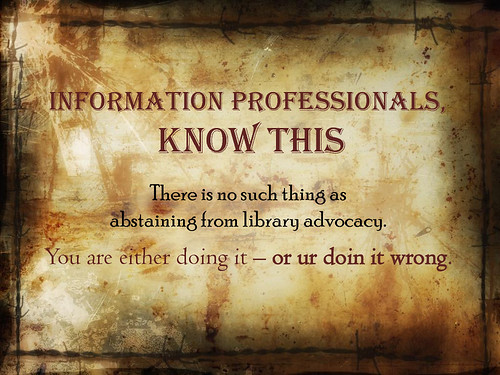
I created a hectoring advocacy poster a few weeks back - it's deliberately harsh and provocative, but I do think there is an underlying truth to it.

Poster that says there's no such thing as abstaining from library advocacy

Phew!

- thewikiman

I'm writing a book on marketing libraries and I'd like your input

Image of a notepad I've been approached by Facet Publishing to write a book on marketing modern libraries. It's intimidating (the previous Facet book on libraries was written by Terry Kendrick, who is a marketing legend and a member of the Marketing Guild and all that stuff) but a really exciting thing to be a part of. The idea is for it to cover all aspects of the nuts and bolts of marketing libraries - the grass roots - and to cover a wide spectrum of sectors, too.

Although the echo chamber theme will pop up here and there, this isn't a book about marketing the profession (or the industry) - it's about marketing your specific library. So, I would absolutely love to hear what you think you'd like to see in such a book. Each chapter will be on a different theme, and they'll all feature a case-study. I'm yet to finalise the proposal with Facet, so if you can give me your ideas quick I'll try and make sure they're addressed!

Stuff I'm currently intending to cover includes:

  • Grass roots essentials
  • Going to where your users are / user studies
  • Marketing with social media + web2
  • Marketing on no budget
  • Marketing to internal stakeholders
  • Language, style + materials
  • Special collections, Archives and Library Branding
  • Understanding the media and using them to market your library
  • Rebranding, reinvention, and the Unlibrary concept
  • Quick wins (a brief overview of a bunch of other people's success stories)

-

What else would you like to see in there? Would you want more than one chapter on web stuff as it is so important these days? Do you think there should be a chapter about advocacy because without it we won't have any libraries left to market, or will the kind of people who'll buy this book not have time for all that? Do you know of a library with a story that would fit any of those themes as a case study?

I would absolutely love it if you can leave me some comments, or email me your thoughts if you'd rather it be private, and tweet a link to this post to encourage others to do the same (or share it on Facebook). I want to make the most relevant and useful tool possible. Thank you! :)

- thewikiman

P.S There will be a separate marketing blog and twitter account coming soon, once we've made the final decision on the name of the book. It'll cover all the stuff the book will cover, and also report on any other great marketing schemes happening out there in libraryland.