Presentations

Library adventures in Latvia! (Plus, what we can learn from their approach.)

I've just got back from Latvia where I've been doing some work for the Father's Third Son project - the part of the Ministry of Culture which looks after libraries, basically. This post is part 'here's what I did and how it went' and part 'Latvian libraries are pretty amazing - here's what we can learn from them'. I'll get the embedded presentation out of the way first.

New librarians: this is your time

The first thing I did was based largely on The Time For Libraries is NOW, and the third thing I did was in two separate Prezis which would be a bit complicated to reproduce here, so I'm embedding the middle one. It was delivered to information science students at the University of Latvia, and is basically about how great our profession is...

(For Slideshare file-size limit reasons, I've actually had to take out about 20 slides and get rid of loads of the pictures, but you'll get the general idea. Feel free to embed this wherever you see fit!)

The background

Father's Third Son have been working with Bill and Melinda' Gates's Global Libraries foundation to revolutionise libraries in Latvia.

The name derives from Latvian folklore, a tale which is a bit like a gender-reversed version of Cinderella but with more emphasis on overcoming difficulties and flourishing - the same story also informs the shape of the National Library of Latvia, being built at the moment (see pic below).

It's a project which has been running since 2007, and with great success. (Global Libraries works across 13 countries and Latvia tends to be held up as the example to follow.) Father's Third Son found me via Twitter and later Slideshare and my blog, and asked me to come over and do some presentations as part of their programme.

Latvian libraries

The Latvian libraries system is pretty amazing; they've done some great things in the past 5 years. I learned a lot - it was great to talk to people who'd surmounted some of the problems we have in the UK and the US, and have different issues. It was eye-opening: normally when I talk to librarians we all seem to be going through exactly the same stuff! But this was a little different. Here are some Latvian library headlines:

  • They have 874 public libraries. For a population of around 2 million! I think that works out at around 7 times as many libraries per member of the population than we have in the UK.
  • Most library users come to the library on foot - on average, nationally, they're an 18 minute walk away from their nearest one
  • Check out this map showing how densely populated the country is with libraries! Latvian library map

  • Father's Third Son has revolutionised the infrastructure - all the libraries now have PCs with up-to-date Office Suite installed, 24/7 free wifi, and 1800 librarians have had 140 hour training programmes to equip them to deal with the new technology and help others get the most out of it
  • There is an information management undergraduate degree, which a lot of people take - but then don't go on to become librarians. So they have a retention issue which we don't have so much here, and not enough young people in the workforce. My second talk was intended to convince the students that this profession holds all sorts of interesting possibilities, so they'll stick with it
  • They have a media briefing programme (which I was part of) - apparently one of the issues they have is the media are so positive about libraries most of the time, it's hard to make the case for taking investment to a new level! Imagine that! So part of my role was to look at future trends and tech possibilities, to showcase that the work (and investment) shouldn't stop yet...
  • They create little success story videos for different markets which illustrate how the library have helped people (brilliant marketing technique!)
  • Librarians are valued by communities as trusted sources of information, and have a very high satisfaction rating of 94%, among Government employees (compared with teachers 84%, and policemen with 48%!)
  • They have an internet portal which all libraries are on. ALL of them - the public libraries, the academic libraries, the school libraries. One place which unites all the libraries online - easy for the user, and great potential for a united, cohesive voice for the libraries, too
  • Did I mention they have a media briefing programme? .

I found it all pretty inspiring really (and I am quite cynical at heart...). The thing I was most impressed with is that Father's Third Son have managed to take a top-down look at the entire country's library system and implement changes from the ground up, and actually reach their goals and change things for the better. It's hard to imagine the same thing happening in the UK or the US, but it's good to know it can be done. What's really striking is how much infrastructure is put in place on libraries' behalf, I wish we had governmental departments working with us in that way. But we can definitely learn from their confidence of inviting the media, giving them lunch, working with them and escaping the echo chamber on a regular basis in a very direct way.

The trip itself and the presentations

It was a three-day trip, with day 1 mostly consisting of travel to Riga. I was then taken out to dinner by my very generous hosts, who told me a lot of useful info about the presentations I'd be giving. In the run-up to going away I'd been ill for two days so that lack of finishing off time, combined with learning a lot more about the context of the talks that evening, meant I was up late into the night using the hotel bar's wifi to tweak my presentations!

Day two started with a presentation to the Latvian media. How good is that? They have a media programme, and print and broadcast journalists, not just from Riga but all over Latvia, come for a morning of presentations. It's absolutely brilliant echo-chamber escaping, library media-narrative dictating stuff! The presentation before mine was about children's drawings of the library. It was in Latvian but I'd been told enough about it to think it was a wonderful idea - basically they give kids pens and blank paper and say 'draw your ideal library' and give no other instructions than that. Some kids just draw a picture, some add notes as well. Then child psychologists come along and analyse the pics, and they feed it all into their future planning for library design.

IS THAT NOT FABULOUS?
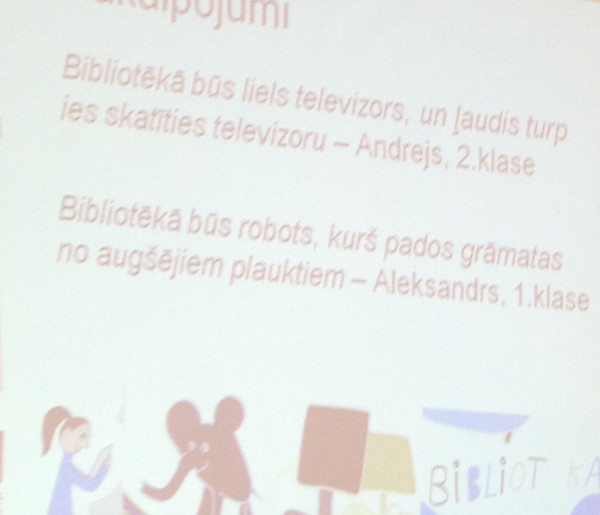
Picture of a Slide in Latvian

Seriously - the Latvian library system is ace.

Anyhow, I now had around an hour to present to the media. This amounted to around 30 minutes of stuff, to give the translator the other 30 minutes to put it all into Latvian. He was really nice - an English Professor at the University, who does a lot of work with movies to get them into the native language via sub-titles etc - and I made him promise not to stitch me up by saying things like 'This guy is talking complete nonsense. I'm not even going to bore you with an actual translation' etc etc.

The talk was mainly about the future trends in technology and the possibilities for libraries within that - it went quicker than I thought so I ended up ad-libbing a load of stuff about FourSquare which I'd had no intention of putting in there. There was also some stuff about the library at York, the new building and its associated technology etc. I don't think my style of presenting suits big statements followed by gaps for translation but it seemed to go fine, they listened all the way through, and they laughed a lot about the gin part of the great library stereotypometer...

I was then taken to the University for the talk to the students (the presentation embedded above). Because of the whole 'they complete the degree but then don't necessarily go on to become librarians' my brief was to convince them that our job has got all sorts of possibilities they may never had considered - I did my best! I've bought a clicker now to move the slides on, and I have to say I did feel much better being able to stride around the stage rather than being tied to the laptop. There was then an interesting panel discussion with academics in the department - most of which was in Latvian but some of it came my way and was translated into English. We ended up talking about the Widening Participation programme we run at York, the library going into Schools. I enjoyed it, it was fun.

Latvian for Ned Potter is apparently 'Neds Potera'

Day 3 featured a recorded presentation at a production company - about marketing and advocacy. The idea is that it will be sub-titled and then circulated on DVD to all the Latvian libraries. I focused on basic principles of marketing, why we need to do it, why strategic marketing is more effective in the long-term, the possibilities and best practices of marketing with social media and how we use it at York, and the echo chamber problem and how to overcome it. I was using two Prezis for this one and I couldn't access them online (they were borked, although they seem alright now - great timing!) so I was incredibly relieved I'd decided to save them to a USB stick.  I had to wear a microphone unit and there were cameras and leads and screens, plus I couldn't have the laptop on the presentation on because it was plugged in to all the recording equipment! I thought it was going to be a nightmare but I asked if the audience could move so I could see them and the big screen without having to turn away from them, and managed to get through it without any restarts. I think it was fine.

Then I met Sanita Maleja who lots of people had told me about in the previous two days - she's like a local ceLIBrity (copyright - @lemurph) for her work with the New Professionals part of the LLA (Latvian Librarian's Association). We had to do a little interview for the New Profs blog but she was kind enough to take me into the old town, which I'd not really been able to see up to this point as I was always on the way somewhere. This was brilliant - Riga is amazing and I really enjoyed just wondering about, plus Sanita and I have very similar views on libraries and on the profession. It was a great end to a great trip.

In the interests of tourism, here's a pic I took, from a tower, of the National Library of Latvia, which is still being built...

Pic of the library

The whole thing was very much in the category of 'interesting things I never thought I'd end up doing in my job'. So huge thanks for Father's Third Son for inviting me, and my bosses for allowing me to go, and to everyone for being so nice to me while I was there...

I don't often do blog posts like this where it's like a school report of what I got up to in the holidays, so for those of you who made this far I hope you'll let me off on this occasion! :-)

- thewikiman
 

Student Induction, Libraries, Prezi, and Interactive Maps

This'll probably be my last blog post for a while - I just wanted to share the results from a bit of an experiment to try and increase student engagement with library induction (and market the library at the same time). All new students go through quite a lengthy induction process in the first three weeks at the University. The library is slotted into that - how much time we get with the students varies between departments - and so it's a good opportunity for us to make contact, promote our services, and try and embed ourselves in the academic culture, but also tricky because the students are overloaded with information as it is.

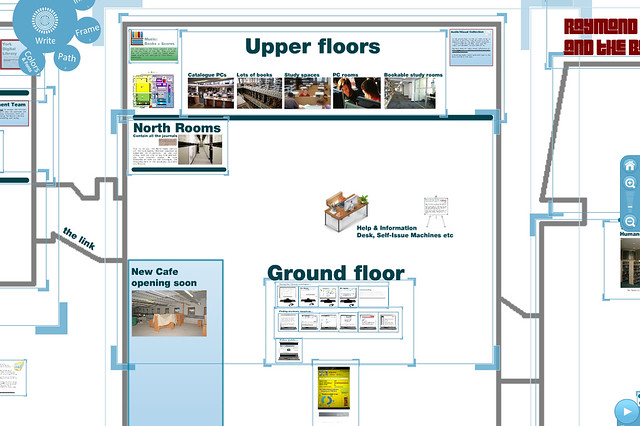
I wanted to give each of my departments an interactive map with all the library info relevant to them specifically - the idea being that it's easier to navigate an actual map of the library than it is to just search for stuff on the library website. Because each department would have a bespoke map it would mean the students had all the info they needed in one place, and because I created the maps in Prezi they could also be used as a presentation tool (as well as a stand-alone web object, later; I give students the URL of the Prezi itself and tell them not to worry about writing down any of the other URLs it contains).

I created a generic map of the library with all the information which wasn't department specific, then copied that for each of my two departments and doctored it accordingly. I also made it available to my colleagues in Academic Liaison here at York, and a few of them created their own subject-specific versions too.

The upshot of all this is, it really seems to have worked! Both me and my colleagues have reported that students noticeably perk up when the Prezi starts zooming about (I even had some gasps from one of my groups...) and seem more engaged than they had in previous years when PowerPoint was used. I don't have anything to compare it to as it's my first Induction as a subject librarian, but my colleagues seem to think the student response is definitely better. What's also really good is that it's been great PR for the library - the academics all seem really impressed by it. One of my departments have asked me to run a session to teach them, the staff, on how to use Prezi, and it's made the library look innovative and more of an intellectual partner to the academic departments. I'm collecting a quote-book of all the comments we're getting (for example, a lecturer emailed one of my colleagues and said "[the Prezi] went down very well, and generated a much greater response from the students than in previous years – it’s a great presentation format, so do pass on that feedback"), and I might submit a proposal for LILAC all about this whole thing as I'd really recommend other libraries using Prezi in this way.

Anyhow, here is the presentation, based on a top-down outline of the library buildings created for my by my colleague Matthew Herring:

It is designed to either be navigated through in the normal way, or to be a proper 'interactive map' with clickable hotspots. Anything that flashes green when you hover over it can be clicked on and zoomed-in on for more info - this also gives you the option of a student-led session where you ask them where they want to go, rather than leading them around. I'm planning on doing this with the Postgrads (many of whom will already know the library fairly well) but I must admit I chickened out of doing it with the Undergrads... I wanted it to be interactive but I didn't think fresh-out-of-school students would know enough about academic libraries to want to lead the session.

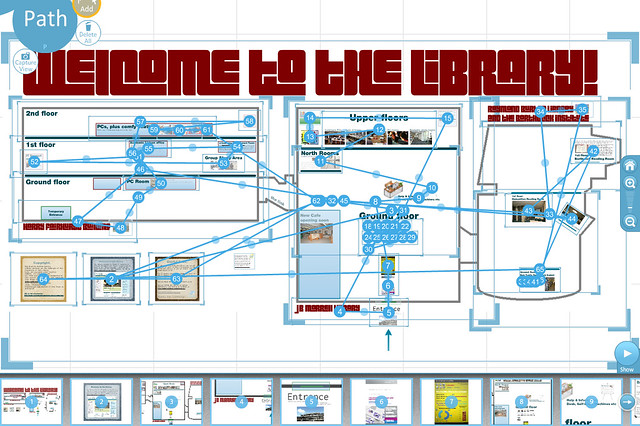
To achieve the hotspots I used a lot of hidden frames, one of the most useful features Prezi has. Here's what the canvas looks like in edit view - check out a new feature of Prezi, along the bottom: a preview screen showing you each stage of your navigation path:

Prezi screengrab

And here's a closer view without the path showing, so you can better see how the hidden frames sit within the canvas:

prezi screengrab number 2

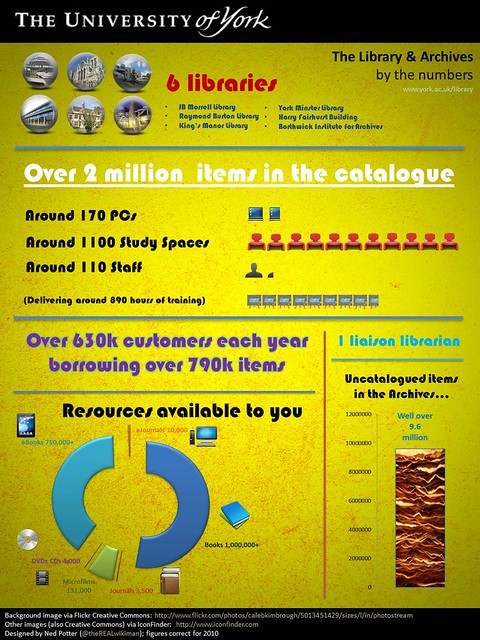
Finally, here's an infographic I created about the library, which you get to when you walk in through the 'door' of the library map. The idea is to get across the scale of the library operation in one screen, without having to bore them with lots of stats throughout the presentation.

Big library infographic

So overall, this approach worked well for everyone. For my other subject (Theatre, Film and Television) I'm planning to use an expanded Prezi for teaching purposes too. I don't think the scope of this is limited to Academic Libraries, either; you could easily embed a virtual Prezi map on a public library website, to help people use it better, too. If you're wondering about creating your own, here's a link to the Prezi guide.

Incidentally, one other  thing I did was let the students leave early from my 45 minute sessions. At this stage of the student lifecycle they are getting too much thrown at them for the full 45 minutes to be valuable - I wanted to get the key info across and leave it at that, rather than get them so bogged down in detail that they forget all of it or just switch off. When I see them again later in the term they'll hopefully be in a better position to go in-depth into the services and resources the library offers.

- thewikiman

5 easy ways to create fabulous slides

Presentations, eh? We pretty much all have to do them now - and we certainly all have to watch them at some time or other. So let's all make nice ones, and collectively save ourselves from death by Powerpoint.

Creating decent slide-decks is actually very straightforward. The deck above details five methods, in order of easyness:

  • The simple colours method (easiest)
  • The one background, many colours method
  • The two-tone-texture method
  • The found-flickr method
  • The augmented white slide method (trickiest) .

On a closely related note, here's a quick reminder not to break the basic rules of presenting, which Slideshare featured on their homepage a while back:

Other guides (including Prezi presentation software) available here: thewikiman.org/tech.

Good luck creating fabulous slides!

- thewikiman


How to build 5 libraries in 2 weeks

Last week I gave a 20:20, or Pecha Kucha, presentation. Basically this means 20 slides, set to run automatically for 20 seconds each - it makes for quick and punchy presentations with none of the filler that can make PowerPoint sessions drag on. We use them at York to keep each other up to date within the Information Directorate (our converged Library and IT service) with what's going on and what we're interested in. I really recommend this, it's a great way to bring people together across an organisation and communicate ideas. Anyway, normally I'd choose something more relevant to my work but this time I decided to do something different, and present on the Buy India a Library Project, which ran at the start of this year. Here are the slides:

View more presentations from Ned Potter
It was really fun to revisit this, and reflect on what an extraordinary thing it was that Buyalib was able to crowd-source nearly $4000 from librarians, in two weeks, for a charitable cause! Everyone who donated or spread the word - you are amazing. We have literally created something out of nothing.
I had a letter from GoodGifts the other day, saying that work had started on building the library in India and would likely be completed by April next year. Justin, Jan, Andromeda and I were invited to the opening but, frankly, if we had enough cash knocking around to afford those air-fares, we wouldn't have needed to crowd-source the cash to begin with. :)
For people who think Twitter is 'just people talking about what they had for lunch', this kind of project - which would have been all but impossible to achieve pre-Twitter, certainly in that amount of time - is the ultimate riposte, I think. If you're new to this story, you can catch up via the Buyalib blog.
Cheers!
- thewikiman
p.s Did I mention that 5 libraries now exist or are being created in impoverished areas with no other access to books - libraries which otherwise wouldn't have existed? That's absolutely amazing!

Presenting opportunities at library events, and how to get them

The Short Version of this post 

Want to present at library events? Want to know how others go about getting speaking engagements? The basic answer is, it's who you know. Don't despair though - it's not a closed club or a clique. You very quickly get to know people by putting yourself out there, answering calls for papers, organising events yourself, and blogging so people know your views and interests. 

I asked people on Twitter how they got their library speaking gigs - it was a 'tick all that apply question'. A massive 69% of respondents have got speaking engagements through someone recommending them: this is the most common route. The next most common was knowing one of the organisers (59%); then answering a call for papers was next (53%). The other significant number of votes was for getting asked off the back of other speaking engagements (51%). So really, once you're in the loop, you're in the loop - do a couple of talks and the whole thing self-perpetuates and you'll probably end up being asked to do more. 

For a more in depth look at all this, read on. 

The Long Version of this post

If you're professionally active and interested in librarianship beyond just your own job (and I'm presuming you wouldn't be bothering with this blog if that wasn't the case!) then you might be wondering about speaking at library events: conferences, open days, symposia, training days etc. This post discusses how other information professionals approach doing this - how do you get to talk at interesting events? 

Presenting is something I'd completely recommend doing, and I know a lot of others feel the same way. It's not as scary as you might think (and it very quickly gets even less scary for a lot of people), it can be really exhilarating, and it's great professional development. Presentations are an increasingly important part of many library roles, so it allows you to put a key skill on your CV. Just being on stage to talk about a subject is enough to really focus your mind on learning more about it, so you become more engaged and more well-researched as part of the process of preparing your talk. Plus of course it gets you out there, allows you to meet interesting people, makes networking a lot easier (people come up to you) and you may be able to build a reputation which leads to more interesting stuff. 

The most obvious way of getting yourself on a bill somewhere is to apply via a call for papers. There are loads of these across the course of the year - subscribe to the A Library Writer's Blog and Dolores' List of CFPs blogs to receive regular alerts, and eventually something relevant (and possibly local) will come up; these blogs also contain calls for book chapters and articles. Another obvious way is to join a professional body - CILIP, the SLA, ALA, BIALL, etc etc. As I've said before, it's a great way of allowing you to get involved with stuff which you might not be able to do as part of your current job (but which might help you get your next job..). 

How it's worked for me

I looked back over 26 events over the last 2 years that I've either done or been asked to do but couldn't (or am booked to do later this year). The route of the opportunities were as follows:

  • Knowing the organiser(s): 7
  • Recommendation: 7
  • Reputation: 6
  • Via my Twitter account / my blog: 2
  • Answered a Call for papers: 2
  • Was there for work: 1
  • Don't know how they got my name: 1

. Some provisos and caveats: 'Reputation' refers to things like being asked to present the Echo Chamber talk with Laura Woods at Umbrella, because the organisers knew of our previous talks on the topic. So I don't mean that I got booked for my reputation! Just that people knew I (or in this case Laura and I) had talked on the subject or related subject before. Also, the twitter / blog category overlaps with the reputation and the knowing the organiser categories. It's all quite fluid and not as black and white as presented above.

Anyhow, clearly knowing people is useful - both organisers, and people with clout who recommend speakers for things. What often happens is that organisers of an event are organising it in their own time and they really want to get it sorted without too much fuss. So if they have a list of people they know are fairly reliable and have spoken at things before, they'll go right to that list. (There's a danger that this approach can lead to a stale or repetitive round of speakers at library events, but that's a debate for another day.) What I'm trying to say is: in a lot of cases you don't have to be the best, or the most knowledgeable, or the expert in the field - it's sufficient just to be okay at it and then people will come back to you as an easy and reliable option... You just need to take that first step on your own, and make something happen.

How it's worked for others

I ran a quick survey via twitter - so the usual disclaimer about the sample being skewed by their very 'being the sort of people who use twitter-ness' applies... I asked people to tick all that applied in terms of ways they'd got speaking gigs - here are the results from 68 respondents: 

Graph showing 'reccomendation' as the most common route for getting library speaking opportunities

The 8 votes for the 'other' categories were mostly what I would classify as 'Knowing one of the organisers' so in actual fact it's more of a tie between that category and 'Recommendation by someone' than is indicated above. Apologies for my slightly woolly categories, and thank you very much to everyone who filled out the survey and retweeted the link!

To give this a little bit of context, the ages of the people responding to this were as follows: 

  • 69% were aged 26-40
  • 24% were aged 41-60
  • 4% were 60+
  • 3% were 18-25

. So for the most part, the twitter poll mirrors my own experiences - it really is a case of the people you're in contact with being the key. That's why networking is so important (both in person and of course online). That said, I honestly believe networking is most effective if you approach it with the question "What can I do to help people?" rather than "how can I develop a network to help me?" - I know that sounds a bit twee but it really does seem to be the case that if you go out there solely with the intention of looking for opportunities, they may be slower to come to you. 

Some tips and other resources

Just briefly here's some related info on a variety of topics. 

Saying no Saying no is really, really hard - particularly to exciting opportunities. But there comes a time where taking more on will actually be bad for you, because to prepare well for a speaking engagement takes time, so it's very stressful if you don't have enough hours available. It's really okay to say no, particularly once you've got a few talks under your belt - in my experience people are generally very nice about it. 

Referring If you can refer the organisers to someone else, do so. Don't just refer at random, but if you know someone who could do a really good job instead of you, then pass on their name and email address to the organiser - it really helps the organiser (they can always ignore the referral, but often they're very grateful) and of course someone you like may well get a great opportunity from it. I once passed on something I couldn't do and recommended someone else - the person ended up doing such an amazing job that they were way, way better than I could've been, so I was really pleased they ended up doing it! I learned more from their presentation than I would've done from researching my own. 

Money There are people who make good money from speaking at library events. I am not one of them. I've only ever been offered one paid key-note, and I don't mind that at all - the fact that your travel is paid for (some people will speak at events for which their travel isn't covered, but that's not something I personally do) and your attendance at the event is paid for is great in itself, because you get to attend something interesting for free. So, don't expect to get paid for a long time - there isn't a lot of money floating around in library-land, and you'll normally have to settle for doing it for expenses, for the experience, and because it's fun. Plus it helps out the organisers out. 

Plus it goes without saying... You'll get more new invitations off the back of previous speaking engagements if you're prompt, courteous, enthusiastic, clear in your communication with the organisers, stick around for the rest of the day wherever possible, don't constantly refer to 'technical problems beyond my control' throughout your presentation, and all the other stuff you know already...

Links Elsewhere on the blog, check out this guide to submitting a proposal, and this guide to first-time public speaking, plus these polemical slides on the basic rules of presenting... There are also links to other people's articles on the same subjects, within those posts.

Over to you So, any more tips for the would-be presenters out there? Please leave a comment and help expand this guide. And if anything I've said doesn't chime with your own experience, I'd love to hear about that as well. 

Cheers!

 - thewikiman