Professional Development

UXLibs II: This Time It's Political

At 9am on Day 2 of the UXLibs II conference, 154 information professionals sat in a large room feeling collectively desolate. I don’t want to be glib or melodramatic but the feeling of communal sadness at what had happened in the EU Referendum overnight felt to me akin to grief, like someone close to the conference had actually died the night before.

Was there anyone present who voted Leave? Possibly. But it seemed everyone was devastated. There were tears. UXLibs is, as Library Conferences go, relatively diverse (although it's still something we need to work on), not least because well over a third of the delegates - 60 this time around - are from outside England. Our North American and Singaporean friends felt our pain, our European friends were sad our country had chosen to leave them, and for the Brits it was already clear what an omnishambles the vote had caused.

The committee had met for an early breakfast to process how we should proceed. We agreed on two things: first that however we all felt, organisers and delegates had to deliver the best possible conference experience in the circumstances; and second that this was not time for neutrality. (In fact I was talking to Lawrie Phipps from JISC a little later that morning and we agreed that perhaps if so many libraries and educational institutions generally weren’t so neutral by habit, people might have a better idea of when they were being systematically lied to by politicians.) Conference Chair Andy Priestner was due to open the conference: say what you want to say, don’t hold back, we agreed. There had been a lot of jokes the day before - humour is an important part of the UXLibs conference as it leads to informality, which in turn most often leads to better and deeper communication, proper relationships – but there would be no attempt at making light of this. Don’t gloss over it. Don’t be glib. Don’t be neutral. But do be political.

So he was. You can read Andy’s reflections on his opening address here, and this is what he said:

Today is not a good day.

I’ve worried for several months about this moment in case unthinkably it might go the way it has gone. I am devastated. Everyone I speak to is devastated. This is a victory for fear, hate and stupidity.

But as Donna said yesterday when describing her experiences in Northern Ireland – ethnographers have to get on with it. WE have to get on with it. Perhaps it’s a good thing that we will all have less time to dwell on what has just happened. Perhaps it’s good that we’ll be busy.

What I do know for a fact is that we have to be kind to each other today however we might feel. Let there be hugs. Let there be understanding.

For me one of the most precious things about UXLibs is the networking and sharing we enjoy from beyond the UK. The collaboration across countries, the realisation that despite the different languages, cultures and traditions that we are all the same and can learn so much from each other.

But it’s too soon to be cheerful. It’s too soon for silver linings.

Today is not a good day.’

I was proud of him.

And then Day 2 happened, and I was proud of EVERYONE. What an amazing group of people. Shelley Gullikson put it like this:

“Last year I said that UXLibs was the best conference I’d ever been to. UXLibs II feels like it might be the best community I’ve ever belonged to.”

Everyone found a way to help each other, support each other, make each other laugh, and work together – after Lawrie’s keynote the first thing on the agenda was the Team Challenge so no one could spend any time sitting in dejected silence, there was too much to do… Collectively everyone not just got through the day but made it brilliant. It wasn’t a good day overall – a good conference doesn’t transcend political and socio-economic catastrophe. But it was the best day it could possibly be.


I attended the first UXLibs conference in 2015 and I was blown away by it. It felt like the organising committee had started from scratch, as if there were no legacy of how a conference should be, and designed it from the ground up. They kept some elements, the ones that work most, and replaced others with new and more engaging things, especially the Team Challenge. It was the best conference I’ve ever attended.

The follow up, UXLibs II, had something of an advocacy theme – as I put it in the conference, if UXLibs I was ‘how do we do UX?’ then UXLibs II was ‘how do we actually make it happen?’. As communication and marketing is something I do a lot of work around and, as Andy so kindly put it, he wanted to see if we’d actually get on and not hate each other if we worked together, I was invited to join he and Matt Borg as the main organising committee (although we had a huge amount of input from several other people in planning the event). This was in September last year; Andy and Matt had already been planning for a while and by October we had our first provisional programme in place.
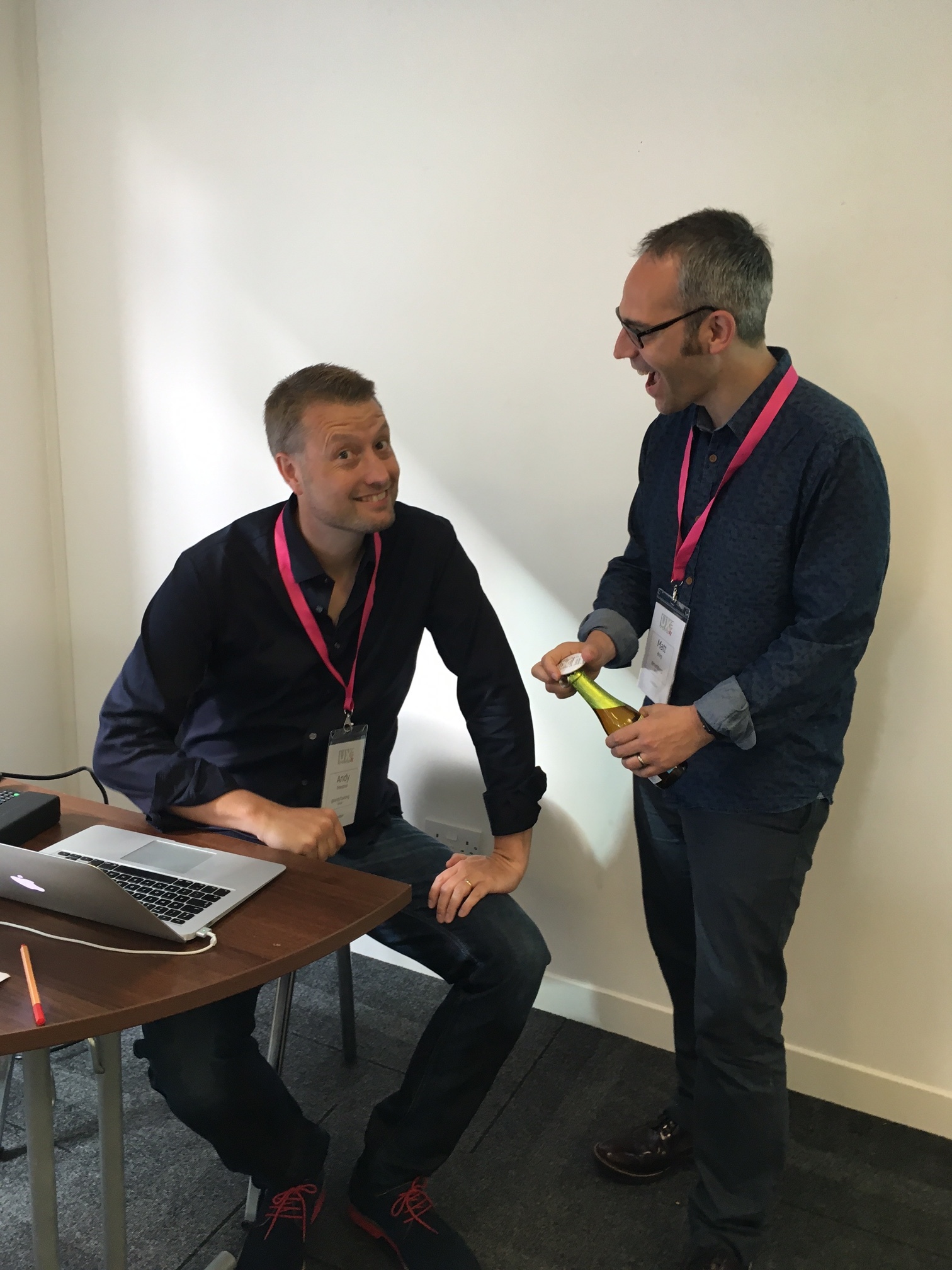
Andy and Matt...
Andy and Matt...

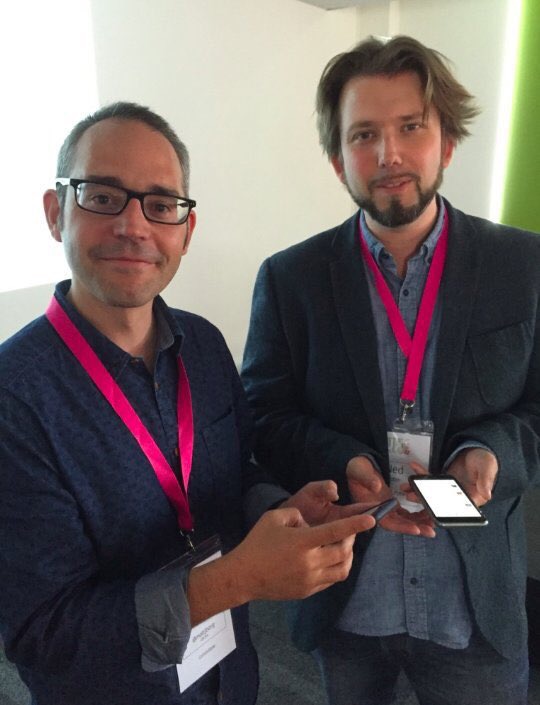
Matt and me...

Matt and me...

I find organising events approximately three trillion times more stressful than speaking at them, and hadn’t got fully involved in putting on a conference since 2011 when I swore ‘never again’. But I couldn’t resist the chance to work with Andy and Matt because we are pretty much on the same page about a lot of things, but disagree on a lot of the details, which makes for an interesting and productive working arrangement. So, around 400 emails later, a couple of face-to-face meetings later, many online meetings using Google Hangouts later, we were in thestudio, Manchester for the event itself. At the end of the two days, despite the dark cloud of Brexit hanging over us, everyone seemed exhausted but fulfilled. We’d built the event around the community and what that community said it needed, and I think it worked. It’s a great community and I felt excited to be part of it – challenged, stimulated, and I’d echo the delegate who came up to me at the end and said she’d never laughed so much at a conference: it was FUN.

Several things made this conference different, for me, apart from just the content. There's the fact that all the delegates have to be active participants (they were 'doing doing' as I put it, somewhat to my own surprise and certainly to my own mortification, when introducing the team challenge), there's the mixture of keynotes, workshops, delegate talks and team challenge, there's the informality and fun but with the Code of Conduct to ensure people can work together appropriately, there's the fact we individually emailed 100 delegates from UXLibs I to find out what their challenges were so we could help shape the conference, there's the fact that 150 people got to choose which workshops and papers they attended, there's the blind reviewing process for accepting papers, there's the scoring system for the best paper prize that was far more complicated than 'highest number of votes' because different papers were seen by different sizes of audience... There's the fact there's less fracture and division than in most conferences: I truly feel we're moving forward together as a UX in Libraries community. There's the fact that the venue was not only excellent but had a trainset running around near its ceiling that you could stop and start by tweeting at it!
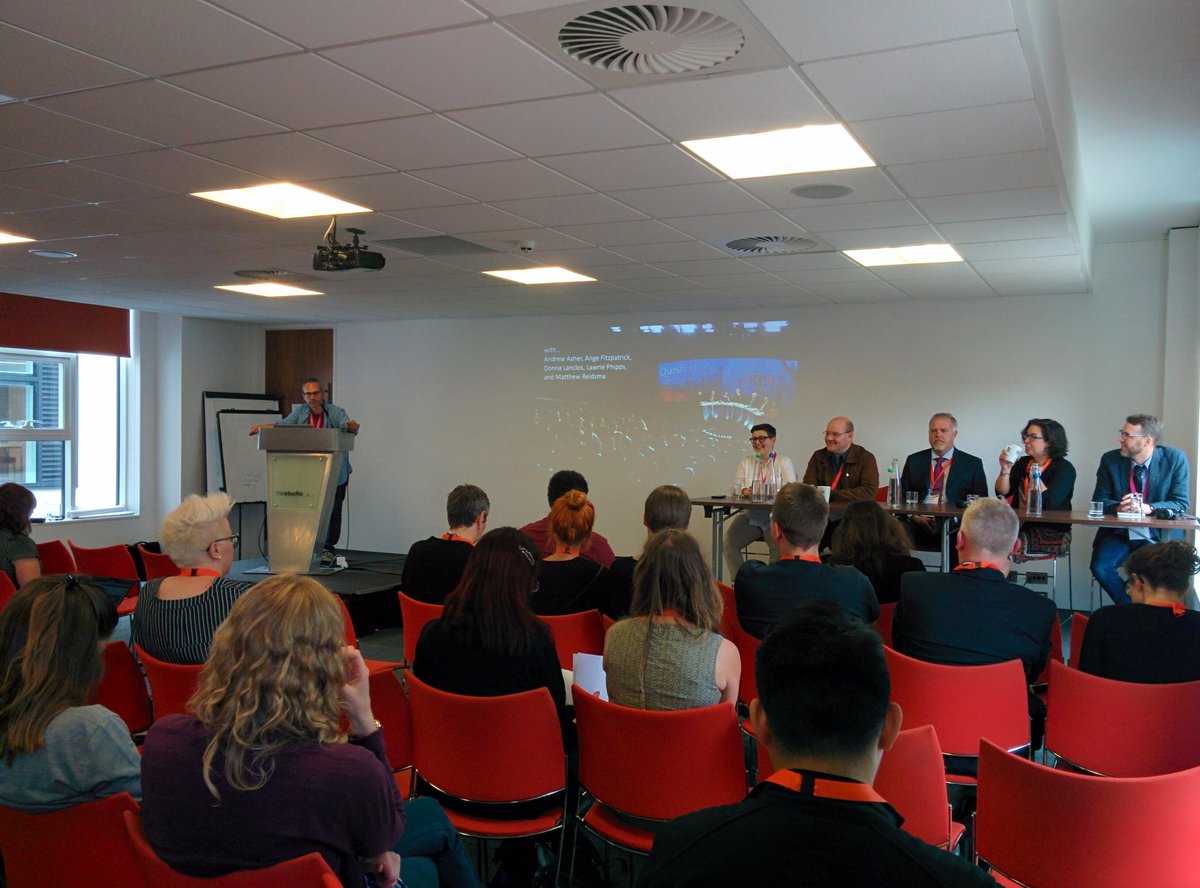
Turns out it's quite easy to avoid All Male Panel. What you do, conference organisers, is you don't put all males on the panel. (Pic by @GeekEmilia)

Turns out it's quite easy to avoid All Male Panel. What you do, conference organisers, is you don't put all males on the panel. (Pic by @GeekEmilia)

There's the fact that Matt made completely bespoke badges with individual timetables for all 154 attendees! I can't tell you what mine said (let's say Matt was experiencing some remorse at saying he'd do the badges by the time he got to 'P') but so many people commented on the good-luck messages he put in to all presenters for their slots...

So it was pretty great, overall, despite everything. Thank you everyone invovled.

UXLibs III planning has already begun.
Life, Librarianship and Everything at #NLPNOpen

I gave at talk at the #NLPNOPEN event on Saturday, organised by the wonderful Manchester New Library Professionals Network. I actually invited myself to talk at this event, something I've not done before, because I think NLPN are ace, and because my favourite events have always been New Professionals events, and I miss the enthusiasm and hope, and what to learn from the new ideas. They were kind enough to let me talk at them for an hour at the start, basically about things that I've found to be important and that I'd wish I'd known earlier, about life, librarianship and everything (although mainly, it has to be said, librarianship).

Here are the slides.

Really the key messages are firstly that the tools exist now for you to make things happen if you want to - start a network, start a JOURNAL even, write blog, join a wider dialogue, whatever it may be - and that if you take one action it can lead to all sorts of other actions, that are rewarding in themselves and can benefit your career.

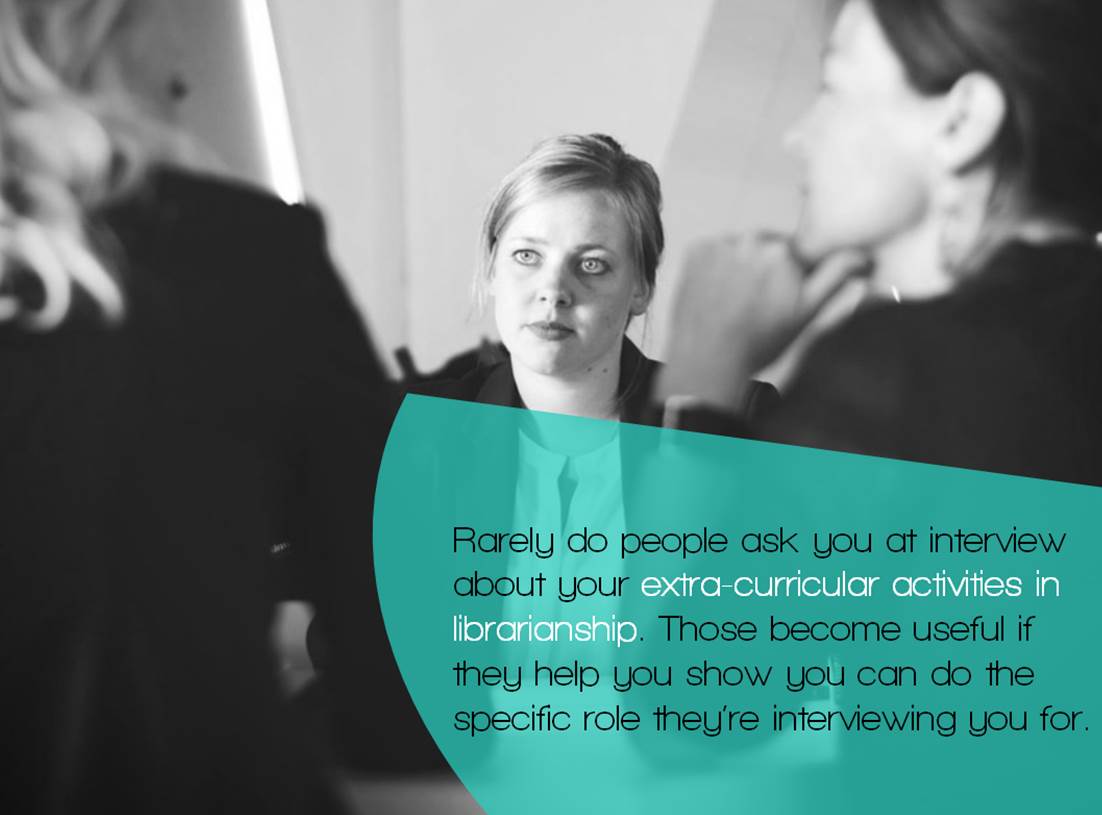
BUT, that said, the second message is no one cares if you're a rockstar, and interview panels don't actually ask about the stuff you do outside your job very often. It may be that you talk about it - it may be that when they say how would you cope with marshalling an annual resources budget, you can reply 'I'm the treasurer for this committee so I have experience' - but no one seems to say 'tell us about what groups you've joined / what conferences you've presented at / what articles you've written'. Not normally. In HE particularly we literally have to ask the same questions to every candidate so there's no room for those kinds of digressions. So this slide is, I think, important to reassure people who feel like they should be Doing All The Things but cannot Do All The Things because life gets in the way:

Everyone present did a brilliant job of tweeting the talk and indeed the whole day, which you can see in the Storify NLPN have pulled together - it's embedded below this next bit.

I saw some really good talks at this event, and I really enjoyed the open nature of the discussion - sometimes at traditional library conferences everything feels quite narrow because so many conversations have been had before, or are on sort of perpetual loop. The standard was very high too, in terms of presentation skills and the slides themselves - hardly any bullet points, lots of images, lots of creativity, lots of good communication.

Suzanne Coleman gave a great mini paper about Instagram, which is absolutely the most important platform for academic libraries using social media at the moment. Laura Green and Louise Beddow (who joined Twitter off the back of my talk - please go and make her feel welcome!) then talked about what they did for National Libraries Day at MMU - generally the academic sector engages with NLD in a fairly minimal way but they went all in and it really seemed to work. They had huge success with their comment board, allowing students to write things which other students (and staff) could reply to on the wall - this is an ethnographic technique which seems to work well so much of the time. We have walls at my own institution which you can write on, but they're specifically designed for students to just workshop ideas or get things out of their brains, rather than for feedback. But we're doing the feedback wall thing properly soon and I'm interested to see how it goes.

Carly Rowley talked about music librarianship, which was interesting to me as I've been a Music Liaison Librarian here. The discussion was a lot more Content / Collections based than my experiences - I tended to focus on the services we could offer rather than the stuff we had, but that probably just reflects my biases and interests. It was interesting that a few people in the room could play instruments or read music but didn't consider themselves musicians! I think if you can play or sing, you're a musician. Surely? I love being a musician and in how I define myself it's a lot more important to me than being a librarian is, although outwardly it takes up far less of my life. On that note, there's actually a secret (as in, unlisted in the navigation) part of this website that acts as an outlet - along with my Instagram - for drum-related things. You can find it here, friends of drums and drumming...

The final two presentations were Open Access themed. They complimented each other well actually - Jen Bayjoo representing the librarian and Penny Andrews representing the Researcher. The common theme was really around what it is actually like to be an academic, which is to say a human being with pressures and insecurities and lives to lead, and interact with library systems. A healthy dose of realism ran through Penny's talk - it's so important to be realistic about which parts of what we do work, which parts really matter, which parts may or may not endure... Jen had a nice practical element too, discussing real life problems and issues of working in an OA advocacy / support role. Her slides are online here.

It's also important that we as info pros are Open Access all the way - don't submit your article to a non-open-access journal, folks! I wrote most of my 'proper' publications before I really understood Open Access, but I've retrospectively got as many permissions as possible to make things OA. See my Publications page for the links, including a thing for Bethan Ruddock's New Professionals Tookit book - although my take on a lot of that stuff has evolved since I wrote that, so if NLPNOpen-me disagrees with Bethan's-book-me, go with NLPNOpen-me...

Organising events is hugely stressful - it's THE WORST, worse than dating a Tory, even - so massive thanks so NLPNOpen for doing this, for free, on their weekend (and of course many more days in the run-up to the event, working everything out). I got a lot out of the day. I learned stuff and I felt good afterwards. It was ace.


Here is @ManchesterNLPN's excellent Storify of the day - check out the tweets to get more of a feel for all of the presentations. Thank you SO MUCH to NLPN for having me. Loved it.

Upcoming presentation skills workshops and library marketing training

Just a quick post to say here's the current list of open workshops I'm doing this year - if you want to see if I'm doing something at your organisation specifically then the full listing is on the Upcoming Events page, but below are the non-in-house events currently in the diary. Hope to see you at one of them!

You can see a whole load of feedback from previous workshops via the Training page.

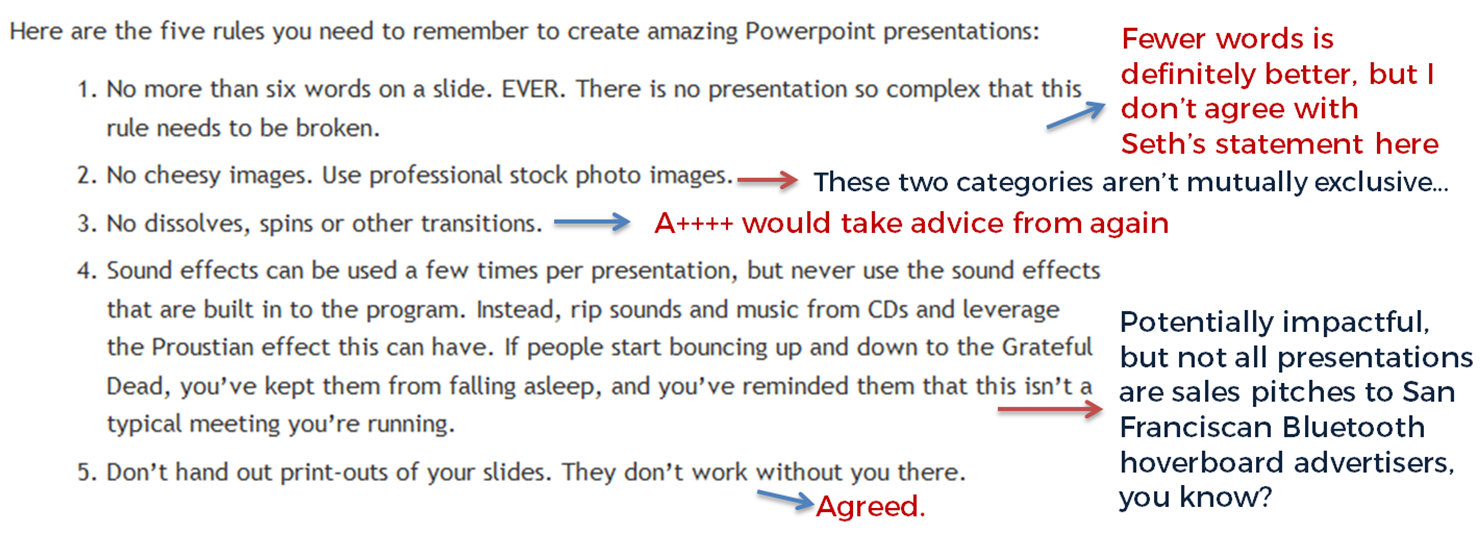
An Alternative to Seth Godin's 5 Rules to create amazing PowerPoint Presentations


Seth Godin is a very influential man, and his views on PowerPoint carry a lot of weight. He wrote a famous post a while back (1.5k Facebook shares, a gazillion tweets about it etc) on creating amazing presentations - you can read it here. I agree with lots of it completely, but I'm not totally on board with the five rules at the end.

My take on Seth's rules

My take on Seth's rules

No more than six words on a slide. EVER. There is no presentation so complex that this rule needs to be broken. To me this seems too arbitrary. Fewer words is without doubt better than more words when it comes to slides - they're presentation tools not written documents. But six? As the maximum ever? Unless that's based on research that shows seven or more words reduces the effectiveness of your PowerPoint, why limit yourself in such an extreme way? I'd say one or two sentences to ensure brevity but allow yourself a little flexibility in conveying meaning and nuance.

No cheesy images. Use professional stock photo images. First of all there are plenty of cheesy professional stock photos! Authenticity is key. The trick is to find images which look like the camera has happened upon a real scene - lots of pro stock images show impossibly perfect people laughing flirtatiously over a blank iPad, I mean come on. I find Pixabay and Unsplash have enough for most presentations I make, plus someone introduced me to Pexels the other day which looks good, and they're all free - both of copyright and financial cost. The professional stock photo sites cost a fortune to use - why use them when so many great (legal) images can be found for free?

No dissolves, spins or other transitions. Yup. No argument here. If it's extraneous to your story, all you're doing is reducing the impact of your message.

Sound effects can be used a few times per presentation, but never use the sound effects that are built in to the program. Instead, rip sounds and music from CDs and leverage the Proustian effect this can have. If people start bouncing up and down to the Grateful Dead, you’ve kept them from falling asleep, and you’ve reminded them that this isn’t a typical meeting you’re running. I like the idea about using music etc but it really needs a certain type of high energy presentation performance to pull this off. It's not for everybody (I couldn't do it). It's hard to think of a rule around sound that is absolute; it all depends on your audience, and some of them way think the use of music is a little distracting, whatever your music taste... From what I understand about the Proustian effect it's a very personal thing; I'm not sure a presenter could expect to cause or induce it for a room full of people. 

Don’t hand out print-outs of your slides. They don’t work without you there. I agree with this. But I wouldn't put it in my top 5...

Header pic is a CC-BY image by Betsyweber - clcik to view original on Flickr.

Header pic is a CC-BY image by Betsyweber - clcik to view original on Flickr.


My own top 5 rules for creating effective PowerPoint slides

So what would I put in my top 5 rules for creating amazing PowerPoint presentations? I can answer that question because the intro to my full-day Presentation Skills training is built around five golden rules, based on existing research into what makes for an effective presentations - and that's the aim here, to build something which works. 'Amazing' is no good on its own; you need people to remember your key messages, not just how great a presenter you were.

Here we go:

  1. Keep it simple. Slides don't need to be flash - get rid of anything that doesn't tell your specific story, and leave behind something which supports and reinforces what you're saying out loud, and prompts you as to what to say next.
  2. No more bullets. Bullet points ruin slides. They're fine for documents, but you're not making a document in PowerPoint. As well as being symptomatic of a general Death By PowerPoint malaise, they make people less likely to agree with, understand and remember your presentation. Oh and they like you less when you use them. That's enough of a reason to never use them, surely?
  3. Make one point per slide. Make your point, allow your audience to digest it, then move on together in sync with them. Several points on a slide inevitably result in your audience moving at a different pace to you, because they can only listen and read for a few short seconds. Why be in conflict with your presentation materials when you don't have to? Give each key message room to breathe.
  4. Big fresh fonts. Font size 24 is the absolute minimum you should ever use in slides. If you need more you're trying to fit too much on one slide. Either ditch some text or cascade it across two slides. Non-standard fonts (which is to say, fonts which don't appear in the Office Suite) can, if chosen carefully, increase the impact of your presentation. Typography is underrated.
  5. More images, less text. Too much text stops slides working. Relevant images help people learn. Make the most of your opportunity with each new PowerPoint you make!

Where to start when planning talk or teaching session

This seems obvious, right? And yet so often it doesn't happen.

Venn diagram showing 'what you know' in one circle and 'what matters to your audience' in the other. Where they overlap is where your talk should be.

Venn diagram showing 'what you know' in one circle and 'what matters to your audience' in the other. Where they overlap is where your talk should be.

There are two main ways in which, when we give talks or run teaching sessions and workshops, we don't adhere to this principle. Clearly no one ever strays entirely into the blue circle (giving a talk about a subject which matters to your audience, but which you no absolutely nothing about, is pretty much impossible) but we can easily spend too much time in the orange circle where it doesn't overlap, or just not make the most of the overlapping section of the diagram.

NB: I very deliberately use the phrase 'what matters to your audience' above - rather than 'what interests them', because I'm not advocating taking a superficial approach and only telling your community about cool stuff they already care about. We can tell them things they don't know they need to know! Sometimes they wouldn't choose to hear it in advance, but they thank us afterwards. So it's very much what matters to them, whether they realise it before the session or not.

There's no excuse for telling an audience things which don't matter at all - unless it's a small part of your presentation, to serve a particular purpose.

Telling people everything we know

I don't wish to generalise but a lot of times Librarians give out too much information, particularly early on in a relationship between the institution and the user. Induction or Welcome talks often contain vast swathes of detail, or a talk at a conference will include ALL the info about a particular project - and often this can actually get in the way of the message. After a while the audience gets overwhelmed and starts to filter, or just switch off. We can only retain so much new information at one time.

So when crafting a talk or presentation, the starting point should not be 'What do I know about this subject?' but specifically what do the audience want to know about this subject, that I can tell them?

Missing out on the over-lap

There's a second, more subtle, factor here. The over-lap of what matters to your audience and what you know about can also include things which aren't part of your core message. In other words, you can establish your credibility with your audience by telling them things which matter to them, and THEN telling about the library's relevance to them - they're more inclined to take you seriously if you aren't just advocating for your own service or value. I use this a lot in infolit teaching - I'll tell the students about internet privacy, different search engines, how to use social media in an academic context etc, as well as telling them about what the library does and how to use databases effectively. Because it's in the overlap of the diagram above - I know about this stuff, and it matters to my audience. What's really interesting is when I started doing this *rather than just talking about the library) the feedback, both the scores and the qualitative feedback, went up hugely; they really liked the sessions. But when they're asked to rate the most useful part of the session, the vast majority mention the bits about the library!

As long as it doesn't conflict with our ethics and values, libraries can provide both services and expertise based on what our users need - it doesn't have to be a 'library' function in the traditional sense.

So: create presentations and teaching from the audience's point of view first, working back to what you know about what matters to them, rather than the other way around. It's only a small shift but it makes a huge difference.