
Rebuilding the library community in a post-Twitter world

I had an amazing experience at the end of last month. I was invited to Dublin to keynote the LIR annual seminar on mine and my wife’s 20th wedding anniversary! We took the tip together, the weather was beautiful, and the conference was great. I learned so much from the other speakers, and everyone who asked questions and shared their own experiences.

It was a hybrid event, with around 100 staff from Irish academic libraries split across in-person and online. The venue was fabulous - the picture in the header of this post is of the view of the Liffey through the window of the room I was speaking in.

I was asked to talk about rebuilding our online communities now that Twitter / X has stopped being an option for so many of us. Although the committee wanted me to touch on this from a library point of view, the main focused they asked for was actually the librarian perspective - where do we, as library staff and info pros, rebuild our networks? It’s a great topic, and here are my slides (slightly amended from the event, to work better without me talking over the top).

Below is not a transcript of my talk by any means, just a few notes on the key themes.

Part 1: The State of X

It gives me no pleasure to be spending so much time hauling Twitter over the coals, because the site has been a hugely positive influence on my my life. I joined after the New Professionals Conference way back in 2012 and suddenly I became plugged in to this network of progressive, interesting library people - I absolutely relished being able to be part of that wider conversation. It gave me incredible opportunities (the original catalyst for my keynote at the LIANZA Conference in New Zealand was a tweet from the LIANZA account about how bad the fonts were on the Library Marketing Toolkit website!), helped me get jobs, introduced me to friends, and allowed me launch a freelance career.

More importantly than any of that though, Twitter was the place that enabled me to view the world through other people’s eyes. As a cis-het white male (and you can now add middle-aged to that list) it’s vital to get an insight into how other people experience life and the world and libraries and more, or you end up in a boring, uninformed bubble with potentially damaging knock-on effects for those around you. They say you get more and more right-wing as you get older, but I’ve found the exact opposite to be true (and I was pretty left-wing to begin with): my brilliant Twitter network was vital in that.

Twitter was great because we made it great, and now it’s terrible because some terrible people have come along and set up shop there. So I get the ‘why should we have to leave?’ argument. Individuals can make up their own minds but I think from an institutional point of view, being there is a real risk, reputationally. As it says in slide 9, hate speech is up, disinformation is up, transphobia is up, misogyny is up, bots are up - and actual active (human) users are down. Even beyond the ethical arguments against X, it has ceased to function effectively as a communication tool for libraries - the algorithm rewards conflict and suppresses links, and even when you do ‘good’ tweets (like the ones in slide 8) they don’t get any reach. It’s time to go. Which leads us to the question which titles the next part.

Part 2: Where next for academic libraries?

In academic libraries we have various audiences we’re trying to reach, including not limited to undergraduate students, postgrads, researchers and academics, professional services staff, members of the public, the rest of the Higher Education industry. Of those, I firmly believe Instagram has the student side really well covered, especially if you throw in TikTok too. It’s the public and the University staff we find harder to reach now X is no longer viable.

The public remains a really tricky issue, but I believe Bluesky is really beginning to fill the Twitter-vacuum for academics and researchers. It has a relatively low number of total users (around 35 million at the time of writing; updating count here) compared with the giant social networks, but despite that it is has now overtaken X as the place where most new scholarly research is shared. The academic community is moving over there in large numbers, which is really great news for us in libraries.

My argument in the talk is that having somewhere online to follow our academic community to is great, but leading them there is even better. I’ve really proactively tried to help catalyse a shift to the platform for researchers at my own institution, writing several guides to the platform aimed at University staff and creating a University of York Starter Pack for colleagues to easily connect with each other on the new platform, among other things.

Overall I’d advocate for using Bluesky specifically for researcher-facing messages at the moment (I’m not seeing evidence of large numbers of taught students on the platform) and letting Instagram take care of your student-facing comms. It’s working really well for us, and we now have a larger and more active network for the Uni of York library on Bluesky than we ever did on Twitter, after only a few months.

Part 3: Reconnecting as Information Professionals

No one is obliged to be in an online professional network, of course. There are people who are entirely off social media and benefiting from that choice. If you do want that connection with the wider profession though, with what do we replace Twitter?

The answer depends on what specifically we need from our network. Before we ask where shall we go, we need to ask what we want to DO when we get there. I asked the audience to talk to each other about the various options on slide 31, as well as adding their own…

I’ve been forced to revise my view that LinkedIn is basically awful, because actually it isn’t - the library and HE professionals part of it has been really helpful to me, especially since I left Twitter a year and a half ago. I’ve also noticed that the total views for posts on there is higher than it is on this website - numbers in the slides - so it’s a good way to disseminate and get feedback on ideas. (Here’s my LinkedIn profile if you’re interested.)

Bluesky has for me killed two (Twitter) bird with one stone - it has become a venue to rebuild my library’s academic network, and my own librarian / info pro network. As always, I’d recommend it: if you’ve not given it a go, check out some of the guidance and maybe dip your toe in.

The key thing is, you can choose whatever platform you like as long as you’re part of the conversations you want to be having. It was really so great to be part of this particular conversation in Dublin, so massive thanks again to LIR for inviting me!


If you’re interested there’s a video of the full talk here. It’s a recording from Teams so the audio is slightly in and out and the picture is a bit grainy! But I appreciate the LIR committee making this available, thank you.
If you need a lift, look at these innovative public libraries...

The library landscape is incredibly bleak at the moment with events in the US, so I wanted to flag up a couple of brilliant examples of library innovation that might give information professionals reason to smile.

In March I presented at the Edge Public Library Conference in Edinburgh - hence the header pic of that beautiful city - on Social Media for Public Libraries in a Post-Twitter world. (The organisers asked me to do this after hearing people say nice things about a similar session I'd done in Kilkenny - if you're interested the slides from that are not identical but cover the same theme.) It was a brilliant event, very uplifting, and huge thanks to Gráinne Crawford and her team for inviting me and making me feel so welcome.

As part of the same conference they have three Innovation Awards and I was honoured but somewhat daunted to be asked to judge the Digital category. Edge 2025 had lots of nominations and I was sent the four finalists - my job was to pick the winner and the highly commended, who would be invited to the Gala Dinner to receive their awards. Here is a summary of the winning entry and first runner-up - I found reading their entries good for the soul.

Highly commended: Tickets for the Afterlife

Tickets For the Afterlife is a web-app to "…help users navigate choices related to their body, memories, and legacies after death." It's not the typical thing a library would provide, but Redbridge saw a need to help their community and learned the skills required to make it happen - and they executed it so, so well. You can read a Guardian article about it here but honestly I’d recommend experiencing it for yourself at afterlifetickets.co.uk.

I loved this whole project, and it's beautifully done - here's what I wrote to be read out at the Awards:

I’ve been in librarianship for a long time, and I can’t remember seeing such an original idea as this. We like to think of libraries as being at the heart of community but that doesn’t happen automatically - we have to make it happen by getting our communities where they need to go. Redbridge identified a unique way to provide support to their community and beyond, in an area that is absolutely universal - dying, death and grief - and did so in such a friendly, accessible way. Tickets for the afterlife is beautifully put together, completely unique, and hugely valuable - a brilliant piece of work.
— On Tickets For The Afterlife


Huge congrats to Anita Luby and Redbridge Libraries on a truly different, innovative service.

Winner: The Hive

Darlington Borough Council created The Hive, a digital hub with virtual reality gear, coding and robotics, 3D printing, animation, digital sewing and quite a lot more. (In fact you can get a good idea of what's on offer by checking the 'what's on' section at the bottom of the Darlington Libraries homepage).

I know that there are quite a few libraries creating maker spaces and so on, but the way Darlington have done this is fantastic - it's a beautiful space, and full of creativity. The reason I chose it as the winner is the extraordinary impact it has had - as Suzy Hill said in her award application, footfall was down, book issues were decreasing and the perception of the digital offering was that it was poor, and The Hive has completely changed that to an amazing degree. Visitors are up by so much, and so is everything else - I feel like they've changed what a library MEANS to the people of their community, and gone from struggle to real triumph.

Here's the comments I wrote which were read out at the Gala Dinner, to announce the winner:

‘The Hive’s digital transformation has been extraordinarily successful. Sometimes the word ‘digital’ can be overused and be so general it loses all meaning, but what Darlington have done is made the digital tangible - they’ve made digital resources and activities of so many kinds available to groups who really need and appreciate them. In doing so I’m confident they redefined the idea of what a public library IS for their local community, and have converted scores of youngsters into lifelong library users. I’ve chosen them as winners partly due to the sheer impact of what they’ve done - this digital transformation has had a halo effect on all their services. Borrowing is up, digital borrowing is up, educational interactions are up, website use is up and the number of people visiting the library is way up. People come for the digital transformation, and they STAY for everything else we have to offer in libraries. Finally, it’s hard to imagine better feedback for anything, ever, than this comment from a Year 3 pupil who visited The Hive: “This is the best day of my entire life!” Congratulations to our incredible winners!’
— On The Hive

I love this project: I found The Hive's work to be uplifting, hopeful and genuinely inspiring.

Edge2025 was brilliant - I missed some talks I really wanted to see on Day 2 as I was hot-footing it to Dublin for another talk, but I can wholeheartedly recommend the conference if you’re able to go next year.

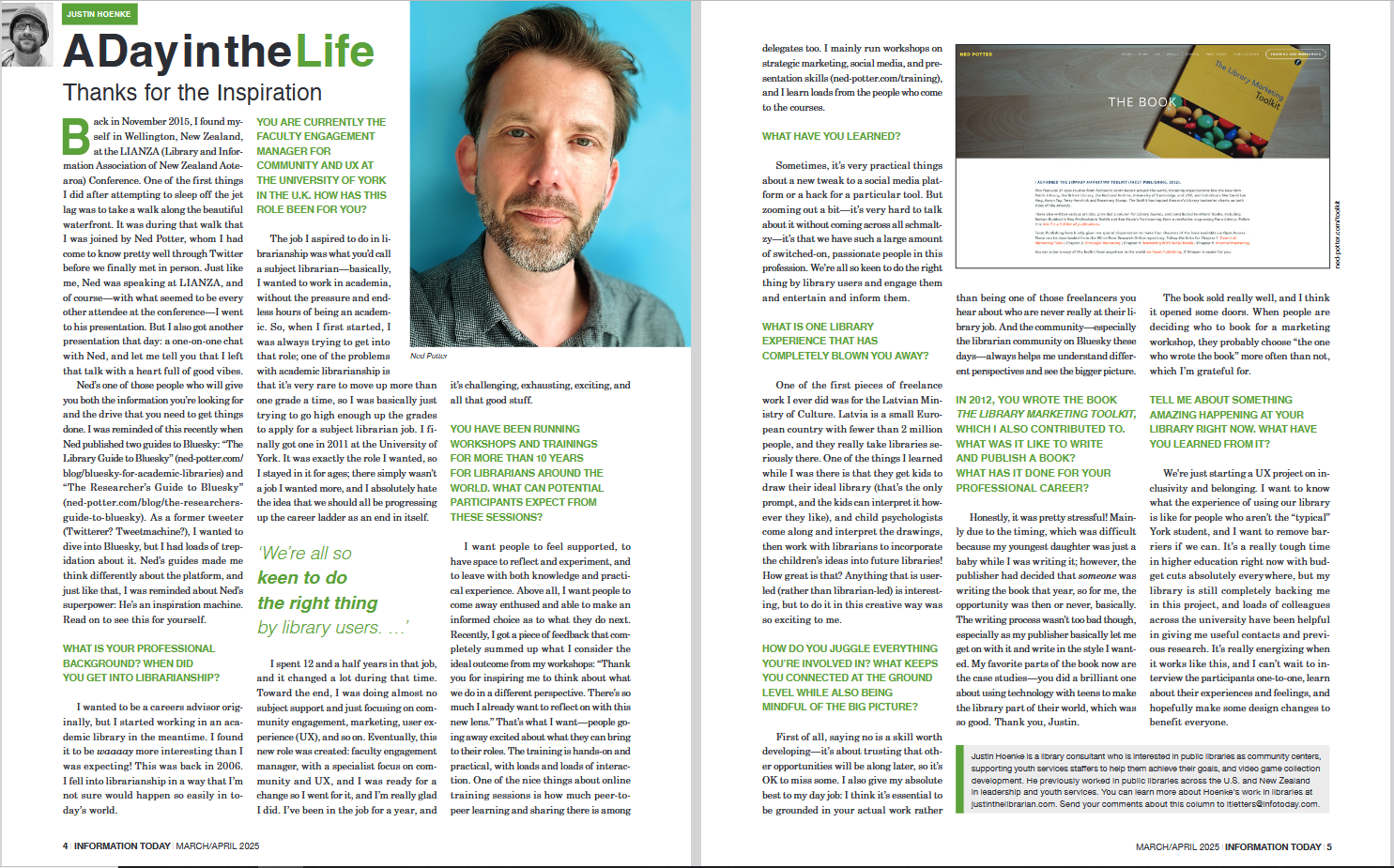
An interview in Information Today

Preview screenshot of the interview - download the accessible PDF below to read

This is just a preview - download the PDF below to read

A couple of months or so before the current Museum and Library cuts in the US kicked in, I had the pleasure of being interviewed by my friend and former collaborator Justin Hoenke for Information Today. I enjoyed the questions and the extremely kind write-up - thank you Justin! You can download the interview here [PDF].

We talk about my job, writing a book, running training and workshops, and amazing library experiences that stay with you.

The end of the SLA

I found out yesterday that the Special Libraries Association is dissolving, citing "shifting industry dynamics, changing professional needs, and financial realities." I've always found the SLA to be an engaged, supporting, uplifting organisation and I'll be really sad to see it go.

I was involved in the SLA Leadership & Management division, and SLA Europe, for several years in the 2010s, serving on a couple of committees and attending / presenting at events. It started with winning one of the 2011 Early Career Conference Awards - I know a whole cluster of people who won an ECCA in that era and we all talk about in the same tones of mild wonder...

The prize is an all expenses paid trip to the SLA Annual Conference in North America - to attend any event as a new professional is great, but for those of us in the UK the scale of US library conferences is just epic, which added another layer of excitement.

There were 3,500 people at SLA2011 in Philadelphia, and there were so many highlights for me. The conference venue was bigger than most airports I've been in. There were usually 5 or 6 sessions of interest running simultaneously. Being in a gang with the other three ECCA winners (Samuel Wiggins, Natalia Madjarevic + Chris Cooper) who were affiliated with different divisions was such a lot of fun: the pic in the header of this blogpost is taken from a visit to the ‘Rocky montage steps’ with them all. I saw a Mary Ellen Bates presentation I still cite a line from in my marketing workshops to this day...

The thing that really struck me though was how welcoming everyone was, and how they treated us all as equals. I was in the Leadership & Management Division, but I was 5 years into librarianship and was neither a leader nor a manager. All these high-powered boss level librarians simply treated me like one of their own, and my mentor Dee Magnoni was just so, so encouraging. It's such a big deal when you're young and new to the profession to have senior people believe in you.

The whole conference, and the SLA and SLA-Europe in general, were incredibly energising and felt like a real privilege to be a part of. I had to pull out of doing a TED-talk style presentation as part of the closing session at SLA2014 in Vancouver because my daughter was ill, and I wish I'd been able to take that opportunity, not least just to get to another SLA conference!

Sincere thanks to all the SLAers I've met along the way (loads of whom I'm glad to say I'm still in touch with), and I hope the community can continue or be reinvented elsewhere.

Show-notes: guest appearence on the Keeper & Curator Podcast, talking social media

I had one of my favourite professional conversations ever the other day, and as it happens it was recorded! I was honoured to be a guest on the Keeper & Curator podcast, run by my colleagues at York Helena Cox and Gary Brannan, which despite being new has already been fantastically successful (number 1 in the Visual Arts UK podcast chart, wooop). I’ve loved long-form conversation podcasts for so long, so to be actually in one and have a really great discussion was properly fun. We talked a lot about social media, about what works and what doesn’t, about exploring art abroad, and about the University of York’s sculpture trail.

I know it’s a big swing to expect anyone reading this to want to listen to me on a podcast about Art, so I thought I’d provide some shownotes with time-codes that tell you what we talk about and when, in case any of it is of interest or relevance to you. A large portion of the chat is relevant to anyone interested in using social media to engage audiences, across libraries, HE, and the Arts more generally.

Here’s the podcast:

First things first, you can find the episode Social Media and Unfinished Business here on Spotify, or you can find it on Apple Podcasts if you prefer, and probably a bunch of other places besides. Here’s the Apple version embedded:

0:00 - 2:17 Preamble

The welcomes and hellos happen in this bit.

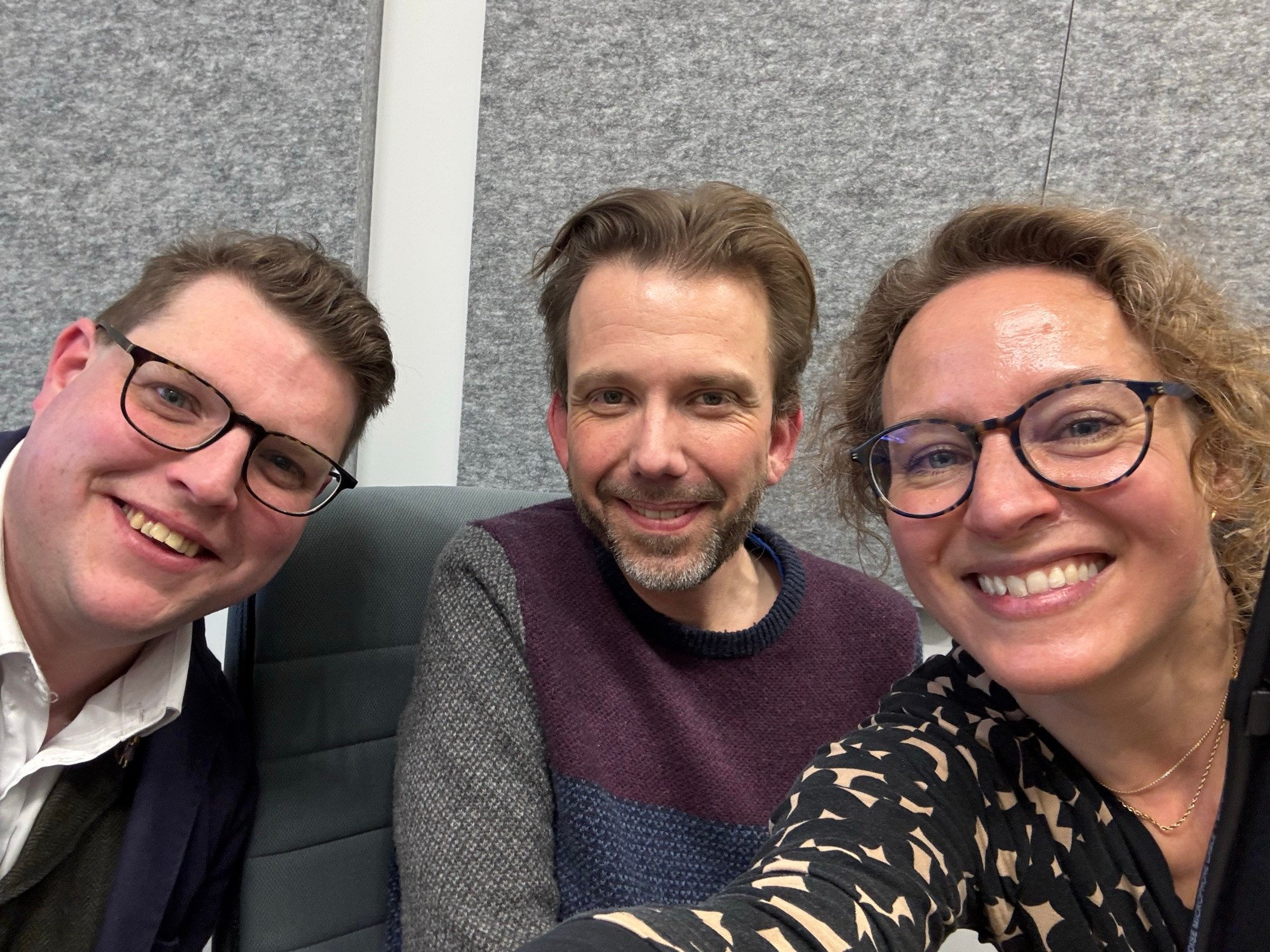
We recorded in the Library’s Podcast Studio - it’s one of our most popular services and I’ve spent some time marketing it, but never used it before. It was pretty nice, extremely high quality mics where you feel like you can hear the blood in your veins they’re so sensitive… Here we all are, in a post-record selfie.

Two men and a woman smile at the camera

From left-to-right: Gary (the Keeper), me (the guest), and Helena (the Curator)

2:18 - 13:49 social media and the arts

In this section we talk a little about the personality-driven social media that Helena does via the Art@York profiles, which I think is absolutely brilliant. You can find Art@York on Facebook here (the former Library account, as you’ll hear if you listen to this bit!), or Art@York on Insta here, or Art@York on Bluesky here.

We talk a lot about why art collections work on Instagram etc, and I found it really interesting to explore this. I do think the overwhelming availability of everything means curation of any kind is more important than ever, and I do think we’ve all become so good at using imagery in our social media that it just becomes white noise - so meaningful imagery on social media really makes a difference.

13:50 - 18:37 can social media be taught or is it intuitive?

An interesting question from Gary prompts a discussion about whether social media can be taught. It absolutely can be (please get in touch and book a workshop!) but certain approaches do rely on an intuitive grasp. Either way though, putting personality into your comms is what builds relationship and engagement - if it’s fully corporate, people just do not respond.

18:38 - 24:35 AI in social media

I have over time become massively against using for example AI-generated imagery on professional social media, and this section covers why. You basically alienate a large part of your potential audience if you continue to use AI slop.

24:36 - 29:39 The different demographics for different social media platforms

One of the traps institutions often fall into when doing social media is treating all the platforms the same, and cross-posting content. I get why this happens, with time-pressures being primarily to blame, but the issue is that the platforms work completely differently, and have quite different demographics.

29:40 - 39:29 Creativity, music, and being from a line of artists but unable to produce visual art…

The Queen Mother in a painting, wearing an elaborate brooch

The Queen Mother, by Peter Walbourn

I hail from generations of artists, and I cannot draw a line or a circle or indeed absolutely anything at all, with any skill. My Mum is an incredible artist (our house is filled with things she’s made for us) and so was her Dad, Peter Walbourn. He once painted the Queen Mum and was struggling to get the detail of her brooch down in time for the end of the sitting. Why don’t you take it home with you, Her Maj suggested! Is it insured, my Grandpa asked? Oh, we couldn’t possibly afford to insure it, she replied… (He took it home anyway and my Gran slept with it under her pillow to keep it safe.)

My Great Grandfather was the painter Ernest Walbourn, and we discuss the many unfinished paintings of his we have in our house during this section of the podcast. Here’s the main himself at work - one of the things I like about this picture is he’s literally doing the thing we discuss in the episode: 70% of the painting is done to completion, but the sky is entirely untouched, a literal blank canvas.

Black & white photo of a man sat at an easel

Ernest Walbourn at work, probably in the early 1920s

The other part of Ernest lineage which did NOT reach me is sporting prowess: he was in fact invited to join the Olympic shooting team, and my parents have a letter from an Olympic committee member reassuring colleagues that Ernest was a gentleman, despite being an artist…

In particular we talk about one painting on my wall, of a tree, unfinished, which I absolutely loved Helena’s expert take on. Here’s the pic.

A wall featuring a painting of a tree, with blank canvas in the bottom left corner

The unfinished tree painting, left

After listening to the podcast my Mum got in touch to say this was the very tree under which my grandparents got engaged! Lovely stuff.

39:30 - 52:17 My top tip for visiting galleries and museums

If you only take one thing… Steal my Te Papa techniques as described in this section! Some more on the New Zealand Lianza experience, including images of the museum in its glorious emptyness, here. Plus more on the Latvian children’s art / library strategy here.

We also discuss UX methodologies, and the benefits of having a curated art collection on campus.

52:18 - end My favourite art on campus

I insisted they ask me this question - what is my favourite art on campus? I talked about two pieces. First of all Beyond and Within by Joanna Mowbray.

A giant steel statue among trees

Pic via the Art@York - click to see the original on Facebook

The piece I picked as my favourite was the Singing Stone by Gordon Young. I mentioned in the podcast the Alumni post on Insta of Helena describing the piece, and the YouTube shorts version is embedded below:


If you’ve made it this far, thank you for reading! I absolutely loved being on the podcast, so thank you Helena and Gary for having me.