instagram

Posting carousels is like an Instagram cheat code in 2026

What is a Carousel on Instagram?

First things first: in Instagram terms a carousel is a single post containing multiple images or videos. They appear on the Grid, and you view the different images by swiping right.

Since mid-2023 you can add music to your carousel natively in Instagram, and doing so is absolutely crucial to success - it pushes the post into a different algorithm, ensuring it will be viewed much more widely than a single-image, music-free, regular Grid post.

Why are CaRousels so important?

The short answer is: reach.

Instagram’s algorithm has always prioritised video Reels over static images. For organisations, this often meant spending hours producing video content, or risking really low engagement and poor distribution with an image post. Reels are also less accessible than images, because there’s no built in alt-text feature for video on Instagram.

Over the last couple of years, there’s been a shift in the algorithm - Carousels now provide the reach and visibility of a Reel with the simplicity and accessibility of an image post. They bridge the gap. Your key messages can now reach massive audiences with less time, less production, and frankly fewer complications.

The proof is in the analytics

I run our institutional Instagram account - @UoYLibrary - which is a really significant part of our communication with students. I have a million and one other duties as Faculty Engagement Manager so as I noticed carousels getting more views I started to prioritise them over video content because they took so much less time to produce, not least because they can often be made using existing images I already have available to me, rather than needing to shoot new content.

The impact has been remarkable, The extraordinary thing is, even the less successful posts that don’t get the Likes and engagement I’m hoping for are getting consistently high reach and views. Meanwhile the successful ones are outstripping Reels - always the most popular format, historically - in all metrics.

2025 engagement

  • Saves: 3 of the top 5 most-saved posts were Carousels (including 1st)

  • Shares: 4 of the top 5 most-shared posts were Carousels (including 1st)

  • Likes: all 5 of the top 5 most-liked posts were Carousels

2025 reach and views

  • In 2024 our top five posts had a combined Reach of 32,095 people: only 1 of these was a Carousel

  • In 2025 our top five posts had a combined Reach of 40,228 people (a 25% increase) and 3 of them are Carousels

The most dramatic increase year on year is from Views - unsurprisingly, as if someone views three images as part of a Carousel, that counts as 3 views compared with just 1 for someone watching a Reel or viewing a single image post.

  • 2024: Our top 10 posts achieved a combined 70,099 views

  • 2025: Our top 10 posts achieved a combined 211,337 views

This represents a 201% year-on-year increase in total views. That top 10 breaks down as follows - several of these are collabs with other accounts, which is hugely important for Reach and Views too.
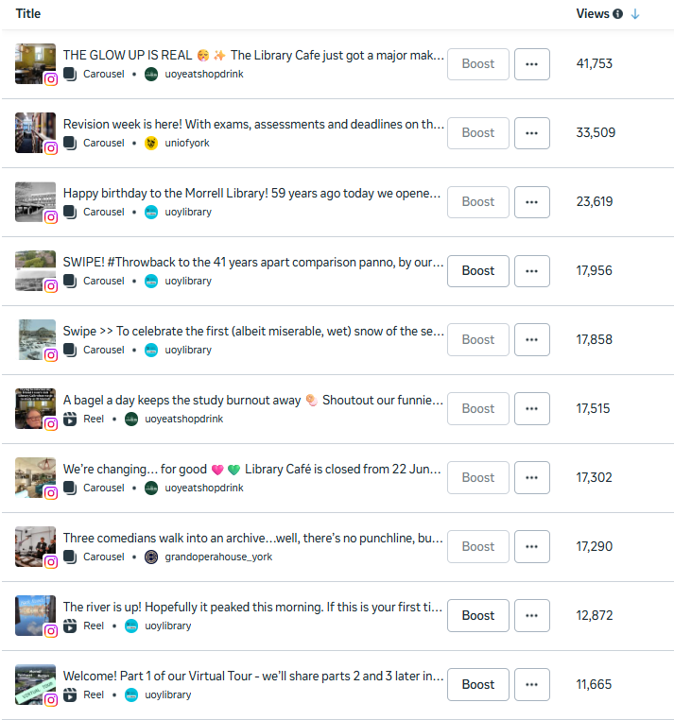
@UoYLibrary’s 10 most viewed posts across 2025: screenshot from Meta Insights

A tale of two posts

Our most successful post (that we originated, rather than were invited onto as a collaborator) in 2025 - by most metrics, albeit not Likes - was this Carousel to celebrate the library’s birthday. It reached over 9,000 people, was viewed over 23,000 times, and had over 750 Likes as well as large numbers of Saves, Shares, and new Follows.
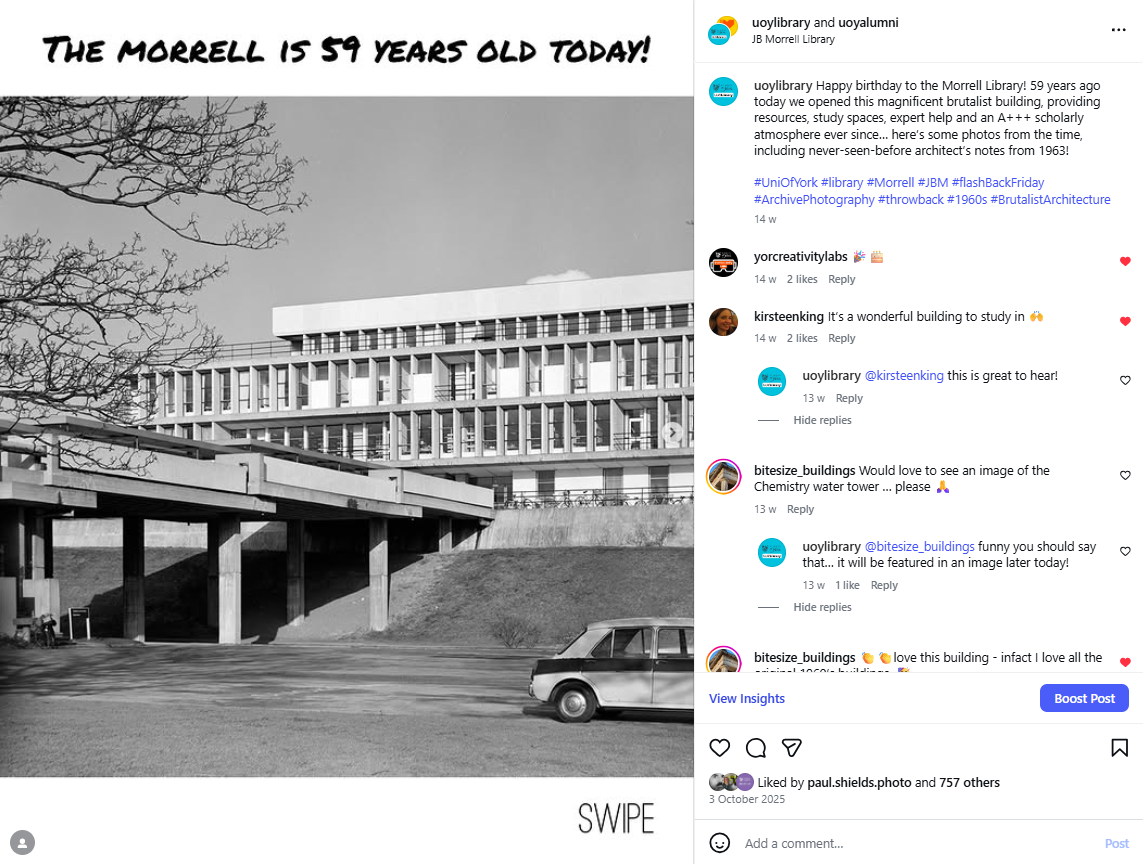
Screenshot of Instagram post - the picture is of a brutalist library, taken in the 1960s, with 'the Morrell is 59 years old today!' written above it

The most viewed post originated by @UoYLibrary in 2025

For me though, a better example of the power of the Carousel is our least successful post of 2025. In fact in terms of engagement, it is, I think, the least successful post I personally have put on the library Instagram account in its entire history (full disclosure I looked back through six years’ worth of posts before giving up)… It got 17 Likes.
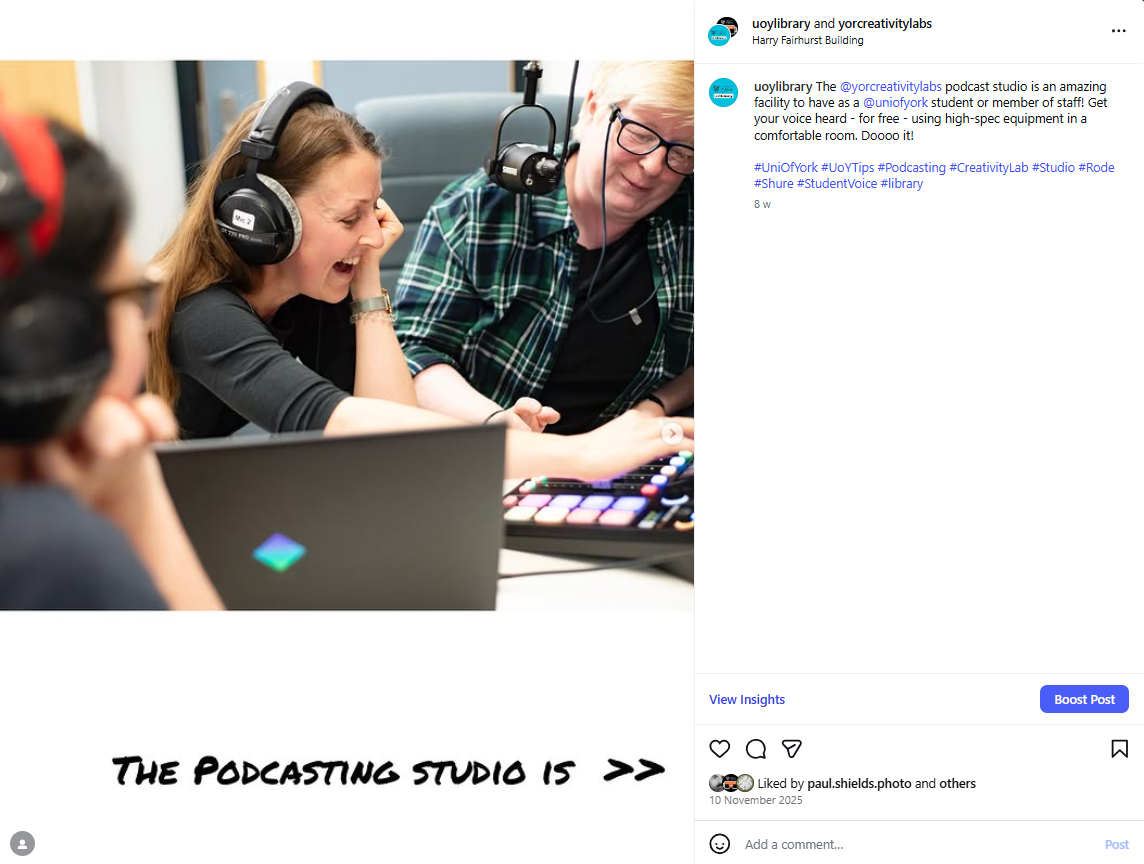
Screenshot from Instagram - the post shows three people in a podcasting studio with caption below 'the podcasting studio is >>'

@UoYLibrary’s least Liked post of 2025

Despite this total failure on my part to pitch the Podcasting Studio in such a way as to get Likes (previously when I’ve done a Reel on this it’s had much more Likes, and the TikTok version did really well too - so it’s the framing, rather than the subject matter, that’s the issue with the post above), the Carousel of it all meant it has still reached nearly 900 people and had nearly 4.5k views.

To put that in context, the post reached more people (and got 106% more views) in a week than the podcasting studio webpage did in the whole of 2025 - and that includes a spike in the webpage views caused by the Instagram post… There’s nothing wrong with the webpage - it’s just that our target audience don’t really web-search, but they scroll-search social media all day. So all in all: the habits of undergraduates x the reach of the Carousel = even an unsuccessful Insta post getting key messages out really well compared with other mediums.

Get posting

I’ll write another post soon about what works and doesn’t work with Carousels but for now I hope you’re convinced that, going into 202,6 if you’re running an organisational account it’s time to plan some Carousels. In fact I wouldn’t post any individual images this year - why throttle your own reach, when a Carousel would go so much further? Get your message out to the widest audience possible, and take advantage of the cheat code while it lasts!

How many hashtags is too many hashtags?

I just ran a social media workshop in which one of the brilliant attendees posed this age old question:

We’ve been having a huge debate about using hashtags. Are they still a thing? Should we be using them?
— Catarina

As I answered I realised I have a pretty definitive idea about not just whether we should be using them - yes - but also how many we should be using, which varies wildly by platform. So if you do social media for your organisation or otherwise create content, and you’ve ever asked yourself how many hashtags is too many hashtags, read on!

Three disclaimers before we start:

  1. Hashtags are the cherry, not the cake. The content of your post is waaaay more important than the tags - but using hashtags well WILL improve your posts’ discoverability.

  2. It’s more important to use the right hashtags, than the right number of hashtags. What is going to help people discover your post? What do people who need your content search for? Hint: adding a universally used hashtag (like #love for example) simply won’t do anything positive. If everyone uses the same hashtag, your post joins an almost infinitely long queue of other posts. Aim for the sweet spot between high volume hashtags that everyone uses, and low volume hashtags that no one will ever search for. For the librarians and archivist out there: hashtags are basically metadata!

  3. The info below is really just my views, as of late May 2025, built on my own experience and reading others’ research, rather than the ‘right’ answer… Use this as a jumping off point and conduct your own experiments!

How many hashtags should I use on TikTok?

Use 3-5 hashtags on TikTok. Recently TikTok started limiting users to five hashtags, so this one is easy. Ignore the super-cool TikTok accounts that use no hashtags at all, or the desperate accounts that use generic like #fyp #ForYouPage and #viral. 3 to 5 hashtags on TikTok will help the algorithm push your content in relevant directions -any more and it will basically get confused… Remember, the majority of TikTok posts are seen by people who DON’T follow the accounts posting them - so use every advantage available to you to get eyes on your videos.

How many hashtags should I use on Insta?

Use 9-11 hashtags on Instagram. This one is controversial because it directly contradicts Instagram itself, which advises using 3-5 hashtags max in this useful post about how they work and what they’re for. However, there are countless examples of companies doing analysis of thousands or even millions of posts, and finding that 10 or even 20 gets better results than 5. This study looked at 38 million posts and found that 11 was the optimum number of hashtags. Too many hashtags can definitely feel spammy, so don’t go above 11 - but using several of the RIGHT hashtags really seems to pay dividends. Finally - and this is really annoying but everything I’ve read confirms it’s true - don’t use the same ones for each post. You need to mix them up a little, and avoid two posts in a row with the same tags. Gah.

How many hashtags should I use on Facebook?

Use 0 - 2 hashtags on Facebook. Hashtags are less important on FB than on TikTok or Insta, but they can help your post show up in searches. Don’t crow-bar them in, but take opportunities to use them organically in your posts.

How many hashtags should I use on Bluesky / Threads?

Use 0-2 hashtags on Bluesky, and Threads. You don’t have to use any at all, of course. The way hashtags are used on these platforms is more like a form of curation - for clicking on and finding related posts, rather than particularly for search. On Bluesky using certain hashtags will also push your post into certain custom feeds - be careful not to abuse this by over-using them!

How many hashtags should I use on YouTube?

Use 3-5 hashtags on YouTube. YouTube is interesting in that it works completely differently to all other platforms listed here: for a start, it has a seperate ‘tags’ section when you upload. Here you can put all the tags you want to help with discoverability, and they won’t be readable by other people - they just help with searching. So use this freely and fill it right up. Secondly, you can put hashtags in the description - or you can put them in the title. With YouTube shorts in particular, putting a hashtag in the title - IF it’s something people will likely be searching for - can be really beneficial. Thirdly, if you use too many hashtags in the description or title, YouTube literally ignores them completely. So don’t do lots! One or two max in the title, and a couple more in the description, should do it.

How many hashtags should I use on LinkedIn?

Use 2-5 hashtags on LinkedIn. A haphazard approach doesn’t work well here: use one or two tags which are specifically relevant to your industry and your post (and avoid the generic, overused cringey ones like #productivity…).

How many hashtags should I use on X?

It doesn’t matter. Just get off it. You’ll feel so much better.

Show-notes: guest appearence on the Keeper & Curator Podcast, talking social media

I had one of my favourite professional conversations ever the other day, and as it happens it was recorded! I was honoured to be a guest on the Keeper & Curator podcast, run by my colleagues at York Helena Cox and Gary Brannan, which despite being new has already been fantastically successful (number 1 in the Visual Arts UK podcast chart, wooop). I’ve loved long-form conversation podcasts for so long, so to be actually in one and have a really great discussion was properly fun. We talked a lot about social media, about what works and what doesn’t, about exploring art abroad, and about the University of York’s sculpture trail.

I know it’s a big swing to expect anyone reading this to want to listen to me on a podcast about Art, so I thought I’d provide some shownotes with time-codes that tell you what we talk about and when, in case any of it is of interest or relevance to you. A large portion of the chat is relevant to anyone interested in using social media to engage audiences, across libraries, HE, and the Arts more generally.

Here’s the podcast:

First things first, you can find the episode Social Media and Unfinished Business here on Spotify, or you can find it on Apple Podcasts if you prefer, and probably a bunch of other places besides. Here’s the Apple version embedded:

0:00 - 2:17 Preamble

The welcomes and hellos happen in this bit.

We recorded in the Library’s Podcast Studio - it’s one of our most popular services and I’ve spent some time marketing it, but never used it before. It was pretty nice, extremely high quality mics where you feel like you can hear the blood in your veins they’re so sensitive… Here we all are, in a post-record selfie.

Two men and a woman smile at the camera

From left-to-right: Gary (the Keeper), me (the guest), and Helena (the Curator)

2:18 - 13:49 social media and the arts

In this section we talk a little about the personality-driven social media that Helena does via the Art@York profiles, which I think is absolutely brilliant. You can find Art@York on Facebook here (the former Library account, as you’ll hear if you listen to this bit!), or Art@York on Insta here, or Art@York on Bluesky here.

We talk a lot about why art collections work on Instagram etc, and I found it really interesting to explore this. I do think the overwhelming availability of everything means curation of any kind is more important than ever, and I do think we’ve all become so good at using imagery in our social media that it just becomes white noise - so meaningful imagery on social media really makes a difference.

13:50 - 18:37 can social media be taught or is it intuitive?

An interesting question from Gary prompts a discussion about whether social media can be taught. It absolutely can be (please get in touch and book a workshop!) but certain approaches do rely on an intuitive grasp. Either way though, putting personality into your comms is what builds relationship and engagement - if it’s fully corporate, people just do not respond.

18:38 - 24:35 AI in social media

I have over time become massively against using for example AI-generated imagery on professional social media, and this section covers why. You basically alienate a large part of your potential audience if you continue to use AI slop.

24:36 - 29:39 The different demographics for different social media platforms

One of the traps institutions often fall into when doing social media is treating all the platforms the same, and cross-posting content. I get why this happens, with time-pressures being primarily to blame, but the issue is that the platforms work completely differently, and have quite different demographics.

29:40 - 39:29 Creativity, music, and being from a line of artists but unable to produce visual art…

The Queen Mother in a painting, wearing an elaborate brooch

The Queen Mother, by Peter Walbourn

I hail from generations of artists, and I cannot draw a line or a circle or indeed absolutely anything at all, with any skill. My Mum is an incredible artist (our house is filled with things she’s made for us) and so was her Dad, Peter Walbourn. He once painted the Queen Mum and was struggling to get the detail of her brooch down in time for the end of the sitting. Why don’t you take it home with you, Her Maj suggested! Is it insured, my Grandpa asked? Oh, we couldn’t possibly afford to insure it, she replied… (He took it home anyway and my Gran slept with it under her pillow to keep it safe.)

My Great Grandfather was the painter Ernest Walbourn, and we discuss the many unfinished paintings of his we have in our house during this section of the podcast. Here’s the main himself at work - one of the things I like about this picture is he’s literally doing the thing we discuss in the episode: 70% of the painting is done to completion, but the sky is entirely untouched, a literal blank canvas.

Black & white photo of a man sat at an easel

Ernest Walbourn at work, probably in the early 1920s

The other part of Ernest lineage which did NOT reach me is sporting prowess: he was in fact invited to join the Olympic shooting team, and my parents have a letter from an Olympic committee member reassuring colleagues that Ernest was a gentleman, despite being an artist…

In particular we talk about one painting on my wall, of a tree, unfinished, which I absolutely loved Helena’s expert take on. Here’s the pic.

A wall featuring a painting of a tree, with blank canvas in the bottom left corner

The unfinished tree painting, left

After listening to the podcast my Mum got in touch to say this was the very tree under which my grandparents got engaged! Lovely stuff.

39:30 - 52:17 My top tip for visiting galleries and museums

If you only take one thing… Steal my Te Papa techniques as described in this section! Some more on the New Zealand Lianza experience, including images of the museum in its glorious emptyness, here. Plus more on the Latvian children’s art / library strategy here.

We also discuss UX methodologies, and the benefits of having a curated art collection on campus.

52:18 - end My favourite art on campus

I insisted they ask me this question - what is my favourite art on campus? I talked about two pieces. First of all Beyond and Within by Joanna Mowbray.

A giant steel statue among trees

Pic via the Art@York - click to see the original on Facebook

The piece I picked as my favourite was the Singing Stone by Gordon Young. I mentioned in the podcast the Alumni post on Insta of Helena describing the piece, and the YouTube shorts version is embedded below:


If you’ve made it this far, thank you for reading! I absolutely loved being on the podcast, so thank you Helena and Gary for having me.

Where should libraries go now Twitter *HAS* become a wasteland?

Or: Nomadic social media part 2: libraries in the post-Twitter age

Just over a year ago I wrote ‘Where should libraries go if Twitter becomes a wasteland?’ and this is a spiritual successor to that earlier post, a check-in on the current state of play - and also a Part 2 to this article I wrote about Nomadic Social Media for Librarians (as opposed to libraries).

Why is this the post-Twitter age?

There are so many reasons libraries need to think about a strategy for being ex-X, but here are the most important:

  1. X might not even survive. Musk has driven away advertisers and lacks the discipline to win them back, so bankruptcy is a realistic possibility

  2. There may be a charge for use soon. Even if it’s $1 a year and you can get permission to subscribe, do you really want your library to financially support a place where hate speech, harassment, extremist content and misinformation are all spiking and the CEO is now actively promoting horrific toxic accounts and white supremacists?

  3. A senior manager at another institution mentioned to me recently that it will soon cause too much reputational harm to be associated with X to justify the potential comms benefits of being there. But that takes up neatly on to…

  4. It just doesn’t work anymore. Some niche areas of Twitter are managing to plough on, but in general it’s broken. Engagement is way down. It’s a haven for the worst people, and huge numbers of library-audience-type-people have left - so replies, ReTweets, just plain views for tweets are all tiny compared to what they once were. Twitter Analytics doesn’t work. The hateful conduct policy has been adjusted to, in essence, allow more hateful conduct. Musk has changed the algorithm so suppress links to news sites or posts that mention things he doesn’t like (I saw a tweet from an account with 58,000 followers which had fewer than 1,000 views, because it was about Bluesky) - so you can be a Twitter marketing genius and STILL not reach your own users with relevant content

All in all, at the very least you need a plan for what to do after Twitter. My own library is still there for now, but the second the subscription charge comes in we’re absolutely gone, if not before. The question is, where do we go, and what is the strategy?

What should libraries do next?

There’s no universal answer to this because it varies by sector.

University and College Libraries need to focus on Instagram

Instagram is absolutely crucial in HE, and not just to libraries. All professional services and departments need to get on there because it’s the only place almost every single undergraduate is on. Almost none of them are on Facebook, hardly any are on X, if they’re on LinkedIn they’re not there to interact with the library, and even email (the one channel literally every UG should be reachable on in theory) is largely ignored unless it is super-specific and very targeted.

I wrote a thing on Instagram for the Times Higher recently which goes into all the details about why Instagram is so important, lays out out some statistics, and gives some advice on how to use it well. Rather than recreating it here, for those working in FE and HE take a look and let me know what you think.

click the image to go to the article, which is free to read

Why not TikTok? Well it’s is not a universal thing for the University demographic (but almost is for the age group below), although it is a Big Deal so if you can spare the time and resources to do TikTok well, by all means get on there. But my advice would be to prioritise Instagram first of all, for its wider appeal and simpler methods for getting key messages to users.

Public Libraries need to up their Instagram game whilst not neglecting Facebook

For all Facebook’s problems (across all demographics except 55+ people are leaving FB, but so many 55+ are on there it is still the biggest social network - and daily use is consistently falling whilst leaping ever upwards on Instagram and TikTok) it remains a really useful tool for Public Libraries. It can act almost as a branch online, and Cape May County Library in the US and Hampshire Library Service in the UK are good examples of places doing that well.

There is a BIG amount of book chat on Threads, so this may be a conversation public libraries can tap into.

However, I think Instagram is the coming platform for this sector - and at the moment some libraries aren’t allowed it or are under a lot of restrictions as to how they can use it. Eventually this will change! So be ready when you’re given the green-light.

Here are some previous posts you may find helpful:

School Libraries probably need to focus on TikTok, but it’s not that simple

TikTok is, by far, the most popular platform among teens. If you’re a school library looking to appeal to students in your school, then here’s a good example of a normal, successful TikTok school library account in Medford.

If you’d like an example of what can happen a school library TikTok account really takes off, look no further than GVHSlibrary. They have over a million Likes so far, Nicki Minaj has commended their vibes in a comment, and Kelsey Bogan, the librarian in question, is just generally smashing it.

I love this post: it’s about ditching Dewey (yesss! In your face Dewey you massive racist) and seeing circulation climb by 600%, and it has been viewed over 1 million times! I mean, come on.

@gvhslibrary Getting rid of the old ways & embracing the new is resulting in more #students using the #library = #win #librariansoftiktok #librarytiktok #progress ♬ Walter White Rap - Mr Cool

If you’re interested in finding out more about Miss B’s approach, here’s a good article she wrote.

So why the ‘but it’s not that simple’ in the section header? Well, not all school library social media is aimed at the students. If your target audience is the parents, then things are lot more complicated - Twitter would have been good but isn’t any longer, which really leaves Facebook as a the primary method of reaching that audience. Not great, but worth doing for now if parent-engagement is part of your strategy. (The previously mentioned book-chat on Threads means it may be useful for school libraries in the future too.)

Special Libraries - Pharma, Health, Law etc - may need to spend more time on LinkedIn

The smaller and more specific your audience, the more useful LinkedIn is. If your library service can connect with every solicitor in your law firm, you’ll get useful intelligence that will prompt useful interaction.

As you’ll have guessed by now I’m pretty sure most libraries can benefit from a focus on Instagram, but that isn’t a universal truth. I’m not sure a Pharma or Law library will have much joy there. Health Libraries have more potential as there is a huge amount of use among healthcare professionals on the platform (specifically including while they’re at work, which is of course the ideal time to hit them with useful info!) but I’ve not yet seen a health library account totally cleaning up on Intagram - that’s not to say there isn’t one though! If you spot one, let me know.

What about Twitter / X alternatives like Bluesky, Mastodon, Threads, Discord and Spill?

None of these appear to be a good place for library accounts at the current time. I know of a handful of libraries and archives now on Bluesky, and I hope they make a go of it, but there’s not exactly a flood of case studies for the rest of us to learn from. (The Bodleian are also there and doing brilliantly as always, but both they and the British Library have such immense cultural capital I’m always wary of taking their success as a true indication that the rest of will also succeed somewhere…) I’ve created a Bluesky list of libraries and archives on the platform, for those already there, which I’ll keep adding to as we go along, so the rest of us can see how the early adopters are doing and adapt accordingly!

If you’ve read Part 1 of this post you’ll know I’m all in on Bluesky as the long term Twitter replacement for us as librarians, but I’m yet to see enough a movement from our target audience towards the platform to think it is ready for the organisational / institutional side of things.

I don’t know of any libraries currently making Mastodon work well (again, please let me know if I’m wrong! I’d love examples of orgs rocking Mastodon) and the somewhat chaotic effect of the multi-server the platform has means you could end up putting in a LOT of work and really only reaching your peers, not your target audience.

Discord was talked about a lot when Twitter first started going downhill, but it longer really gets mentioned as a viable alternative. It consists of several smaller, focused networks rather than one big one, so is unlikely to be suitable for a library’s needs.

Threads is an interesting one… In Part 1 I discussed the issues with it (very small active user group, not available in the EU [EDIT: since I wrote this post, Threads has become available in the EU after all]) but there are libraries making it work, for sure. Check out LMUlibrary for a great example. A real problem with it is once you’ve enabled your Threads account, it cannot be deleted unless you also fully delete your Instagram. So if you decide to give Threads a try and it doesn’t really work out, your threads account will be other there more or less forever, representing your library even though it’s not being actively used.

As part of a pilot at University of York my own library is on Threads, and we have a relatively health number of followers. Our posts get some engagement but I’m not convinced we’re nudging the needle on behaviour - fundamentally I put time into library social media because I want our users to actually DO something because of it. At the moment Threads feels very much like a classroom with no teachers - all the social media admins for brands and orgs are having a great time and producing some genuinely funny content, because no one is checking on them… I sort of enjoy this, but I also don’t want to sink any time into it because whilst I could try and make @UoYLibrary a fun Threads account that people generally like, that wouldn’t actually help me further the library’s strategic aims. That is the bottom line, and why we’re on social media at all.

Spill is an interesting site that may become a viable Twitter alternative in time, launched last year by former Twitter employees and specifically aimed at creating safety for diverse communities. You can read more about it here - at the moment it’s still in Beta and there’s a waiting list to join, so it’s hard to assess in greater detail, but I’d love this one to take off.

Have I forgotten anything important? let me know below

I always encourage comments but have recently realised my Comments box wasn’t displaying properly so no one could leave any… A short CSS code-injection later and that should now be fixed - so if I’ve left out a key issue or a key platform, I’d love to hear your perspective!

Universities need to get better at using Instagram – here’s how

I wrote an article for the Times Higher all about University use of Instagram. I think Insta is absolutely the most important social media in Higher Education at the moment now Twitter has become unusable, and this article sets out why that is and what to do about it.

It contains some stats, some useful links, and above all guidance on how to use it well!

Screenshot. Text reads: Instagram is the most effective social media channel to engage students, argues Ned Potter. In this resource, he outlines ways to produce successful content and increase reach

The article is free to read - click the image or the link above go to the post on Times Higher Education site