
For as long as I can remember I’ve been in charge of my library’s Induction / Orientation process for new students, and it has evolved over the years into a fairly well oiled machine. We treat the whole thing as a marketing campaign, designed to maximise the chances of the students taking in our key messages.
Our Induction Group is full of brilliant staff from all different areas of the Library and Archives. There are specific aspects of what we do that I’d really recommend to all academic libraries, as they are sympathetic to students who are at constant risk of overwhelm as they enter the new University environment. Here are our key guiding principles for the art of empathetic library induction…
1 Don’t try to tell them everything
The most important part of an empathetic induction is putting the students’ needs above your own as a library - which is hard to do! But trying to get students to know all the things we need them to know simply does, not, work. There is too much information to ingest in too short a space of time.
I don’t like cliches about librarians but I’m willing to accept we do have a habit of trying to tell everyone, everything, all the time. When you’re brand new to a City, you’re sat next to someone you’re living with for the next year but only met for the first time last night, you’re finding out how your course works and where you need to go for lectures, and a whole new world is opening up, you just don’t have room for the different types of ebook availability.
So the key is to accept we can’t tell people everything, and move towards a model of BEGINNING a conversation. Tell the students the very essentials, and ensure the library is friendly enough that they come back and ask us more questions later. Induction is the start of the relationship, and not the whole thing.
2 Use week by week themes across multiple platforms
One of the easiest ways to make complicated information easier to digest is to cascade it across a period of time, in clear chunks - rather than using the same period of time to talk about everything all at once. Over the years at York we’ve got this down to a fine art, and we have five (or, arguably, six) themes that form the focus of our comms across the opening weeks of Semester:
Week 0 (Welcome week): general welcome info - the fundamentals.
Week 1: This is your space. A summary of the library buildings and how it all works.
Week 2: Our resources are easy to use. Book borrowing, eresources, subject support.
Week 3: We’ll help you develop next level skills - study skills, digital skills, academic skills.
Week 4: You’re part of a supportive community. All the ways you can get in touch, get help, support and guidance.
Week 5: Unlimited Possibilities. All the stuff you might not expect from the library if you’ve not been paying attention - digital labs, maker space, podcasting studio, archives, art collection and so on.
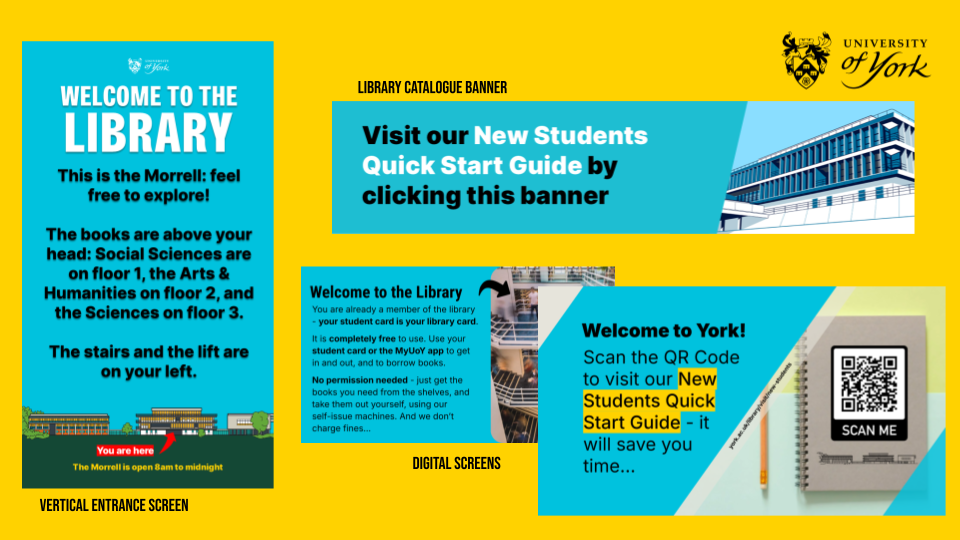
All these are summaries on our New Students Quick Start Guide, and then each week’s theme is distributed across various channels in various ways. These include vertical welcome screens in each library building, regular digital screens, a banner in YorSearch (the library catalogue), articles on the library website, and social media posts. Here’s an example of some of the Week 0 general welcome themed messages:
3 Speak to people face to face
We attend as many face-to-face induction sessions within Departments as possible, usually with someone from the Library Skills Team (which I co-manage) representing the entire Library. We have three versions of our Welcome Slides, aimed at Undergrads, Postgrads and Articulation Students respectively - it’s important not to take a one-size fits all approach, and we also have separate welcoming guidance for York Online students.
We also attend various welcome fairs, and run a welcome stand in the entrance of the library each lunchtime for Weeks 0 and 1 - this year we spoke to just under 1,000 students as part of this. All these interactions are essential in establishing the kind of relationships where students feel empowered to come back and ask more questions later.
4 Prioritise social media
Our social media numbers are exponentially higher than any other means we have of getting people information. Whilst the library website or the Subject Guides allow for nuance and depth, we know that not nearly as many people will see them than will see a successful Instagram post.
For us this year an important part of the general welcome was telling people that Careers & Placements had moved in to our building for 2026/27 - so I absolutely optimised the Instagram post about it (e.g. made it a carousel with music added, made it a collab, added text natively in Insta, etc etc) and thankfully it has now reached over 13,000 people (with over 30k views in total) - there’s simply nothing comparable available to me for getting the word out there.
5 Sneak in useful things for returning students
All of our info for new students is designed to be equally applicable to existing students who may have missed things first time around… We’re trying to give them fundamentals about how things work without making them feel silly for not already knowing - and in addition to this we produce specific guides for returning 2nd and 3rd years too.
By taking this joined up approach to induction we hope our students feel welcome above all. We hope they feel like the library is truly theirs. And we hope they know enough to get started, and to come and ask us when they need greater detail…