University of York Library

Elevating voices: UX as a tool for equity

Today I am honoured to give a keynote at UXLibs 10, the User Experience in Libraries Conference. Below is a version of my slides, and then I’ve linked to several relevant articles and reports covering things I discussed in the talk, finishing with highlights from my report on the Inclusivity and Belonging UX project at the University of York.

The presentation

My slides are embedded below and available on Slideshare here.

The abstract

Higher Education is facing financial crisis. When budgets tighten, services often shrink to fit the needs of the majority, and ‘maintaining core services’ can easily become a proxy for exclusion. By designing for the ‘typical’ user – those with the fewest barriers and the most flexibility – we inadvertently sideline marginalised groups with complex needs.

This keynote positions UX work as an essential tool for equity, with a five point manifesto. We will explore how libraries can represent the under-recognised, elevate diverse perspectives and ensure our institutions remain inclusive, authentic spaces for everyone.

Recruiting for diversity

An absolutely essential part of my UX manifesto is to recruit as diverse a group of fieldwork participants as possible, rather than taking a first-come, first-served approach, or trying to achieve a representative sample. Your service will be more inclusive if you design it to meet the most needs, rather than for the most people. I cover this and several other aspects of communication around UX in ‘Communicating the benefits of UX to everyone who needs to hear it’ in the User Experience in Libraries: Yearbook 2024 edited by Andy Priestner and Marisa Martin (2024) - the Open access version available via White Rose Research Online here.

Three rounds of five, and getting UX done

A really effective structure for UX projects is to interview 15 participants, split over three rounds of five people each. The first round is generative, the second round is for prototyping, and the third round is evaluative. This process is covered in more detail, along with some advice on how to advocate for UX and get it done at your institution, in ‘Ask not what your organisation can do for UX; ask what UX can do for your organisation,’ in User Experience in Libraries: Yearbook 2023, edited by Andy Priestner (2023). The Open access version of that is available via White Rose Research Online.


The Inclusivity and Belonging Report

Throughout my talk I referred to a recent UX project at the University of York, entitled Inclusivity and Belonging. The report was written for use within the University and it wouldn’t be appropriate to share all of it - however, below are some highlights, with the quotes from participants removed.

Executive Summary

Our spaces help shape the daily experiences of our users, and should reflect the communities that use them as far as possible. This project originated from the need for better data on the library experiences of students from smaller, under-recognised demographics. We have consistently prioritised diversity in participant recruitment for previous User Experience (UX) projects, but rarely have we made that diversity the focus of the project itself; while we have made good strides in specific areas relating to inclusivity, there are many groups outside the ‘typical’ York student, who face barriers to service use which we could potentially remove. In particular we wanted to focus on the experiences of first-in-family students and ethnically minoritised students, and to make the library a more trauma-informed service, as part of this project. There was intersectionality here among our participants, both in terms of class and race, and in terms of neurodiversity.

Key findings and observations

The Library is widely regarded as an inclusive environment, but this perception is carried by the interpersonal skills of our staff, our communication online, and specific initiatives (such as the Sensory Rooms or Family Study Room) - rather than the building itself.

  • Staff are a key part of inclusion. Students frequently praised the approachable and welcoming nature of library staff, especially in the Customer Services Team. In general, the library's approach to inclusion and belonging is actively noticed, and appreciated.

  • Elements of the physical environment - often beyond the library's control - actively work against inclusion. Several safety features required by the University - such as the turnstiles, high-intensity lighting, and glass-fronted study rooms - act as signals of exclusion for marginalised groups. In contrast, spaces like the Spring Lane Building are perceived as more inclusive despite being unstaffed: this is attributed to the absence of turnstiles, more thoughtful lighting, and flexible furniture configurations. However, those spaces do not foster a sense of belonging in the same way the library does.

  • Louder study spaces are important. Students from marginalised groups often feel exposed or scrutinised as they move through University spaces. Silent or very quiet study areas heighten this feeling of hyper-vigilance, whilst louder, Studious Buzz areas help to reduce the exposure, helping students feel more at ease. (This is a key reason one of the outcomes of this project, the Ethnically Minoritised Author Showcase Space, is located in the Fairhurst rather than the Morrell.)

  • Students from marginalised groups experience information gaps. We know from the 'York Risks' work from the No Gaps Project that 'Without a sense of belonging, students may feel isolated, excluded and marginalised, leading to lower engagement in learning, support and university life.' Students from working-class or ethnically minoritised backgrounds often operate under a constant state of "decoding" the university environment. This cognitive overload leads to missed opportunities within the library - such as students unnecessarily purchasing books, failing to seek help, or overlooking available services.

Outcomes and recommendations

This report details findings across 8 key themes and offers 19 recommendations. Rather than waiting for the publication of this report to take action, we adopted an iterative approach. As a result, over half of the recommendations are already complete or well under way.

Methodology: a UX-led approach

User Experience

As with all major projects, we based our approach around User-Experience (UX) methodologies. The best way to hear from students is not through focus-groups or surveys but through one-to-one conversations. The data we get from a semi-structured interview is so rich that only a small sample size can yield incredibly useful - and actionable - insights.

Project Overview

The project began in September 2024. Phase 1 focused on existing data: we met with around 10 staff from around the University to assemble perspectives and documentation from related studies. Phase 2 was the UX fieldwork, beginning in May 2025 and running until January 2026; we spoke to 13 students recruited directly, via channels such as Step Ahead or recommendations from relevant staff. Phase 3 - thematic analysis and reporting - began in January and ended in April 2026.

The project group consisted primarily of Ned Potter, Clare Ackerley, Martin Philip and Olivia Else, all from the Faculty Librarian Team, and we benefited from three later additions to the group. Raj Mann (who was at the time Project Manager for the Yorkshire Consortium for Equity in Doctoral Education) joined us for two months of the project, bringing invaluable expertise on many pertinent areas including providing a safe environment for interviewing students on potentially traumatic subjects, and introducing us to the term Trespasser Syndrome (more on which below).

Sarah Lapacz and Emanuela Buizza from the Customer Services Team joined up after most of the fieldwork was conducted, to help with thematic analysis and recommendations. Having their perspective and fresh eyes on the data was really valuable, and I'd recommend this approach of involving new people at the analysis stage for future UX projects going forwards.

A note on terminology

We use the term under-recognised groups rather than under-represented groups, which is the phrase we typically see used in the University. Even though it is almost always not intended this way, there is an implication with the latter term that the onus is on the marginalised person to represent themselves better, whereas of course the reasons for under-representation are systemic and institutional.

We use the term ethnically minoritised students rather than BAME or Black, Asian and Minority Ethnic students, based on advice from specialists in Diversity, Inclusion, Equity and Belonging. This framing highlights the fact that Black and Asian students' minority status at the University is an active, systemic process, rather than a static identity. Talking about 'BAME students' also risks implying a homogonisation of very diverse experiences.

We use the term Trespasser Syndrome where the University often used the term Imposter Syndrome. Imposter Syndrome individualises suffering: it’s not something being done to you; it’s something you ‘have’, a personal flaw that comes from within. But students from marginalised groups are made to feel like outsiders by the University - that comes from without. To quote Dr Arin N Reeves: "People from under-represented groups are not afraid that they are imposters; they are afraid that the majority groups won’t see them for who they are and won’t welcome them if they do see them. These fears are not the fears of imposters; they are the fears of trespassers."

Findings

1) Standard library environments can be exclusionary to marginalised students.

Large, bright, open study areas (such as Morrell Floor 1 or the Burton) are perceived as overwhelming and high-pressure spaces.

It was notable that this was the one area in which ethnically minoritised students, first in family students, students who have experienced trauma, and neurodivergent students all reported similar experiences and issues: the discomfort that comes from feeling observed ("it's just eyes and heads"), or 'taking up someone else's space' in an environment in which they already feel like a trespasser.

2) Bright fluorescent lighting is a source of overstimulation, especially for neurodivergent students. We know from previous UX projects that students want controllable lighting (such as desk lamps) or dimmer zones within the library - this was further confirmed in the fieldwork here. The natural light from windows is appreciated, but strong internal lighting is not.

3) There is a demand for semi-enclosed "micro-spaces". Students want the comfort and privacy of a "little house" while remaining in a public study environment rather than in an isolated area where they feel vulnerable.

Student needs are not as straightforward as wanting to study in busy areas, or quiet areas, or secluded areas. They require different combinations of good sight-lines, whilst not being overlooked; being private whilst not being isolated; feeling not just more scholarly but more inspired than they would at home.

4) The Hidden Curriculum causes financial stress in the library context. The hidden curriculum a wider issue across the University, but in the library it manifests in students not knowing that textbooks are available for free or that online copies exist, leading to unnecessary financial worries. There is also a lack of understanding around borrowing, returning and requesting books which is exacerbated for any students who feel othered or like they don't belong, as they're less likely to seek out help for their problems.

5) The lack of a quiet, segregated prayer space within the library is a functional barrier to long-term study for Muslim students. We know there are many reasons why a prayer room is not currently possible in the Library - however it continues to be raised in the research, every time we speak to students, even if we don't ask about it. Any student needing to pray during their study faces a stark choice - the discomfort of public, overlooked prayer in the library, or losing time (and potentially their study space within the building) by needing to travel to a prayer room elsewhere on campus.

6) Inclusion and belonging can come from exhibitions and events in the library. When we asked what could make the library more inclusive, several students talked about events or exhibitions as being key to seeing themselves (and those of other cultures) in the space.

7) The library is considered a diverse space. The majority (though not all) of ethnically minoritised students we spoke to considered the student body who use the library to be relatively ethnically diverse.

However it was notable that working class students are keenly aware of how many private school educated people are in the wider University. Several mentioned feeling othered by this.

8) Library staff are considered open, helpful and approachable. Many students report positive interactions with library staff, including ethnically minoritised students who have not had positive experiences elsewhere on campus. This is a real strength in the library which we should continue to build on.

For many of our participants, asking for help at all is significant. We need to continue to encourage and reward help-seeking behaviour at all times, and to foster non-direct forms of communication - students told us they'd prefer to DM on Instagram than speak to a member of staff face-to-face when seeking help, for example.

As mentioned in the executive summary, it is my belief that the staff of the library go a long way towards mitigating the more exclusionary aspects of our buildings and services, and are a key part of why we are widely considered to be a very inclusive space within the University.

Recommendations

There were 19 recommendations, many of which are complete. A selection are mentioned below.

  1. Ethnically Minoritised Author Showcase Space (completed): This collection was suggested by Raj Mann as a way to celebrate ethnically minoritised authors and make the library a more inclusive environment. It began with the purchase of around 500 books, and rather than selection being driven by the library each item was a recommendation from students or staff at the University. To ensure these books remain accessible throughout the library, we purchased dedicated copies specifically for this room rather than moving existing stock. There is a QR code in the room where students and staff can suggest additional purchases for the collection: these are reviewed twice a year in Collections Community.

  2. Add tags to study spaces in LibCal to aid students affected by trauma in choosing where to work (completed): The LibCal booking system now has additional checkable boxes when searching for study spaces. These allow you to filter the spaces and, for example, show only spaces with good sightlines, or spaces where you're seated with your back to the wall.

  3. Add blinds to study rooms to allow privacy for prayer (completed): we have had bespoke blinds fitted to two Morrell bookable study rooms (on Floors 1 and 2) to allow students privacy to pray

  4. Offer bespoke Library Tours for relevant Student Communities particularly First in Family groups

  5. Introduce more cultural event programming within the Library buildings. We will also explore offering LFA/144 as a safe, warm, well-lit event space for EDI+B related events at evenings and weekends, for student groups and societies.

  6. Better promotion of money-saving and no-cost services in the Library ideally in collaboration with Central Comms channels where possible

  7. Expand the glossary of library terms (in progress): our current glossary is focused on library terminology: we want to expand this to cover more colloquial and idiomatic territory, to help those adapting from other countries. Will include English and Yorkshire based expressions, as well as the usual definitions of library jargon such as 'quartos'.

Conclusions and future work

This project has taken a year and half to explore the experiences of several communities, and this has been extremely successful. However, in the future we aim to undertake smaller UX projects with specific communities to understand their needs better. This more agile approach would see us undertake three projects (interviewing 5 participants each rather than 15) each year, focusing on one group at a time.

The Library must continue to be an exemplar across campus in investing in, and genuinely believing in, inclusivity. The user voice is key to this, and this project has shown how valuable it is to continually undertake research directly with the student (and staff) population to inform our decisions.

We need to work to mitigate some of the systemic issues beyond our control. We can't solve all the problems we identified, but our experience from previous UX projects has shown people really appreciate any efforts to reduce the impact of the issues - see for example providing blankets because we don't have the ability to make our buildings warmer. What are the blanket equivalents for the issues identified in this project?

We need to ensure that designing for the typical York user doesn't become a proxy for exclusion. When budgets tighten, services often shrink to fit the needs of the majority: when we design for those with the fewest barriers and the most flexibility we can inadvertently sideline marginalised groups with complex needs. UX projects like this one are an essential tool for equity, elevating diverse perspectives and ensure our library remains an inclusive, authentic spaces for everyone.

Ned Potter, April 2026
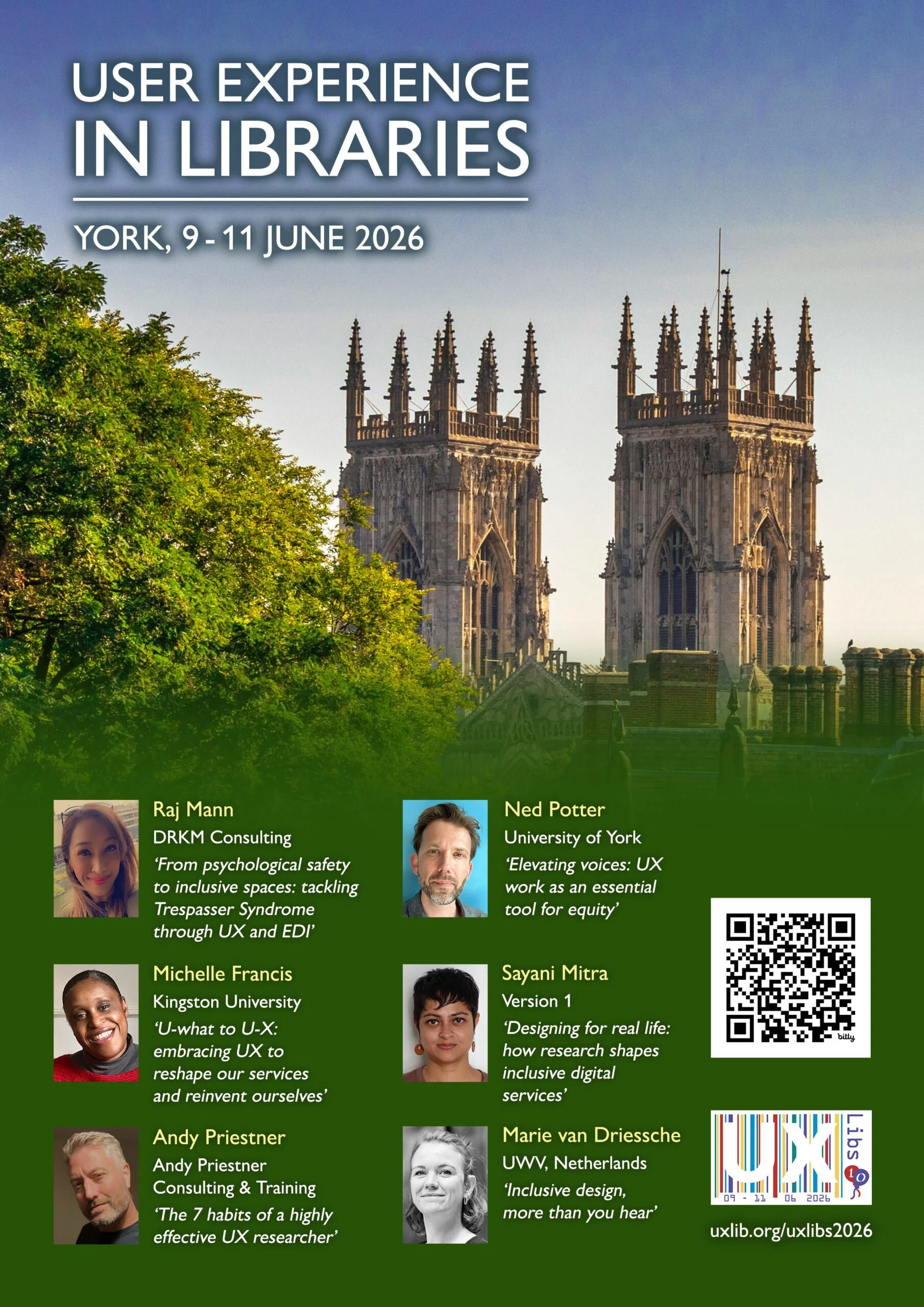
UXLibs 10

You are about to read a blog-post devoid of nonchalance or professional cool… Because this summer I am delivering a keynote speech at my favourite conference of all time, User Experience in Libraries, on its 10th anniversary, in my home City of York.

I am completely thrilled about this!

UX as a tool for equity

My talk is entitled Elevating Voices. Here’s the summary:

Higher Education is facing financial crisis. When budgets tighten, services often shrink to fit the needs of the majority, and ‘maintaining core services’ can easily become a proxy for exclusion. By designing for the ‘typical’ user – those with the fewest barriers and the most flexibility – we inadvertently sideline marginalised groups with complex needs.

This keynote positions UX work as an essential tool for equity. We will explore how libraries can represent the underrepresented, elevate diverse perspectives and ensure our institutions remain inclusive, authentic spaces for everyone.

I feel really passionately about this subject, and I can’t wait to explore it and share some of the work we’ve done at York.

About the conference

The list of speakers is fantastic, and I’m delighted Raj Mann will also be delivering a keynote: I’ve been working with her on our Inclusivity + Belonging UX Project she has been inspirational. I’ve mentioned Raj on this blog before, with regards to Trespasser Syndrome, which she’ll be talking about in her own keynote.

I have bored onto anyone who will listen about how much I love UXLibs. I attended the first one ten years ago in Cambridge, and it was revolutionary for me - learning about User Experience techniques beyond the app / web usability realm I’d previously understood was game-changing, and the conference format was incredibly innovative. A decade on and I have UX in my job title (Faculty Engagement Manager: Community + UX) and it’s a key part of my role.

I have also previously been on the organising committee of the conference for two years, so I know first hand how inclusive and forward-thinking the event is. The community that attends is usually drawn from 25 or more countries, and there’s no group of people who are more interested in the sharing of ideas. To want to do UX work you need empathy above all else, and 100 empathetic people in a room makes for a fantastic event..

If you have even have an inkling that UXLibs might be for you, I cannot recommend coming highly enough. You will learn so much you can USE, and have so much fun, and meet so many great people.

You can find full details of the conference, including booking, on the UXLibs website.

About York

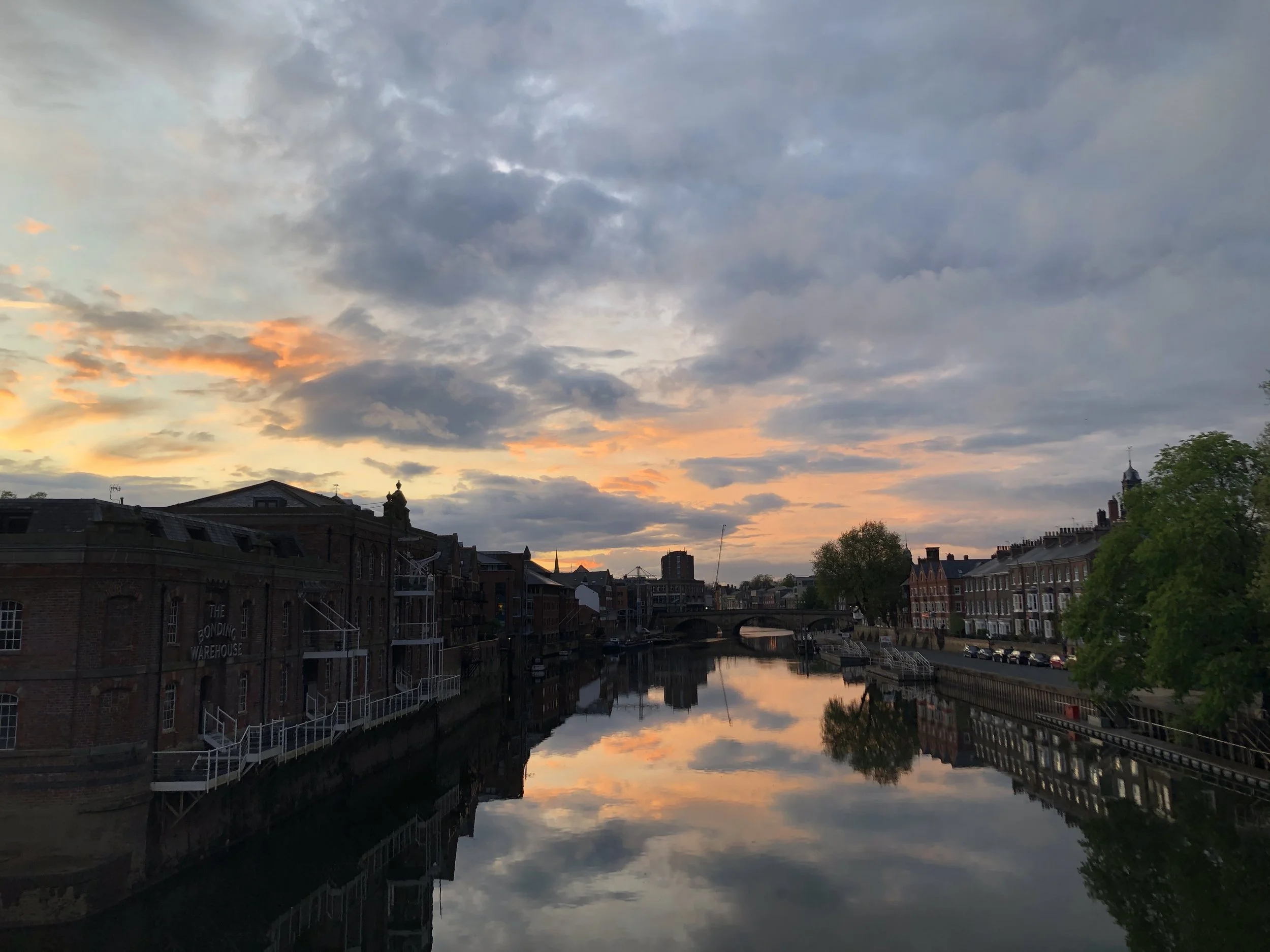
The River Ouse at sunset

The River Ouse is pretty but very floody - hopefully in June though you should still be able to walk along the path shown here.

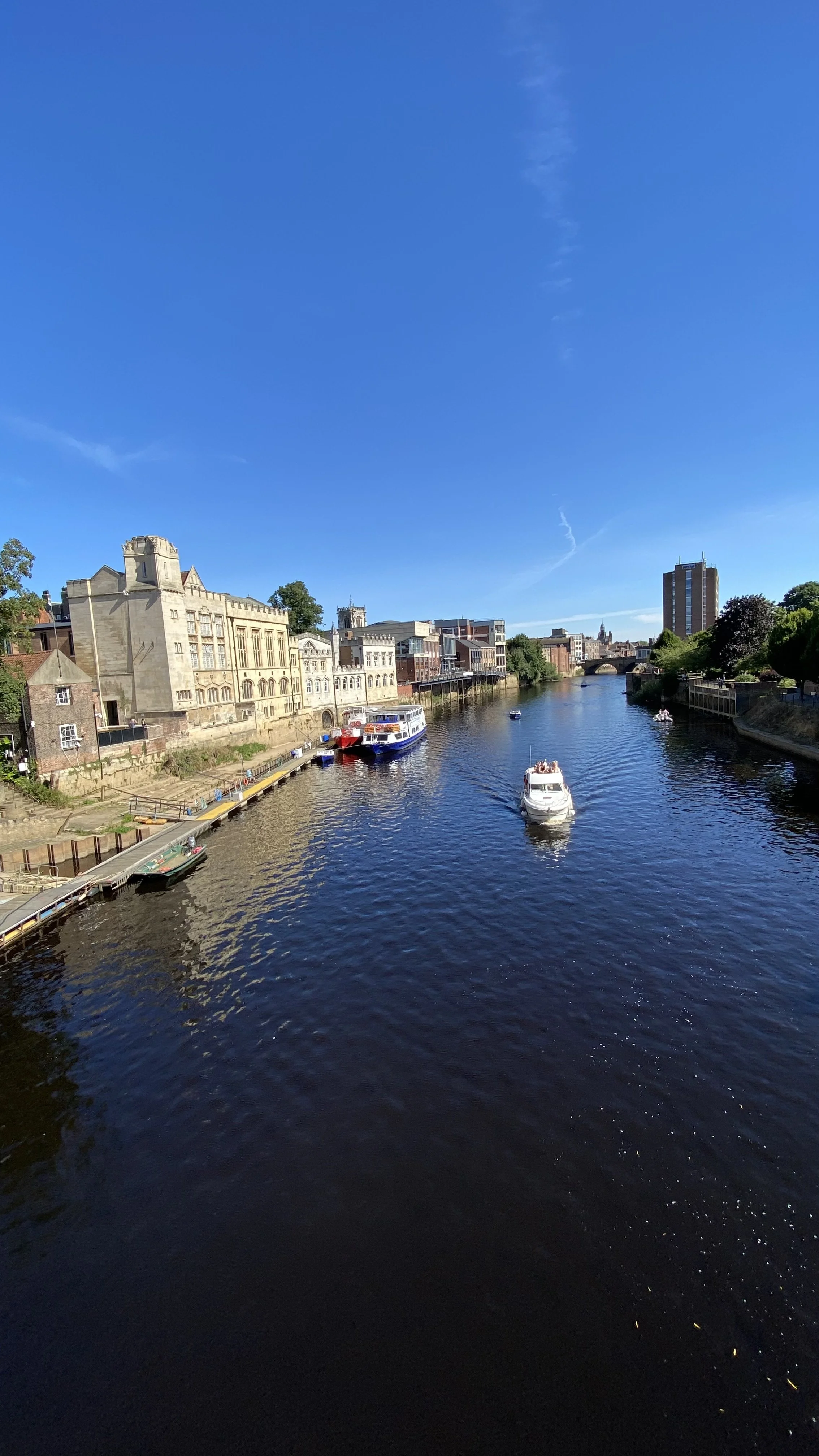
The River and the Guildhall in York

In the top right of this pic you’ll see the hotel at which the conference dinner takes place. Lovely hotel, but the exterior is unloved by the locals. The good thing about the Gala dinner being there is it’s one of the few places in York you can’t see the building from, because you’re inside it.

Former factories converted into flats above a canal-like river

The Ouse gets all the headlines but York’s other river, the Foss, is pretty great

York is tiny as Cities go - you probably won’t need to use a bus or a taxi while you’re here as pretty much everything is walkable. It’s very beautiful. has a famously large number of pubs, and some great places to eat. For anyone who wants recommendations:

  • If you want variety and you like shipping containers, Spark York has both of these in abundance. Loads of different foods in what is, by York’s standards, a very cool and happening place.

  • If you want six million inventive varieties of beer in and industrial-chic setting with some banging Korean street food, Brew York is the place to go. It’s very near Spark York so why not go directly from one to the other?

  • If you like cake, drop what you’re doing and head to Brew and Brownie immediately. Their pancake breakfast is famous but the trouble with it is you don’t want to eat any cake afterwards, and you need to eat their cakes.

  • For fabulous sandwiches head to Mannions

  • If you like cafes head to Bishy Road where there’s a lot to choose from - the Pig & Pastry and Robinsons in particular are a delight

If you’d like any more specific local tips just send me an email. It goes without saying I hope to see you there!

It might not be Imposter Syndrome... We need to talk about Trespasser Syndrome

Back in 2014 I wrote on this blog that Imposter Syndrome ran through librarianship like a vein. Writing now in 2025, I consider that a misdiagnosis.

Imposter Syndrome is defined as a psychological condition, characterised, as Miriam-Webster has it, by ‘persistent doubt concerning one's abilities or accomplishments accompanied by the fear of being exposed as a fraud despite evidence of one's ongoing success.’

The insidious thing about Imposter Syndrome is it individualises suffering. It’s not something being done to you; it’s something you ‘have’, a personal flaw that comes from within. And because the concept of Imposter Syndrome is so wide-spread, it’s easy not to question that the blame is yours.

It reminds me of the concept of ‘resilience’ as it is applied in Higher Education - the onus is on us as staff to simply become strong enough (or numb enough) to deal with any amount of stress or disruption, rather than on the institutions to try and reduce the imposition of harsher and harsher conditions.

Back in 2014, and indeed now, I was surrounded by brilliant colleagues in the profession who doubted themselves, who thought they were only ever a slip away from the big reveal that they Didn’t Belong Here, despite the evidence to the contrary. It was their ‘condition’ which meant they couldn’t see the truth of their excellence. Right?

Then in 2020, I read a brilliant article on In the Library With the Lead Pipe (consistently the most readable and through-provoking peer-reviewed journal I’ve come across), by Nicola Andrews, entitled It’s Not Imposter Syndrome: Resisting Self-Doubt as Normal For Library Workers.

I’d recommend reading the whole thing but this is the paragraph that really stuck with me:

As a Māori, takatāpui, immigrant, person of colour, and first-generation scholar, I know that libraries and academia were not constructed for my benefit; and that systems of colonization, white supremacy, misogyny, and hatred continue to operate within them and wider society. The lack of belonging I felt did not stem from a lack of self-esteem, but from the knowledge that libraries and academia as institutions never intended I belong.
— Nicola Andrews

I feel embarrassed now, that someone needed to point this out to me. I had credited my own lack of Imposter Syndrome as basically being down to a) the sense of self instilled in my by my parents and b) the fact I’d chosen the right profession for me. But of course, it has infinitely more to do with privilege: with the fact that as a white middle-class male my profession and my industry - librarianship and higher education - didn’t treat me like an imposter.

If you’re an ethnically minoritised member of staff in a University and you feel doubt concerning your abilities and whether you truly belong, I’d wager that there’s a good chance it is not the apparently capricious ‘condition’ of Imposter Syndrome - I’d wager you’ve been made to feel like an imposter. If you’re female, or from a working class background, or disabled, or are part of any other underrepresented group, and you feel like an imposter, there’s a good chance you’ve been treated like an imposter. This comes from without, not from within. And that’s not Imposter Syndrome.

(Sidenote: if you’re a white middle class man who feels doubt concerning your abilities and whether you truly belong, it’s not impossible you’ve been promoted beyond your abilities. That’s not Imposter Syndrome either, that’s actually being an imposter…)

How many cases of Imposter Syndrome are actually misdiagnosed? This matters because the term becomes pernicious when it is widely used for groups it was never intended to describe. As Dr Raquel Martin notes, the original 1970s study ‘focused on high-achieving, middle to upper-class European American women, observing how they attributed success to luck rather than their own abilities… the concept was never designed to capture the experiences of marginalised groups like black people, who face additional systemic barriers.’

Trespasser Syndrome

I’ve been working with a brilliant colleague at York, Raj Mann, on a project centred on inclusion and belonging in the library, and I’m indebted to her for introducing me to the term ‘Trespasser Syndrome’. If you’ve read this far and you agree with most or all of what I’ve said above, you’re probably already nodding your head in recognition at how much this new framing improves upon the old framing. It’s not that Imposter Syndrome doesn’t exist - it’s that in so many cases, it is misapplied: in fact the person is made to feel like they’re trespassing in a space simply not intended for them.

I believe the term ‘Trespasser Syndrome’ was coined by Dr Arin N. Reeves, in 2022. I’d recommend reading all of her article Is It Imposter Syndrome or Is It Trespasser Syndrome? - here’s a key quote:

People from underrepresented groups are not afraid that they are imposters; they are afraid that the majority groups won’t see them for who they are and won’t welcome them if they do see them. These fears are not the fears of imposters; they are the fears of trespassers.

A trespasser is someone who enters spaces they are not supposed to be, where they do not belong. A trespasser isn’t afraid of being discovered for who they really are; they are afraid of being treated like they don’t belong where they are.
— Dr Arin N. Reeves

What we do about it?

Language and nuance matter, so let’s stop misapplying the term Imposter Syndrome to situations where individuals and groups are being treated like imposters. It’s never good perpetuate harmful language, whether intentionally or not. Reeves advises us to ‘Use “imposter syndrome” when it’s relevant. Differentiate it from “trespasser syndrome” to honor the realities of succeeding in spite of not belonging.’

More than that though, we need to interrogate examples of Imposter Syndrome. If someone you work with says they have it, or describes its symptoms, we need to do more than nod and smile and say ‘I know how you feel’ - we need to work out why they’ve been made to feel like an imposter, and whether we can do anything to change that. How can we create environments that support under underrepresented groups, and dismantle the systems which tell people they don’t belong?

I’ll leave the last word on this to someone much more qualified to talk about it than me. Raj has in fact organised the first ever Trespasser’s Conference as part of her role at YCEDE (the Yorkshire Consortium for Equity in Doctoral Education) and during her keynote address she said this:

For those of you here today who support racially minoritised staff and students, ask yourselves: have I provided people with the tools they need to be able to thrive in the space? If not, what else do I need to be doing? Instead of helping underrepresented groups to walk past the metaphorical ‘no entry or ‘no trespassing signs,’ instead pull down the sign before they get there, have a comfortable seat ready for them: don’t just applaud the courage and grit on getting there.
— Raj Mann

Show-notes: guest appearence on the Keeper & Curator Podcast, talking social media

I had one of my favourite professional conversations ever the other day, and as it happens it was recorded! I was honoured to be a guest on the Keeper & Curator podcast, run by my colleagues at York Helena Cox and Gary Brannan, which despite being new has already been fantastically successful (number 1 in the Visual Arts UK podcast chart, wooop). I’ve loved long-form conversation podcasts for so long, so to be actually in one and have a really great discussion was properly fun. We talked a lot about social media, about what works and what doesn’t, about exploring art abroad, and about the University of York’s sculpture trail.

I know it’s a big swing to expect anyone reading this to want to listen to me on a podcast about Art, so I thought I’d provide some shownotes with time-codes that tell you what we talk about and when, in case any of it is of interest or relevance to you. A large portion of the chat is relevant to anyone interested in using social media to engage audiences, across libraries, HE, and the Arts more generally.

Here’s the podcast:

First things first, you can find the episode Social Media and Unfinished Business here on Spotify, or you can find it on Apple Podcasts if you prefer, and probably a bunch of other places besides. Here’s the Apple version embedded:

0:00 - 2:17 Preamble

The welcomes and hellos happen in this bit.

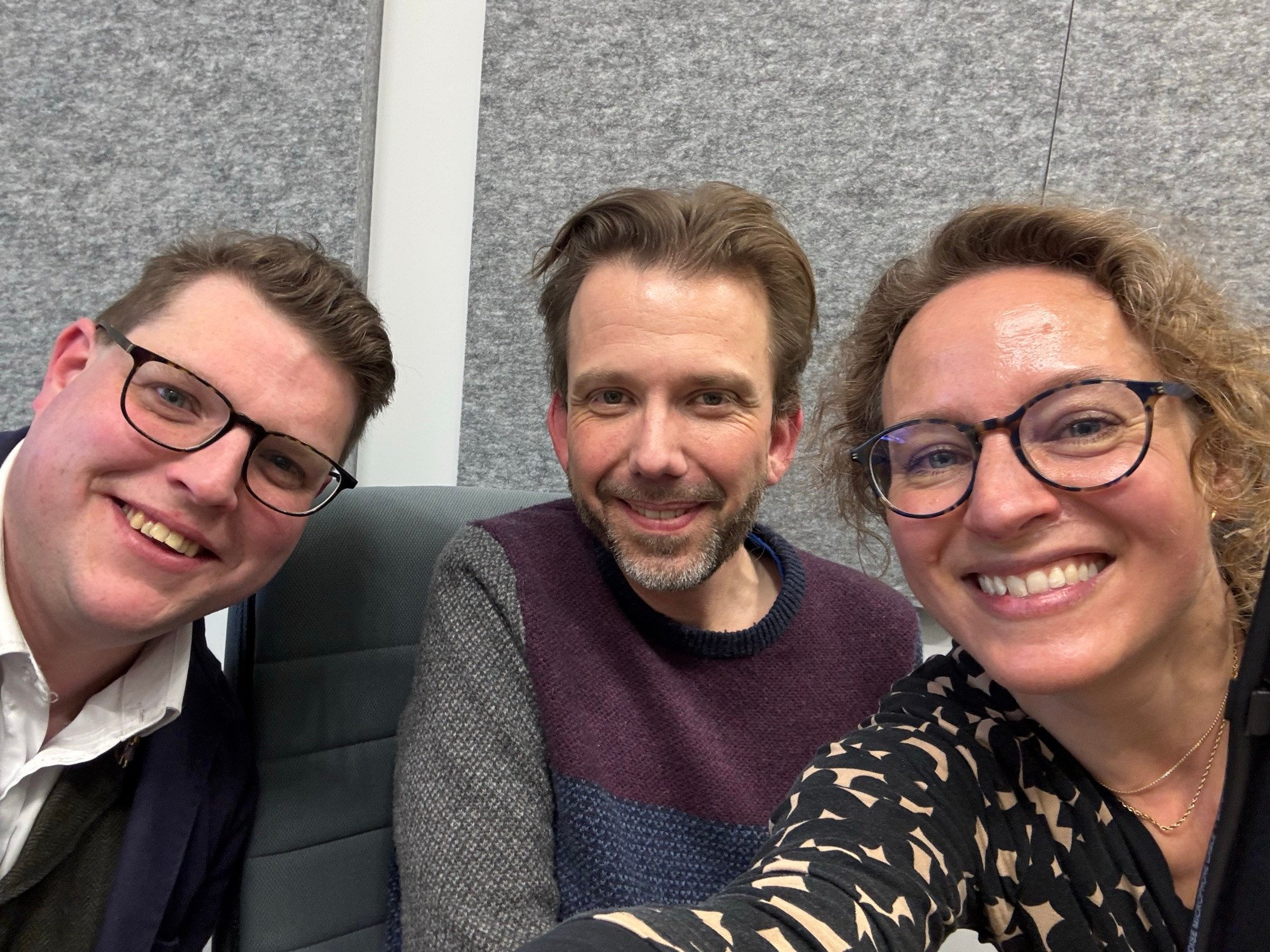
We recorded in the Library’s Podcast Studio - it’s one of our most popular services and I’ve spent some time marketing it, but never used it before. It was pretty nice, extremely high quality mics where you feel like you can hear the blood in your veins they’re so sensitive… Here we all are, in a post-record selfie.

Two men and a woman smile at the camera

From left-to-right: Gary (the Keeper), me (the guest), and Helena (the Curator)

2:18 - 13:49 social media and the arts

In this section we talk a little about the personality-driven social media that Helena does via the Art@York profiles, which I think is absolutely brilliant. You can find Art@York on Facebook here (the former Library account, as you’ll hear if you listen to this bit!), or Art@York on Insta here, or Art@York on Bluesky here.

We talk a lot about why art collections work on Instagram etc, and I found it really interesting to explore this. I do think the overwhelming availability of everything means curation of any kind is more important than ever, and I do think we’ve all become so good at using imagery in our social media that it just becomes white noise - so meaningful imagery on social media really makes a difference.

13:50 - 18:37 can social media be taught or is it intuitive?

An interesting question from Gary prompts a discussion about whether social media can be taught. It absolutely can be (please get in touch and book a workshop!) but certain approaches do rely on an intuitive grasp. Either way though, putting personality into your comms is what builds relationship and engagement - if it’s fully corporate, people just do not respond.

18:38 - 24:35 AI in social media

I have over time become massively against using for example AI-generated imagery on professional social media, and this section covers why. You basically alienate a large part of your potential audience if you continue to use AI slop.

24:36 - 29:39 The different demographics for different social media platforms

One of the traps institutions often fall into when doing social media is treating all the platforms the same, and cross-posting content. I get why this happens, with time-pressures being primarily to blame, but the issue is that the platforms work completely differently, and have quite different demographics.

29:40 - 39:29 Creativity, music, and being from a line of artists but unable to produce visual art…

The Queen Mother in a painting, wearing an elaborate brooch

The Queen Mother, by Peter Walbourn

I hail from generations of artists, and I cannot draw a line or a circle or indeed absolutely anything at all, with any skill. My Mum is an incredible artist (our house is filled with things she’s made for us) and so was her Dad, Peter Walbourn. He once painted the Queen Mum and was struggling to get the detail of her brooch down in time for the end of the sitting. Why don’t you take it home with you, Her Maj suggested! Is it insured, my Grandpa asked? Oh, we couldn’t possibly afford to insure it, she replied… (He took it home anyway and my Gran slept with it under her pillow to keep it safe.)

My Great Grandfather was the painter Ernest Walbourn, and we discuss the many unfinished paintings of his we have in our house during this section of the podcast. Here’s the main himself at work - one of the things I like about this picture is he’s literally doing the thing we discuss in the episode: 70% of the painting is done to completion, but the sky is entirely untouched, a literal blank canvas.

Black & white photo of a man sat at an easel

Ernest Walbourn at work, probably in the early 1920s

The other part of Ernest lineage which did NOT reach me is sporting prowess: he was in fact invited to join the Olympic shooting team, and my parents have a letter from an Olympic committee member reassuring colleagues that Ernest was a gentleman, despite being an artist…

In particular we talk about one painting on my wall, of a tree, unfinished, which I absolutely loved Helena’s expert take on. Here’s the pic.

A wall featuring a painting of a tree, with blank canvas in the bottom left corner

The unfinished tree painting, left

After listening to the podcast my Mum got in touch to say this was the very tree under which my grandparents got engaged! Lovely stuff.

39:30 - 52:17 My top tip for visiting galleries and museums

If you only take one thing… Steal my Te Papa techniques as described in this section! Some more on the New Zealand Lianza experience, including images of the museum in its glorious emptyness, here. Plus more on the Latvian children’s art / library strategy here.

We also discuss UX methodologies, and the benefits of having a curated art collection on campus.

52:18 - end My favourite art on campus

I insisted they ask me this question - what is my favourite art on campus? I talked about two pieces. First of all Beyond and Within by Joanna Mowbray.

A giant steel statue among trees

Pic via the Art@York - click to see the original on Facebook

The piece I picked as my favourite was the Singing Stone by Gordon Young. I mentioned in the podcast the Alumni post on Insta of Helena describing the piece, and the YouTube shorts version is embedded below:


If you’ve made it this far, thank you for reading! I absolutely loved being on the podcast, so thank you Helena and Gary for having me.

The Researcher's Guide to Bluesky

If you’re reading this you probably know the emerging social network Bluesky has had an explosion of popularity. I wanted to set up a profile for my library, but I needed it to be worth it - we needed a critical mass of University of York people there to rebuild our former Twitter network.

With that in mind I decided to adapt a Bluesky guide I’d written on here, to make it a guide for Researchers - the idea being to make it as easy as possible for people to make the switch. In other words, I’ve tried to help catalyse the change I needed in order to justify putting time into Bluesky, and I think overall this approach actually worked!

Because the guide was aimed at academics in particular, I sought input from academics at York who were already on the platform. Would you like to be in a York Starter Pack I asked them, and do you have any tips for your peers? They were all terrifically enthusiastic about the idea for the guide, and gave lots of useful quotes - the researcher perspective was essential, so I’m grateful to them all. I also got permission from the Central Comms Team at the University to do this in the first place, sharing a draft with them and adding some pointers around policy which they wanted included.

1: The Researcher’s Guide to Bluesky

>> Here, then, is the Researcher’s Guide To Bluesky.

It’s published on my library’s blog rather than on here because I wanted it to be seen as an ‘official’ output of the Library & Archives. I promoted it via staff newsletters, asking the Central Comms Team to add it to their Bluesky guidance, and of course going back to each and every York academic I’d spoken to about the platform to share a link with them.

I also used it to launch the library’s Bluesky account. I thought this would be good - you can’t beat being USEFUL to hit the ground running on a new social media platform - but considering we had no followers and Bluesky doesn’t have a centralised algorithm to push content towards people, I’m fairly stunned about how much engagement we got. At the time of writing it is exactly three weeks since we posted a link to the guide (as part of a larger thread outlining its key points) and we’ve had over 600 reposts and 750+ Likes - plus so, so many replies, pins, and messages of thanks.

We've written a Researcher's Guide to Bluesky! It's a bit like all those other useful guides to Bluesky, but with several useful insights from University of York academics about using the platform, and we'd love it if it was reposted far and wide... >> blogs.york.ac.uk/library/2024... 🧵 below

[image or embed]

— University of York Library (@uoylibrary.bsky.social) November 13, 2024 at 12:17 PM

The great thing about the guide doing so well is it exposed us to new followers (including York people who may not otherwise found us), established some credibility for us as an account worth listening to, and literally brought more researchers to the platform which was of course the main driver for writing it in the first place. We now have around five-and-a-half thousand followers after 21 days - on Twitter we had around 7,500 (before Musk took over and everyone left) but that took us 12 years, and engagement was way lower than it is on Bluesky.

As successful as the guide was, the fact is the York blog on which it was posted isn’t well known enough for people to just randomly stumble across it - you need to be sent there via a link in an email or a Bluesky post, realistically. I wanted to reach more researchers through an existing authority with an established network, to get more eyes on the guide - so I pitched a version to the LSE Impact Blog for Social Sciences. You’re probably familiar with this but if you’re not, the key thing to know is it has completely out-stripped the original purpose that gave it its name! The blog has become a sort of academic hub for ideas and practical guides for people across all disciplines in Higher Education.

2: How to get started on Academic bluesky

>> Here, then, is How To Get Started With Academic Bluesky.

The above is a shorter version of the first guide, due to the Impact Blog’s word-count limit - it has the York-policy-specific parts omitted, and is generally leaner. It also benefits from some helpful suggestions given to me by Michael Taser, the Managing Editor (the final paragraph in particular) and in general I prefer this edition of the guide.

This version has also had a great reception and achieved the aim of reaching more people, hopefully bringing more researchers to the platform (which will in turn make it more useful for the York academics, meaning more of THEM will come to the platform, meaning the time WE are putting into it becomes more worthwhile, and so on and so on). Certainly the greater reach of the Impact blog has helped a lot - it’s had probably around 150% of the views of the original guide.

As more and more libraries started to appear on the Bluesky as part of its November popularity surge, it was inevitable that I’d end up writing yet another iteration…

3: The Library Guide to Bluesky

>> Here, then, is the Library Guide to Bluesky.

The edition is published here on this blog because it’s written ‘as me’, rather than as the library itself. This is a culmination of what I’ve learned and applied from writing the other guides, with some advice on actual content thrown in there as well.

Again I’d like to reach a wider audience than I can get to on this blog alone, so I’ve pitched a version to Library Journal and we’ll see what they say. Speaking of pitches…

4: a bluesky guide for academic departments and professional services

>> Here, then, is the University Guide to Bluesky.

I pitched a guide to the Times Higher (for whom I’ve written a couple of pieces previously), again on the grounds that reach will be higher there than here, with my target audience. This version is organisational rather than individual, and very much HE in nature - although much of it could apply across the cultural sector.

And that will be that - no more Bluesky guides from me (almost certainly!) and all bases covered. Taking experiences and chunking them up into (hopefully useful) guidance for others has always been one of my favourite things, so I’ve actually really enjoyed this whole Bluesky business… One reply I got to a Bluesky post sums up why it’s worth the time to write these:

So appreciated!!! From little tips to engagement and the starter packs. You have no idea how helpful this is when you’re doing this in addition to the ‘day job’ but also trying to inform/advocate for your colleagues/researchers that you support in a newish area of social media! Bravo!!
— A Researcher Engagement Team