Training

Ten tiny tips for preparing a talk

I love prepping a talk, which is what I've spent the last few days doing ahead of my keynote at #UXLibs 10s today. Here are some things I've found helpful in the process.

1) Get your ideas down first; sort the visuals later. Think of it like building a house - you lay the foundations and see the walls are going before you pick furniture and colours... Sometimes the content can dictate the style, too.

2) Make a version with everything you want to say. Don't worry about timings or length at this stage.

3) Practice, out-loud, like you mean it. You cannot practice a talk in your head - you'll unknowingly take shortcuts and find yourself facing a slide on the day and not knowing how to actually express yourself. To get the language right you need to do it at full volume, as some things (especially colloquial phrases) just don't work when you're projecting your voice.

4) Time the your talk. The chances are it'll be long; that's fine. It's easier to make it long and work out what to cut, than it is to try and make it the right length in the first place where you might accidentally leave out more impactful themes or framings.

5) Get it the right length, then cut another 10% off anyway. Things always tend to go longer than you think at conferences. Or maybe there's a tech issue, or the host's intro takes too long. It's better to be too short than too long, because the latter eats time from other speakers. So if you have a 40 minute slot, prepare 36 minutes; for a 10 minute slot, prepare 9 minutes, etc.

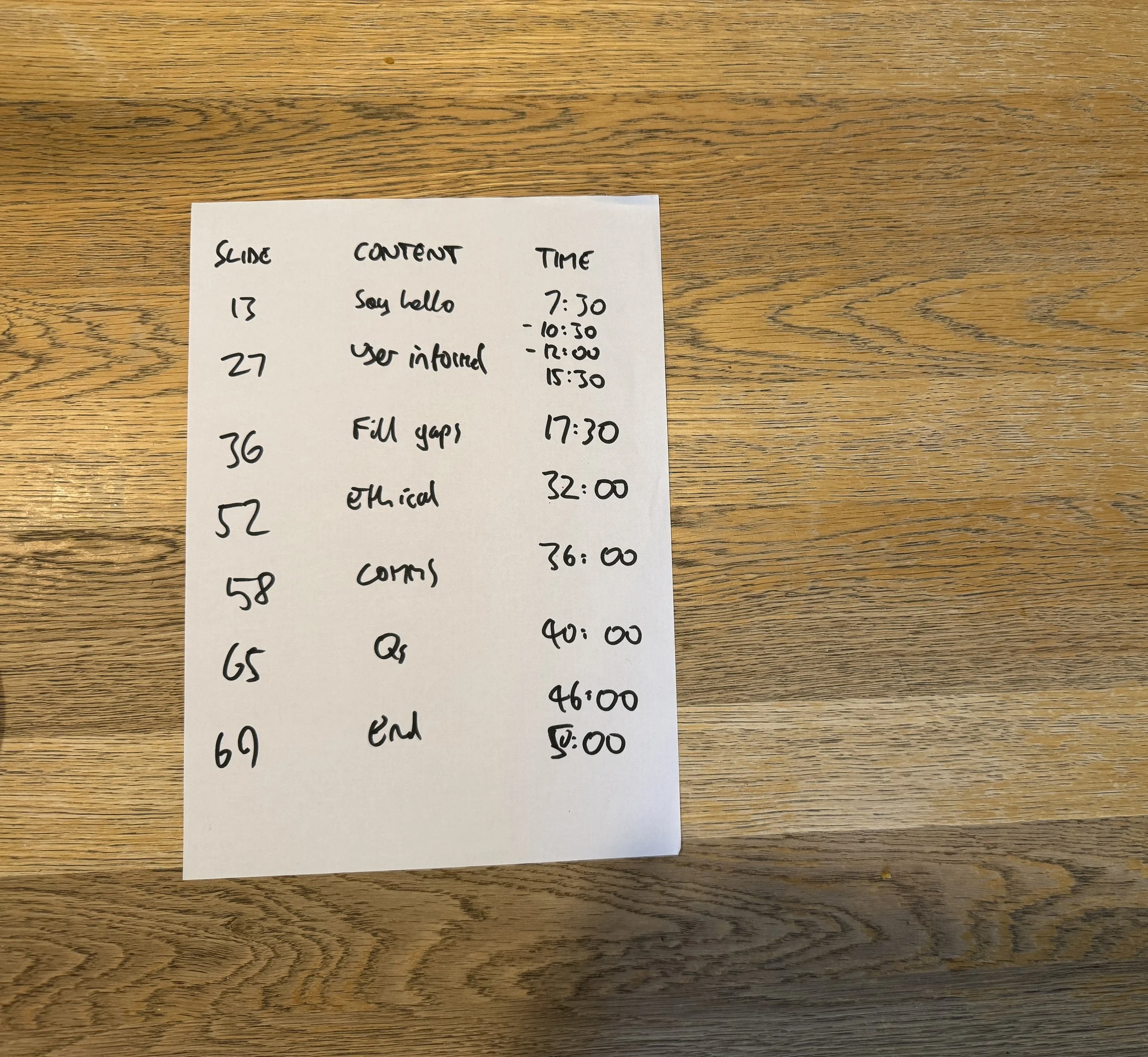
6) Run it one more time, and note the key timings of where you'd expect to be for each section. I've posted a picture of mine below (forgive my handwriting). The idea is if I get to, say, slide 36 and I'm already on 20 minutes, I'm going long and need to tighten up and compensate. This is a *really* useful piece of paper to have in front of you in a talk.

Sheet showing talk timings, e.g. Slide 52, 32 minutes in

7) Don't put questions right at the end. I think it's better to put questions 5 minutes before the end, then answer the questions and do your final summing up - end the talk on your terms.

8) Add the alt-text (assuming your slides will be shared afterwards). I use a lot of boxes as part of my slide design, and it takes a while to mark them all as decorative, describe my graphs etc.

9) Make a sharing version. The slideshare edition of my slides may have slightly more text on, and I'll have hidden slides which don't make sense without any context, before saving the PDF.

10) Save it to a stick, save it to your laptop, AND upload it to the Cloud... That should cover almost any eventuality!

If there are any tips would you add, let me know in a comment! The next post on here will be my slides and relevant links from the UXLibs talk. I love running Presentation Skills training and workshops, so if you’d like to book something bespoke for your organisation, you’ll find details of what I offer and feedback from previous workshops towards the bottom of my Training page.

The Public Library Brand: refuge, joy, connection, purpose, and expansion

In my Strategic Marketing training, we conduct an exercise around the library brand. It begins with a key question: what do you want your library's brand to be? What would the ideal sum-total of everyone’s perceptions of your organisation amount to? Or to put it more simply: what do you want people to say about you when you’re not in the room?

From there we explore how to assess your library’s current reputation, and then talk about all the great marketing strategies you can use to influence and shape your brand, steering it closer to that ideal vision. It’s always one of my favourite workshop activities because I love people hearing the sets of words and phrases people come up with.

Some brand aspirations are easy to work with, from a marketing perspective. If your ideal brand is ‘a place of learning and support’ you can quickly come up with a strategy for the kinds of services you’ll promote and the target audiences for those efforts. Other aspirations are more challenging (though no less valuable because of that): for example ‘innovative and exciting’ or ‘inclusive for all’ are NOT going to become your brand on their own. Achieving these requires a deliberate effort to shift perceptions and actively demonstrate in the marketing content how inclusive, welcoming, or innovative your institution truly is.

I’ve never seen such a fabulous brand to aspire to than the one public libraries already have, revealed in some new research by the New York Public Library.

Let’s start with the quote given to Book Riot, which gives this post its title, from Daphna Blatt, the NYPL’s Senior Director of Strategy & Public Impact, who says the research shows that:

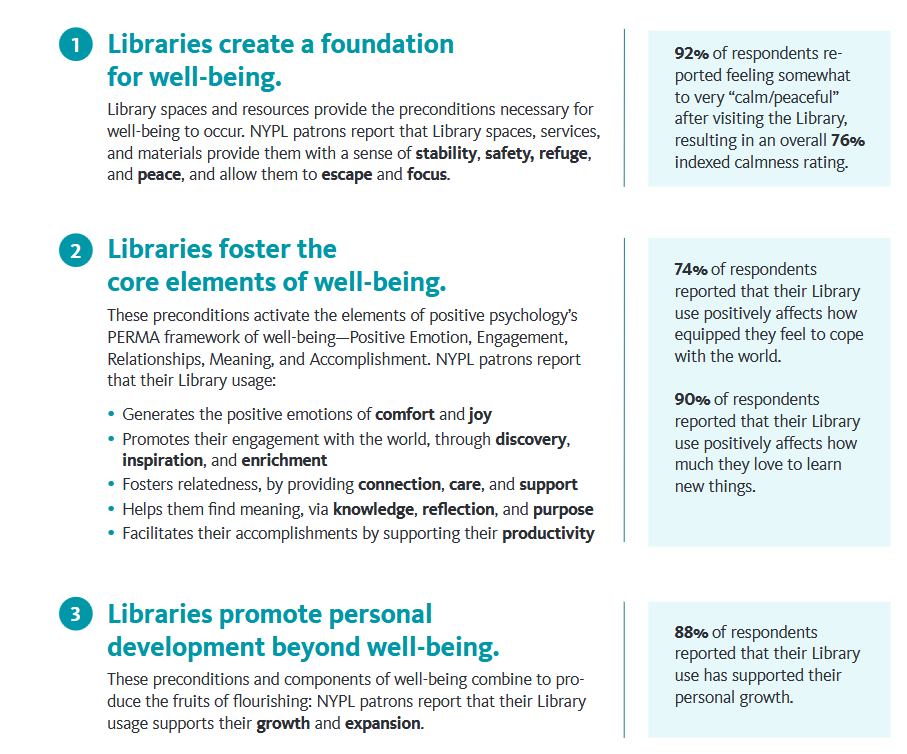
...library usage positively contributes to externally validated measures of well-being. Our research found that patrons experience refuge, joy, connection, purpose, and expansion through their library use.
— Daphna Blatt

Wow. WOW! It’s just such a fabulous set of terms. And what an exciting challenge to try and build that into a marketing campaign. You could take them together, or work on them one at a time over a period of months - the great thing about it is you’d be building an evidence-based piece of marketing. The research tells us how libraries make people feel, and our job as marketers is to convey that in different ways to different audiences - including, of course, potential new users.

And in fact, those terms are just five of twenty identified by NYPL, across three stages detailed in the full report which you can view here [PDF]. Here’s a screenshot of the page I was most excited about (with as much alt-text as the system allows):

Click the pic to open the full NYPL report in a new tab

It’s a very positive piece of research at a time when positivity can be pretty scarce around public libraries: I’d urge you to read the report, share it with colleagues, and then run with it as a way to inform your library marketing in 2025.

The Pros and Cons of Hybrid Freelancing

Is there a word for people who are both employed and self-employed? There's a group of us who work the majority of our time in a normal job and also do freelance work in the remaining time: I'm going to call us Hybrid Freelancers, for want of a better term. I love being a hybrid freelancer, and a new change has got me reflecting on the pros and cons.

Today I start a new regime of compressed hours: I'm now doing my 90% FTE hours over 4 days rather than 4.5. I reduced my hours to 90% 12 years ago when I first started doing freelance training & workshops as well as my regular day-job at the University of York, and it has worked really well - taking either a day each fortnight, or half a day each week since Covid hit and things moved online, to prepare and run training sessions.

I literally never run the same session the same way twice. I will always, always revise my materials in some way before each session, either to tailor them to the sector or the organisation, or update them with new information, or just tweak them based on something which went well or less well the previous time I ran it. Up until now, I’ve tended to do that at the end of my regular working day, and the morning of the workshops – 45 minutes here, an hour there, and the materials are updated and ready to go.

Just under a year ago I changed roles at York and became a Faculty Engagement Manager, and I’ve found the new position to be much more intense and to take up a lot more emotional energy than my old one. I’ve noticed I’d get to 5pm or so and simply be too knackered to change gear completely and work on freelance materials, so I’ve found myself working at the weekends or evenings occasionally to prep for workshops - something I absolutely do NOT wish to be doing.

As a result of this, I’ve made the change to compress my hours. 5 days compressed across 4 has always been a mystery to me – the days seem so long I don’t get how people manage it… But to fit less than 4 additional hours into 4 working days, and then have a day off a week, seems very doable. It will mean on a regular workshop day where I run something online from 10am – 1pm, I will have the afternoon completely free to prep the NEXT workshop after that, and so on and so on. I think this will really help.

It also means I can potentially take on more freelance work, although by some miracle I have almost always had the same amount of demand for freelance work as I have time do it in, and I don’t expect demand to double just because my availability has! But hey, if you’re reading this and wondering if I can fit in a larger 2-day workshop or whatever, the answer is, yes, by all means get in touch…

Anyway, one of the cons of being a hybrid freelancer is also one of the pros: dividing your brain in two. On the one hand, the con is that it can be hard to switch gears and fit those two different worlds into a reasonable number of working hours. One the other hand, the pro is that both worlds benefit each other: I’m better at my day-job because I learn so much from my freelance work, and my freelance work is anchored in the reality of what is achievable in a library, because I work in one…

What else is there in the pro column, and does it outweigh the con column? First of all I’m going to talk about money. Even though I *know* it’s better when we’re open about financial matters when it comes to jobs, I still feel awkward and gauche! But here we go, anyway.

The Cons of hybrid freelancing

Part of your income is not guaranteed. I’m starting with the obvious one – for 10% of my time I’m relying on generating work, and if I don’t get any work I don’t get any salary. And of course if I’m ill I don’t get sick pay. This is inherently stressful, although much less so as a hybrid than as a full freelancer. On the upside, if you DO get work, it generally pays better than the day-job: my annual income is greater than if I was 1.0 FTE in my day-job.

Continuing on the subject of financial matters, you’re paying less into your pension. You can of course supplement your day-job pension with a private pension if you choose to, but you won’t get any sort of employer-matching type offer. You also have to get good at guessing what your tax bill will be, and putting aside that amount, because you’re taxed annually rather than at-source on your freelance income.

Here’s a tricky one: what does being a hybrid freelancer do for your reputation at your place of work? I’ve heard ‘oh they’re never there, really’ about people in other libraries who also do freelance work: I really, really hope my colleagues at York have never said that about me! Of course, I wouldn’t know if they did. What I do know, however, is I put absolutely everything into my day-job: I make sure I personally make a difference not just to the library but the actual student experience, and I hope this ensures no one ever thinks I see the day-job as lesser in any way to the freelancing.

The Pros of Hybrid Freelancing

I don’t want to be cheesy but the main pro is the people. As a freelancer I’ve run over 300 workshops across four continents (five if you count working online!) and I must have spoken to getting on for 10,000 people across that time: it is an absolute privilege to interact with so many professionals in my field and others, and to get so many different perspectives and experiences shared with me. It makes me better at both my jobs and it helps me understand the world from viewpoints other than my own, which is especially important as a cis, white, straight male.

The work itself is incredibly rewarding. I can only speak as a trainer, but I completely love it – working with engaged professionals who want to learn and share ideas and really get something out of the workshops. I’ve met people years later who’ve told me in detail about how they implemented ideas I’d given them in workshops and that is an uncomplicatedly brilliant feeling!

You get to travel, without travel becoming the only thing you do. I’ve had amazing opportunities thanks to freelancing, to visit South Africa and New Zealand and Australia and all sorts of places in Europe, which I’ve loved. But, I’ve also turned down a lot of overseas trips because they didn’t work for my family - as a ‘hybrid’ I can say no to things, but if I was fully freelance I may well have felt like I had to take on the trips to make ends meet.

Your worklife is inherently varied. I stayed in my previous job (Academic Liaison Librarian) for 13 years, which is a long time. Mainly it was because I hadn’t found a job I wanted to do more, but a big reason I didn’t get itchy feet was because I had constant professional *variety* and change in my freelance life.

All in all I’d say to anyone considering going freelance, try the hybrid system first to see if it suits you – the additional security it provides is really beneficial, especially when you’re first starting out!

Library marketers! Don't fall into the trap of thinking TikTok is just a young person's platform...

There’s some really interesting data I’d like to present in this post for your perusal, so I’m going to put it at the top as a sort of tl;dr version - but obviously please do carry on reading for the context of why it matters!

So here it is. Broadly speaking, we think of Facebook as being for older people, Insta and TikTok as being for younger people, and Twitter* for being somewhere in the middle - the sweet spot for that 25-34 demographic. However:

Twitter has around 127 million users aged 25-34, where as TikTok has 256 million users aged 25-34. In other words there are more than twice as many 25-34 year olds on TikTok (the young person’s platform) than there are on Twitter (the 25-34 year old’s platform!).

Remarkable, eh? But why does this matter? Recently I was working with a library on their marketing, and asked them if they'd considered using TikTok. No, came the reply: our average user is 28 years old, an age more associated with Twitter demographics.

First of all, kudos to the institution for a) knowing useful demographic data and b) using it to inform their decision-making! We all need to do more of that.

However there's a risk that we can let the dominant narratives about social networks disguise important insights: in this case, the idea that TikTok is full of young people (which it is) obscured the fact that there are SO MANY people on the platform overall that it's useful library marketing for all age-ranges.

These days accurate Twitter user-figures are hard to find, but here's what I discovered via Statista. There are around 335 million users of the platform, a massive 38% of whom are in the 25-34 age bracket. So: 127 million people in the age range for the target 28 year old. And no other social network that I looked into had such a high percentage in this particular group: so far, so good for Twitter.

However! Whilst only 16% of TikTok users are in the same 25-34 age-range, that's 16% of 1.6 billion users - this amounts to 256 million people in total. In other words *twice as many 28 year olds are on TikTok than are on Twitter.*

Only 8% of TikTok users are aged 35-44 like me (I am clinging on to that age-range for another few months before I get promoted to the 45+ one!) but in my own experience if feels chock-full of them... I drum for a band that exclusively plays 90s Dance music - trust me when I say, people aged 35-50 love it but it's of very little interest to anyone younger! And yet we do very well on TikTok (more so than Insta or Twitter or Facebook) because it turns out, there are a lot of nostalgic people in their 40s on there, who want to see a band play the song Renegade Master live on stage (42,000 views and counting) 😄

Anyway. The point is that TikTok is an option worth considering (in the long term its battles with the US Government may, or may not, change that) even if you don't consider your library's key demographic to be especially youthful. It's always worth looking deeper at the numbers behind the narratives, and how they relate to YOUR library community.

----

*I'm just not going to say X. I'm not going to say X, formerly Twitter. It's too annoying. I'm just going to say Twitter, forever.

Upcoming Power Hours on UX and Marketing

Two of my favourite people in Libraryland, Phil Bradley and Val Skelton, are running Power Hours on a Friday lunchtime. The idea is a packed hour of useful CPD, with space for discussion afterwards, for £35 a session. I’ve done one of these already and it was great, with loads Chat back-and-forth; they have sessions coming up on Canva, AI and more - plus three in the diary between now and the new year, hosted by me!

I hope to see you at one or more of them. Here’s what we’ve got coming up.

Introduction to UX in Libraries: November 17th

Libraries using UX are discovering rich and often fascinating data on their patrons, which is proving a nuanced feedback method to complement traditional surveys and focus groups. We'll explore what ethnography really is and why you might want to use it, then look at specific examples of techniques to try out. We'll also look at examples of changes libraries have made to their services based on UX projects.

More details of the UX In Libraries session on Eventbrite


Jargon free introduction to Library Marketing

This session will focus on how to approach marketing libraries in all sectors. How do we frame messages so they have the most impact? What actually matters to our audiences? How do we keep things simple without dumbing down?

This works as a stand-alone session, but can also work as an introduction to the Strategic Marketing session below.

More details on the Intro To Library Marketing on Eventbrite.


Strategic Marketing in Library Campaigns

Library marketing becomes hugely effective when it is coordinated and joined up. In this Power Hour we'll explore marketing strategically and in campaigns. We'll work on segmenting audiences and tailoring messages for each group, before tying everything together in a strategic marketing plan.

This session works as a stand-alone session, but also picks up where the Intro To Marketing, above, leaves off, if people want to take them as a pair.

More info on the Strategic Marketing Power Hour on Eventbrite.