UXLibs 10

You are about to read a blog-post devoid of nonchalance or professional cool… Because this summer I am delivering a keynote speech at my favourite conference of all time, User Experience in Libraries, on its 10th anniversary, in my home City of York.

I am completely thrilled about this!

UX as a tool for equity

My talk is entitled Elevating Voices. Here’s the summary:

Higher Education is facing financial crisis. When budgets tighten, services often shrink to fit the needs of the majority, and ‘maintaining core services’ can easily become a proxy for exclusion. By designing for the ‘typical’ user – those with the fewest barriers and the most flexibility – we inadvertently sideline marginalised groups with complex needs.

This keynote positions UX work as an essential tool for equity. We will explore how libraries can represent the underrepresented, elevate diverse perspectives and ensure our institutions remain inclusive, authentic spaces for everyone.

I feel really passionately about this subject, and I can’t wait to explore it and share some of the work we’ve done at York.

About the conference
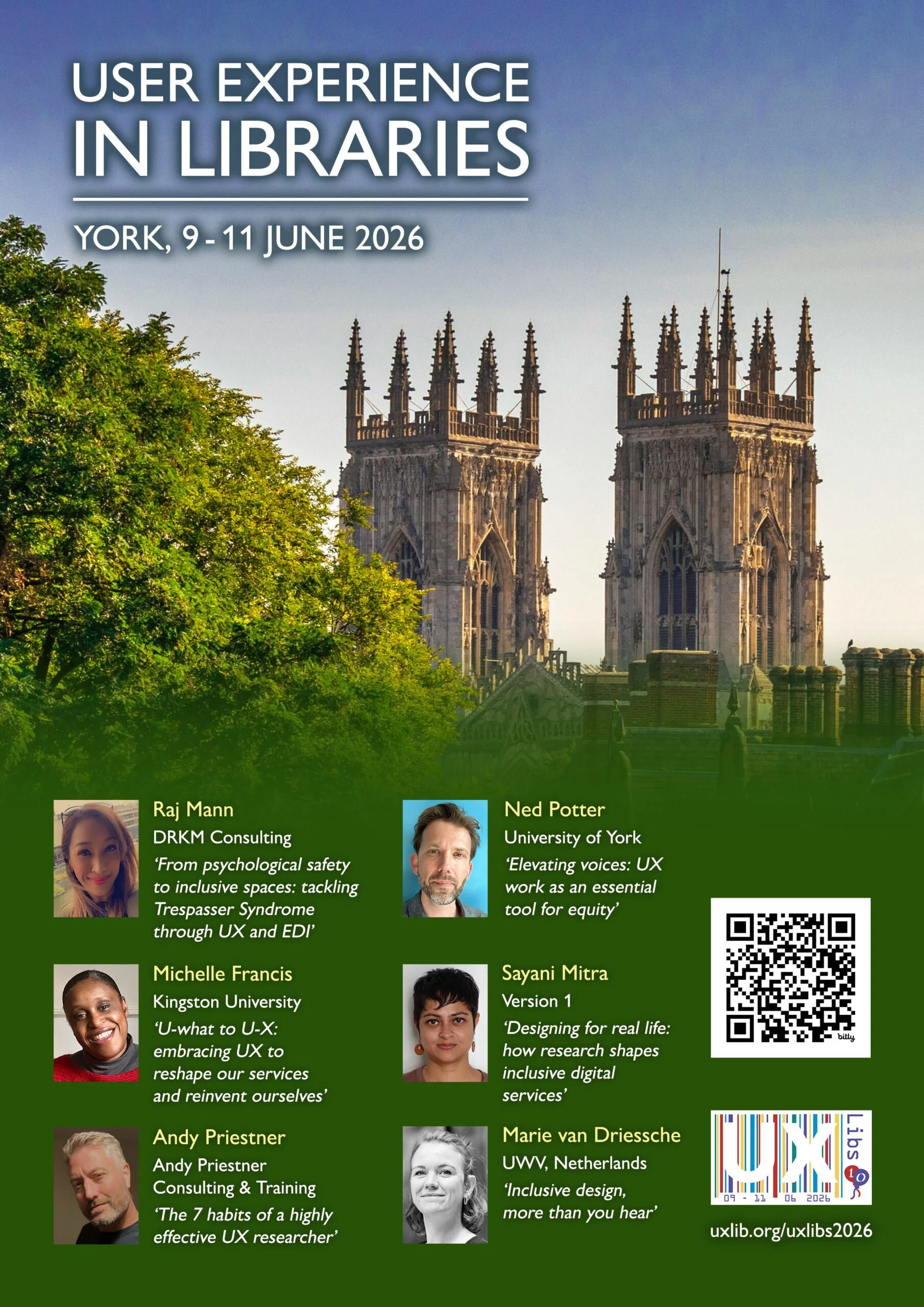
The list of speakers is fantastic, and I’m delighted Raj Mann will also be delivering a keynote: I’ve been working with her on our Inclusivity + Belonging UX Project she has been inspirational. I’ve mentioned Raj on this blog before, with regards to Trespasser Syndrome, which she’ll be talking about in her own keynote.

I have bored onto anyone who will listen about how much I love UXLibs. I attended the first one ten years ago in Cambridge, and it was revolutionary for me - learning about User Experience techniques beyond the app / web usability realm I’d previously understood was game-changing, and the conference format was incredibly innovative. A decade on and I have UX in my job title (Faculty Engagement Manager: Community + UX) and it’s a key part of my role.

I have also previously been on the organising committee of the conference for two years, so I know first hand how inclusive and forward-thinking the event is. The community that attends is usually drawn from 25 or more countries, and there’s no group of people who are more interested in the sharing of ideas. To want to do UX work you need empathy above all else, and 100 empathetic people in a room makes for a fantastic event..

If you have even have an inkling that UXLibs might be for you, I cannot recommend coming highly enough. You will learn so much you can USE, and have so much fun, and meet so many great people.

You can find full details of the conference, including booking, on the UXLibs website.

About York
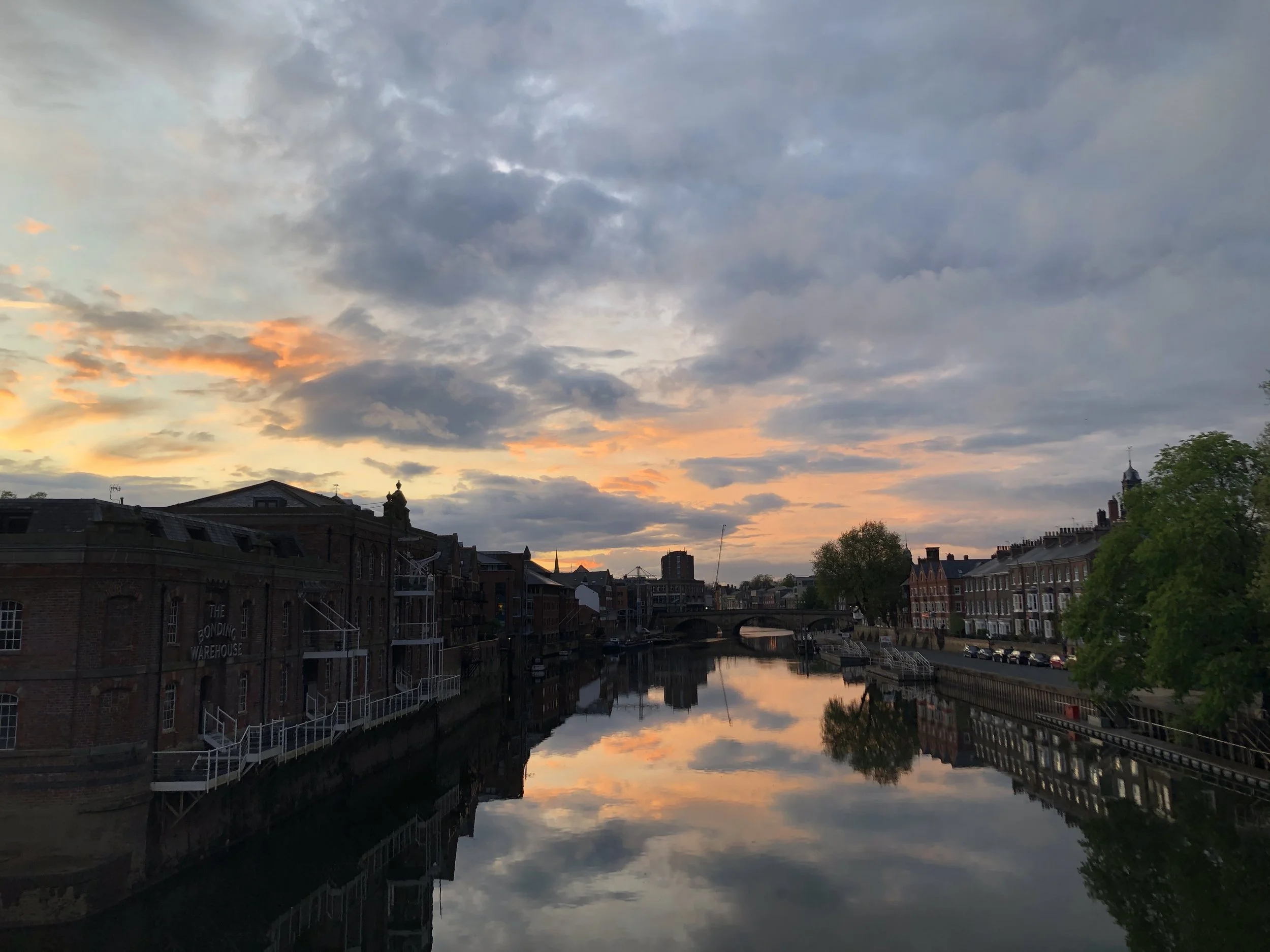
The River Ouse at sunset

The River Ouse is pretty but very floody - hopefully in June though you should still be able to walk along the path shown here.
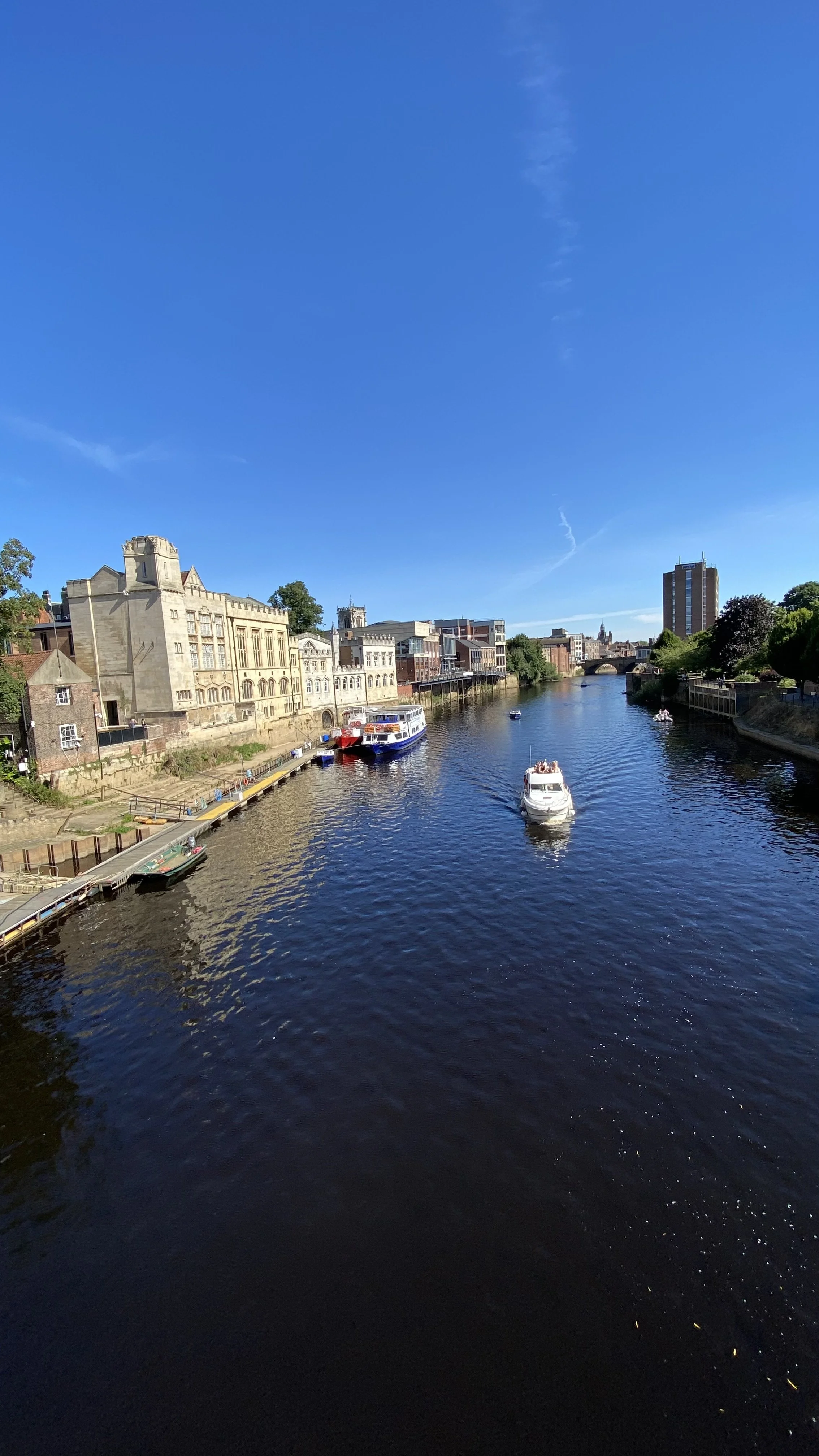
The River and the Guildhall in York

In the top right of this pic you’ll see the hotel at which the conference dinner takes place. Lovely hotel, but the exterior is unloved by the locals. The good thing about the Gala dinner being there is it’s one of the few places in York you can’t see the building from, because you’re inside it.

Former factories converted into flats above a canal-like river

The Ouse gets all the headlines but York’s other river, the Foss, is pretty great

York is tiny as Cities go - you probably won’t need to use a bus or a taxi while you’re here as pretty much everything is walkable. It’s very beautiful. has a famously large number of pubs, and some great places to eat. For anyone who wants recommendations:

  • If you want variety and you like shipping containers, Spark York has both of these in abundance. Loads of different foods in what is, by York’s standards, a very cool and happening place.

  • If you want six million inventive varieties of beer in and industrial-chic setting with some banging Korean street food, Brew York is the place to go. It’s very near Spark York so why not go directly from one to the other?

  • If you like cake, drop what you’re doing and head to Brew and Brownie immediately. Their pancake breakfast is famous but the trouble with it is you don’t want to eat any cake afterwards, and you need to eat their cakes.

  • For fabulous sandwiches head to Mannions

  • If you like cafes head to Bishy Road where there’s a lot to choose from - the Pig & Pastry and Robinsons in particular are a delight

If you’d like any more specific local tips just send me an email. It goes without saying I hope to see you there!
Posting carousels is like an Instagram cheat code in 2026

What is a Carousel on Instagram?

First things first: in Instagram terms a carousel is a single post containing multiple images or videos. They appear on the Grid, and you view the different images by swiping right.

Since mid-2023 you can add music to your carousel natively in Instagram, and doing so is absolutely crucial to success - it pushes the post into a different algorithm, ensuring it will be viewed much more widely than a single-image, music-free, regular Grid post.

Why are CaRousels so important?

The short answer is: reach.

Instagram’s algorithm has always prioritised video Reels over static images. For organisations, this often meant spending hours producing video content, or risking really low engagement and poor distribution with an image post. Reels are also less accessible than images, because there’s no built in alt-text feature for video on Instagram.

Over the last couple of years, there’s been a shift in the algorithm - Carousels now provide the reach and visibility of a Reel with the simplicity and accessibility of an image post. They bridge the gap. Your key messages can now reach massive audiences with less time, less production, and frankly fewer complications.

The proof is in the analytics

I run our institutional Instagram account - @UoYLibrary - which is a really significant part of our communication with students. I have a million and one other duties as Faculty Engagement Manager so as I noticed carousels getting more views I started to prioritise them over video content because they took so much less time to produce, not least because they can often be made using existing images I already have available to me, rather than needing to shoot new content.

The impact has been remarkable, The extraordinary thing is, even the less successful posts that don’t get the Likes and engagement I’m hoping for are getting consistently high reach and views. Meanwhile the successful ones are outstripping Reels - always the most popular format, historically - in all metrics.

2025 engagement

  • Saves: 3 of the top 5 most-saved posts were Carousels (including 1st)

  • Shares: 4 of the top 5 most-shared posts were Carousels (including 1st)

  • Likes: all 5 of the top 5 most-liked posts were Carousels

2025 reach and views

  • In 2024 our top five posts had a combined Reach of 32,095 people: only 1 of these was a Carousel

  • In 2025 our top five posts had a combined Reach of 40,228 people (a 25% increase) and 3 of them are Carousels

The most dramatic increase year on year is from Views - unsurprisingly, as if someone views three images as part of a Carousel, that counts as 3 views compared with just 1 for someone watching a Reel or viewing a single image post.

  • 2024: Our top 10 posts achieved a combined 70,099 views

  • 2025: Our top 10 posts achieved a combined 211,337 views

This represents a 201% year-on-year increase in total views. That top 10 breaks down as follows - several of these are collabs with other accounts, which is hugely important for Reach and Views too.

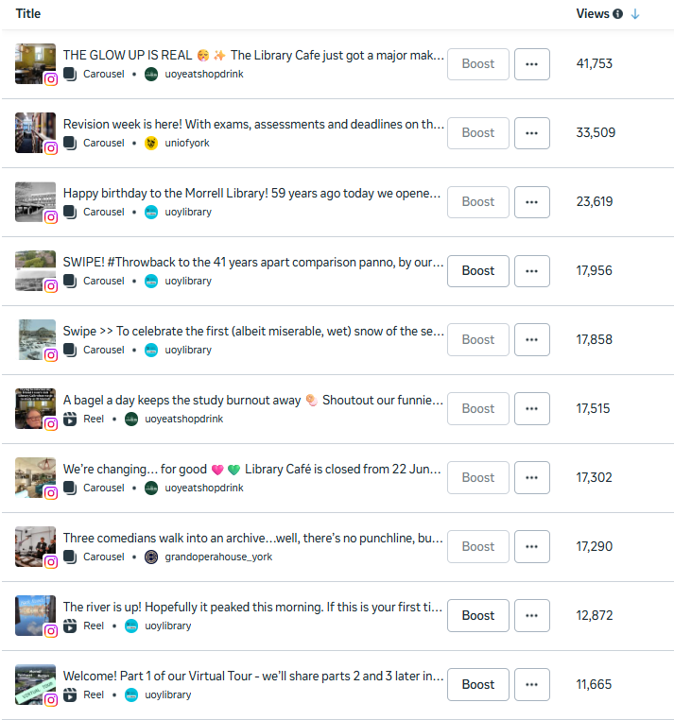
The top 10 posts on the UoYLibrary account in 2025, showing a Reach of 11,665 for the 10th, up to 41,753 for the 1st

@UoYLibrary’s 10 most viewed posts across 2025: screenshot from Meta Insights

A tale of two posts

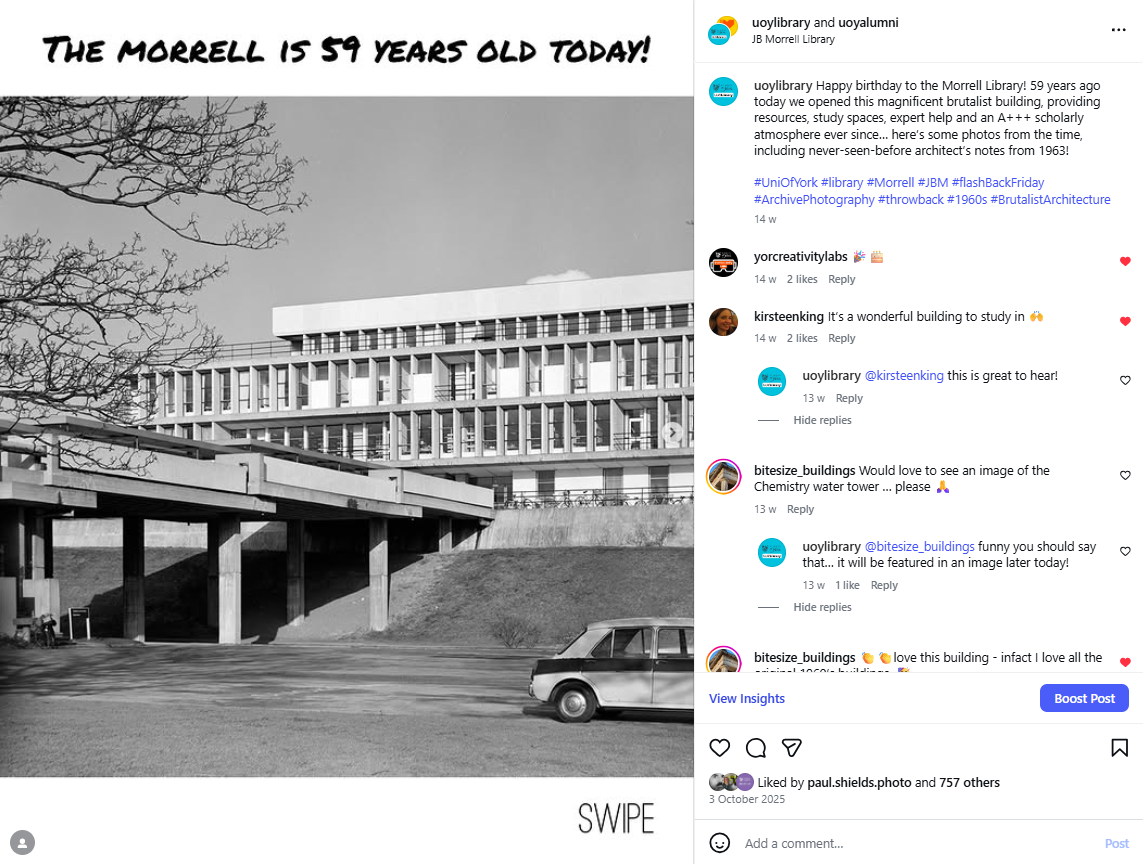
Our most successful post (that we originated, rather than were invited onto as a collaborator) in 2025 - by most metrics, albeit not Likes - was this Carousel to celebrate the library’s birthday. It reached over 9,000 people, was viewed over 23,000 times, and had over 750 Likes as well as large numbers of Saves, Shares, and new Follows.

Screenshot of Instagram post - the picture is of a brutalist library, taken in the 1960s, with 'the Morrell is 59 years old today!' written above it

The most viewed post originated by @UoYLibrary in 2025

For me though, a better example of the power of the Carousel is our least successful post of 2025. In fact in terms of engagement, it is, I think, the least successful post I personally have put on the library Instagram account in its entire history (full disclosure I looked back through six years’ worth of posts before giving up)… It got 17 Likes.

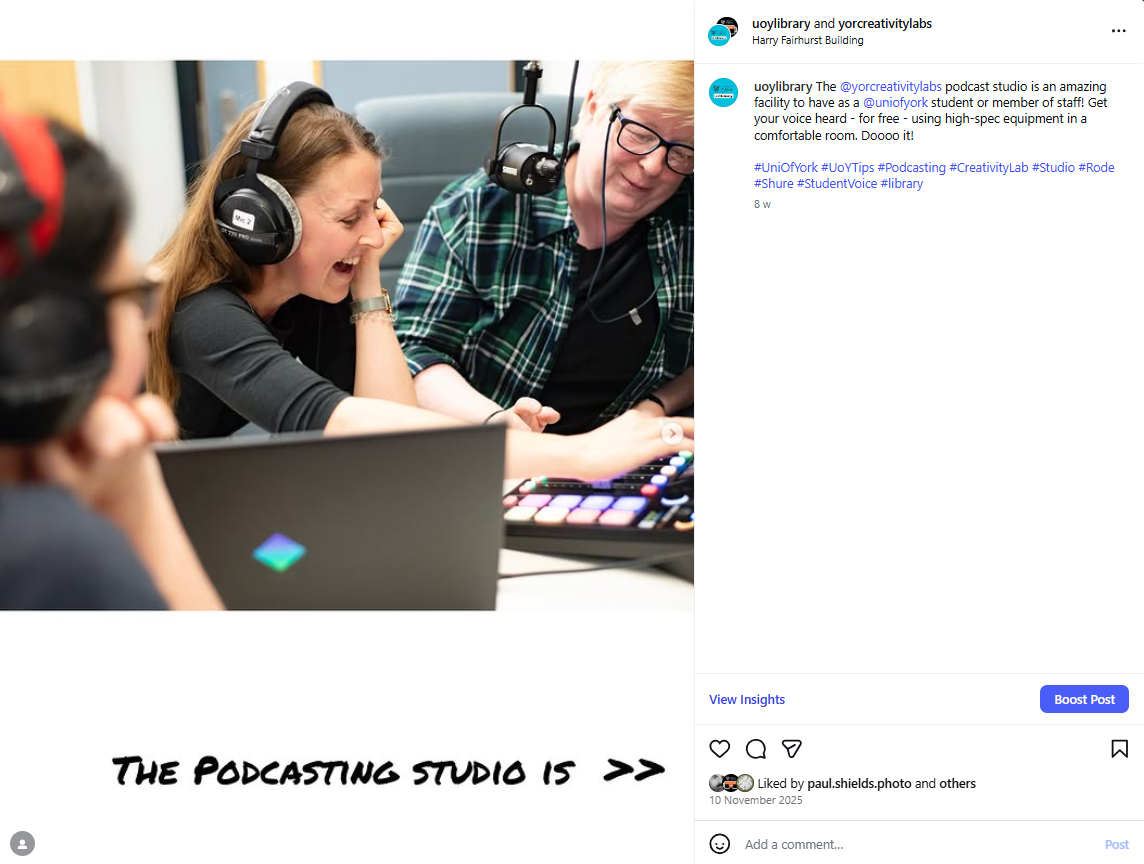
Screenshot from Instagram - the post shows three people in a podcasting studio with caption below 'the podcasting studio is >>'

@UoYLibrary’s least Liked post of 2025

Despite this total failure on my part to pitch the Podcasting Studio in such a way as to get Likes (previously when I’ve done a Reel on this it’s had much more Likes, and the TikTok version did really well too - so it’s the framing, rather than the subject matter, that’s the issue with the post above), the Carousel of it all meant it has still reached nearly 900 people and had nearly 4.5k views.

To put that in context, the post reached more people (and got 106% more views) in a week than the podcasting studio webpage did in the whole of 2025 - and that includes a spike in the webpage views caused by the Instagram post… There’s nothing wrong with the webpage - it’s just that our target audience don’t really web-search, but they scroll-search social media all day. So all in all: the habits of undergraduates x the reach of the Carousel = even an unsuccessful Insta post getting key messages out really well compared with other mediums.

Get posting

I’ll write another post soon about what works and doesn’t work with Carousels but for now I hope you’re convinced that, going into 2026 if you’re running an organisational account it’s time to plan some Carousels. In fact I wouldn’t post any individual images this year - why throttle your own reach, when a Carousel would go so much further? Get your message out to the widest audience possible, and take advantage of the cheat code while it lasts!

It might not be Imposter Syndrome... We need to talk about Trespasser Syndrome

Back in 2014 I wrote on this blog that Imposter Syndrome ran through librarianship like a vein. Writing now in 2025, I consider that a misdiagnosis.

Imposter Syndrome is defined as a psychological condition, characterised, as Miriam-Webster has it, by ‘persistent doubt concerning one's abilities or accomplishments accompanied by the fear of being exposed as a fraud despite evidence of one's ongoing success.’

The insidious thing about Imposter Syndrome is it individualises suffering. It’s not something being done to you; it’s something you ‘have’, a personal flaw that comes from within. And because the concept of Imposter Syndrome is so wide-spread, it’s easy not to question that the blame is yours.

It reminds me of the concept of ‘resilience’ as it is applied in Higher Education - the onus is on us as staff to simply become strong enough (or numb enough) to deal with any amount of stress or disruption, rather than on the institutions to try and reduce the imposition of harsher and harsher conditions.

Back in 2014, and indeed now, I was surrounded by brilliant colleagues in the profession who doubted themselves, who thought they were only ever a slip away from the big reveal that they Didn’t Belong Here, despite the evidence to the contrary. It was their ‘condition’ which meant they couldn’t see the truth of their excellence. Right?

Then in 2020, I read a brilliant article on In the Library With the Lead Pipe (consistently the most readable and through-provoking peer-reviewed journal I’ve come across), by Nicola Andrews, entitled It’s Not Imposter Syndrome: Resisting Self-Doubt as Normal For Library Workers.

I’d recommend reading the whole thing but this is the paragraph that really stuck with me:

As a Māori, takatāpui, immigrant, person of colour, and first-generation scholar, I know that libraries and academia were not constructed for my benefit; and that systems of colonization, white supremacy, misogyny, and hatred continue to operate within them and wider society. The lack of belonging I felt did not stem from a lack of self-esteem, but from the knowledge that libraries and academia as institutions never intended I belong.
— Nicola Andrews

I feel embarrassed now, that someone needed to point this out to me. I had credited my own lack of Imposter Syndrome as basically being down to a) the sense of self instilled in my by my parents and b) the fact I’d chosen the right profession for me. But of course, it has infinitely more to do with privilege: with the fact that as a white middle-class male my profession and my industry - librarianship and higher education - didn’t treat me like an imposter.

If you’re an ethnically minoritised member of staff in a University and you feel doubt concerning your abilities and whether you truly belong, I’d wager that there’s a good chance it is not the apparently capricious ‘condition’ of Imposter Syndrome - I’d wager you’ve been made to feel like an imposter. If you’re female, or from a working class background, or disabled, or are part of any other underrepresented group, and you feel like an imposter, there’s a good chance you’ve been treated like an imposter. This comes from without, not from within. And that’s not Imposter Syndrome.

(Sidenote: if you’re a white middle class man who feels doubt concerning your abilities and whether you truly belong, it’s not impossible you’ve been promoted beyond your abilities. That’s not Imposter Syndrome either, that’s actually being an imposter…)

How many cases of Imposter Syndrome are actually misdiagnosed? This matters because the term becomes pernicious when it is widely used for groups it was never intended to describe. As Dr Raquel Martin notes, the original 1970s study ‘focused on high-achieving, middle to upper-class European American women, observing how they attributed success to luck rather than their own abilities… the concept was never designed to capture the experiences of marginalised groups like black people, who face additional systemic barriers.’

Trespasser Syndrome

I’ve been working with a brilliant colleague at York, Raj Mann, on a project centred on inclusion and belonging in the library, and I’m indebted to her for introducing me to the term ‘Trespasser Syndrome’. If you’ve read this far and you agree with most or all of what I’ve said above, you’re probably already nodding your head in recognition at how much this new framing improves upon the old framing. It’s not that Imposter Syndrome doesn’t exist - it’s that in so many cases, it is misapplied: in fact the person is made to feel like they’re trespassing in a space simply not intended for them.

I believe the term ‘Trespasser Syndrome’ was coined by Dr Arin N. Reeves, in 2022. I’d recommend reading all of her article Is It Imposter Syndrome or Is It Trespasser Syndrome? - here’s a key quote:

People from underrepresented groups are not afraid that they are imposters; they are afraid that the majority groups won’t see them for who they are and won’t welcome them if they do see them. These fears are not the fears of imposters; they are the fears of trespassers.

A trespasser is someone who enters spaces they are not supposed to be, where they do not belong. A trespasser isn’t afraid of being discovered for who they really are; they are afraid of being treated like they don’t belong where they are.
— Dr Arin N. Reeves

What we do about it?

Language and nuance matter, so let’s stop misapplying the term Imposter Syndrome to situations where individuals and groups are being treated like imposters. It’s never good perpetuate harmful language, whether intentionally or not. Reeves advises us to ‘Use “imposter syndrome” when it’s relevant. Differentiate it from “trespasser syndrome” to honor the realities of succeeding in spite of not belonging.’

More than that though, we need to interrogate examples of Imposter Syndrome. If someone you work with says they have it, or describes its symptoms, we need to do more than nod and smile and say ‘I know how you feel’ - we need to work out why they’ve been made to feel like an imposter, and whether we can do anything to change that. How can we create environments that support under underrepresented groups, and dismantle the systems which tell people they don’t belong?

I’ll leave the last word on this to someone much more qualified to talk about it than me. Raj has in fact organised the first ever Trespasser’s Conference as part of her role at YCEDE (the Yorkshire Consortium for Equity in Doctoral Education) and during her keynote address she said this:

For those of you here today who support racially minoritised staff and students, ask yourselves: have I provided people with the tools they need to be able to thrive in the space? If not, what else do I need to be doing? Instead of helping underrepresented groups to walk past the metaphorical ‘no entry or ‘no trespassing signs,’ instead pull down the sign before they get there, have a comfortable seat ready for them: don’t just applaud the courage and grit on getting there.
— Raj Mann

New video: library social media in a post-twitter world

Earlier this year I spoke about the social media landscape for public libraries in particular, at the Edge Conference in Edinburgh. It was a great room full of interesting and passionate people, and one of those slightly intimidating setups where you’ve got no laptop in front of you, just a TED-talk style presenter screen facing you from the floor below the stage…

The talk was filmed by prettybright.co.uk (more on which below) and they kindly gave me the footage, to which I’ve added a real-time screen-record of me doing my slides.

There are two reasons I want to share this here. Firstly it gives a pretty up to date state of play on library social media (and although it is public library focused a lot of it applies to other sectors too) and encapsulates a lot of key tips and approaches I feel really passionately about. I really enjoyed the take-aways from my talk (and others) in Dr Mary-Ellen Lynn's review of the event here.

Secondly it will give people an idea of what you get if you book me for a talk, and this particular presentation is a sort of microcosm of the social media workshops I run, minus the activities. When I speak at a conference I’m actively trying to flatten the hierarchy between speaker and audience - I want it to be as much a conversation as possible. I want to focus on ideas that can lead to actions. I want people to feel included, and reassured, as well as inspired to do things differently afterwards. Anyway: if you want to me to talk at your event or run some training, get in touch!

Shownotes:

1) Prettybright really helped me out here. They’d already uploaded a version of the talk to Vimeo but it had minor formatting issues with the slides and I wanted to be able to chop the talk up into shorter chunks (e.g. for sharing a section on LinkedIn) so I asked for the original footage, without realising how much work this would entail at their end. They had to shrink down and colour-grade the original broadcast quality footage from a giant 113 gig file and I’m really grateful to Howard Elwyn-Jones and his colleague Louisa for going above and beyond to do this for me.

2) In the section about Insta I mention ‘the Paisley presentation’ as being filled with the kinds of images that would work really well on that platform: that was in reference to Stephen Slevin’s talk which you can see here

3) At the end I mention handing over to my also Yorkshire-based colleagues: those were Jen Boyle and Rachel Ingle-Teare whose brilliant talk you can view here, about Leeds Libraries

4) The other talks from Edge are all on prettybright’s Vimeo too

5) I delivered a talk in Dublin about social media from the academic library point of view - this was also filmed (albeit just via Teams for the hybrid event, rather than on high quality gear): view Rebuilding the library community here

6) While I was at Edge I also judged a library innovation competition, which I found completely inspiring - I wrote about the winning and highly-commended entries here

How many hashtags is too many hashtags?

I just ran a social media workshop in which one of the brilliant attendees posed this age old question:

We’ve been having a huge debate about using hashtags. Are they still a thing? Should we be using them?
— Catarina

As I answered I realised I have a pretty definitive idea about not just whether we should be using them - yes - but also how many we should be using, which varies wildly by platform. So if you do social media for your organisation or otherwise create content, and you’ve ever asked yourself how many hashtags is too many hashtags, read on!

Three disclaimers before we start:

  1. Hashtags are the cherry, not the cake. The content of your post is waaaay more important than the tags - but using hashtags well WILL improve your posts’ discoverability.

  2. It’s more important to use the right hashtags, than the right number of hashtags. What is going to help people discover your post? What do people who need your content search for? Hint: adding a universally used hashtag (like #love for example) simply won’t do anything positive. If everyone uses the same hashtag, your post joins an almost infinitely long queue of other posts. Aim for the sweet spot between high volume hashtags that everyone uses, and low volume hashtags that no one will ever search for. For the librarians and archivist out there: hashtags are basically metadata!

  3. The info below is really just my views, as of late May 2025, built on my own experience and reading others’ research, rather than the ‘right’ answer… Use this as a jumping off point and conduct your own experiments!

How many hashtags should I use on TikTok?

Use 3-5 hashtags on TikTok. Recently TikTok started limiting users to five hashtags, so this one is easy. Ignore the super-cool TikTok accounts that use no hashtags at all, or the desperate accounts that use generic like #fyp #ForYouPage and #viral. 3 to 5 hashtags on TikTok will help the algorithm push your content in relevant directions -any more and it will basically get confused… Remember, the majority of TikTok posts are seen by people who DON’T follow the accounts posting them - so use every advantage available to you to get eyes on your videos.

How many hashtags should I use on Insta?

Use 5 hashtags on Instagram. I’ve had to update this one since I originally wrote this post… I used to recommend a higher number, because of a study which looked at 38 million posts and found that 11 was the optimum number of hashtags. However Instagram has now imposed a limit of five per post, so that’s what we all have to work with. Finally - and this is really annoying but everything I’ve read confirms it’s true - don’t use the same ones for each post. You need to mix them up a little, and avoid two posts in a row with the same tags. Gah.

How many hashtags should I use on Facebook?

Use 0 - 2 hashtags on Facebook. Hashtags are less important on FB than on TikTok or Insta, but they can help your post show up in searches. Don’t crow-bar them in, but take opportunities to use them organically in your posts.

How many hashtags should I use on Bluesky / Threads?

Use 0-2 hashtags on Bluesky, and Threads. You don’t have to use any at all, of course. The way hashtags are used on these platforms is more like a form of curation - for clicking on and finding related posts, rather than particularly for search. On Bluesky using certain hashtags will also push your post into certain custom feeds - be careful not to abuse this by over-using them!

How many hashtags should I use on YouTube?

Use 3-5 hashtags on YouTube. YouTube is interesting in that it works completely differently to all other platforms listed here: for a start, it has a seperate ‘tags’ section when you upload. Here you can put all the tags you want to help with discoverability, and they won’t be readable by other people - they just help with searching. So use this freely and fill it right up. Secondly, you can put hashtags in the description - or you can put them in the title. With YouTube shorts in particular, putting a hashtag in the title - IF it’s something people will likely be searching for - can be really beneficial. Thirdly, if you use too many hashtags in the description or title, YouTube literally ignores them completely. So don’t do lots! One or two max in the title, and a couple more in the description, should do it.

How many hashtags should I use on LinkedIn?

Use 1-4 hashtags on LinkedIn. A haphazard approach doesn’t work well here: use one or two tags which are specifically relevant to your industry and your post (and avoid the generic, overused cringey ones like #productivity…).

How many hashtags should I use on X?

It doesn’t matter. Just get off it. You’ll feel so much better.