Conferences & Events

Elevating voices: UX as a tool for equity

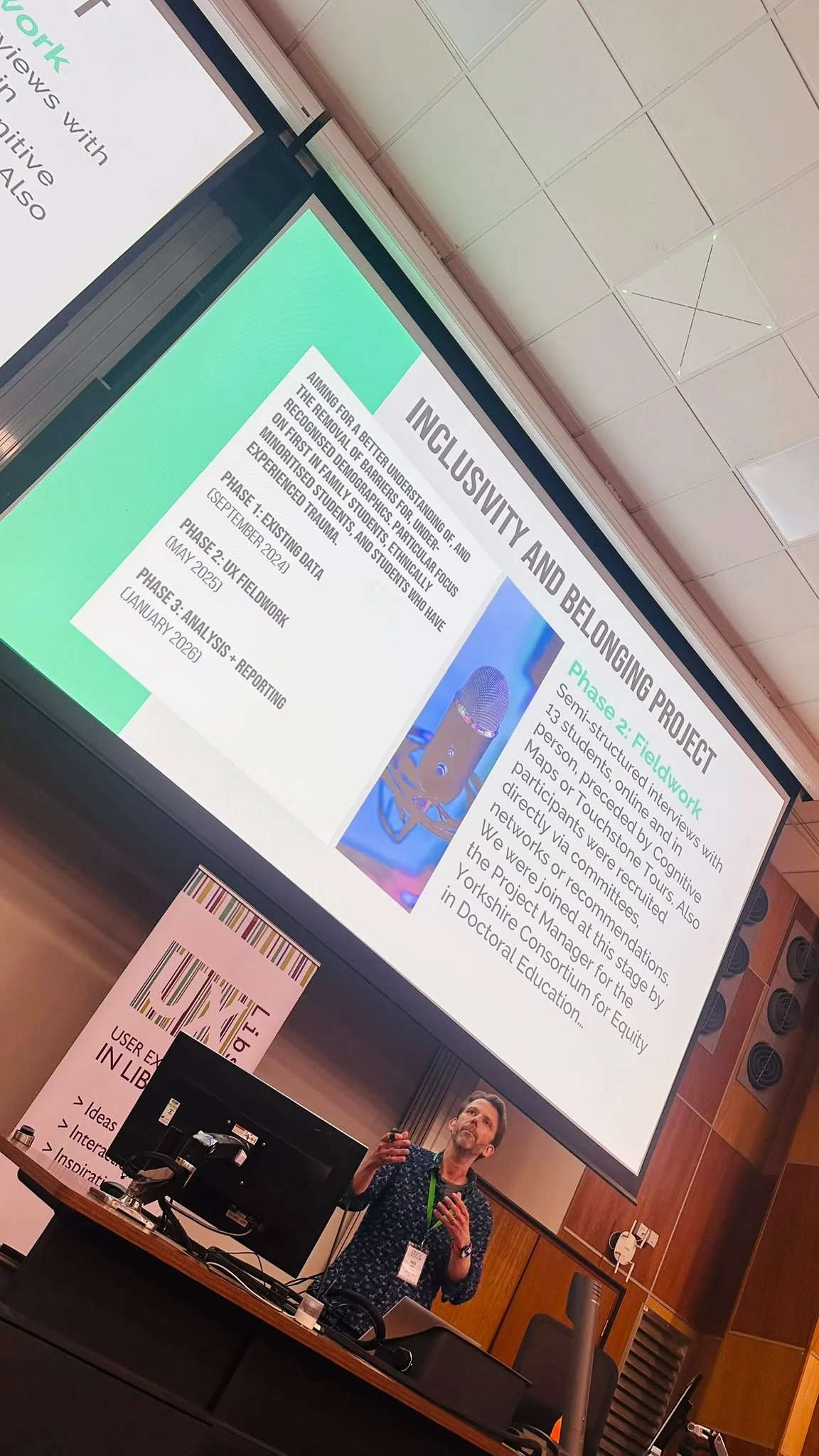
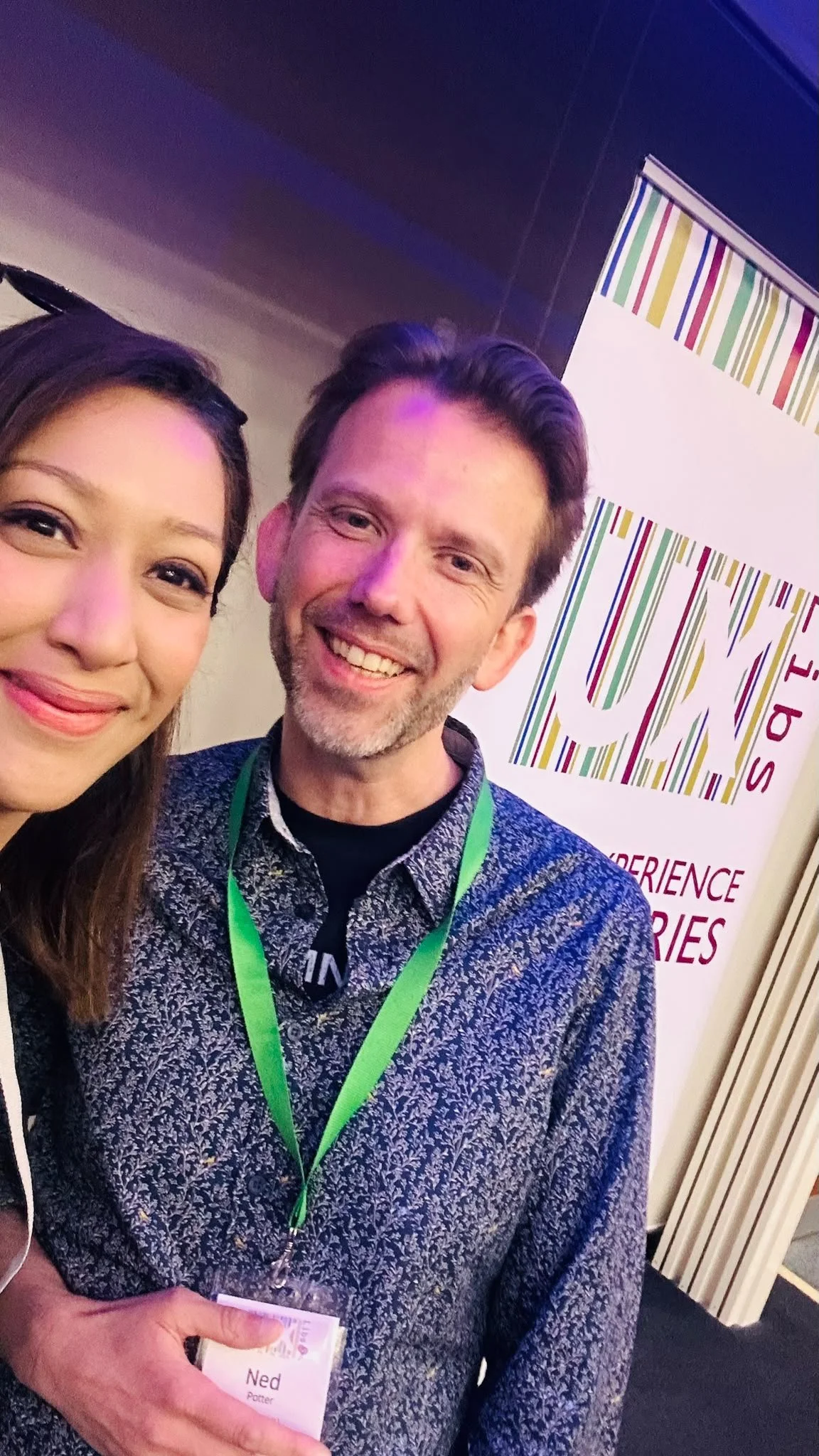
Today I am honoured to give a keynote at UXLibs 10, the User Experience in Libraries Conference. Below is a version of my slides, and then I’ve linked to several relevant articles and reports covering things I discussed in the talk, finishing with highlights from my report on the Inclusivity and Belonging UX project at the University of York.

The presentation

My slides are embedded below and available on Slideshare here.

The abstract

Higher Education is facing financial crisis. When budgets tighten, services often shrink to fit the needs of the majority, and ‘maintaining core services’ can easily become a proxy for exclusion. By designing for the ‘typical’ user – those with the fewest barriers and the most flexibility – we inadvertently sideline marginalised groups with complex needs.

This keynote positions UX work as an essential tool for equity, with a five point manifesto. We will explore how libraries can represent the under-recognised, elevate diverse perspectives and ensure our institutions remain inclusive, authentic spaces for everyone.

Recruiting for diversity

An absolutely essential part of my UX manifesto is to recruit as diverse a group of fieldwork participants as possible, rather than taking a first-come, first-served approach, or trying to achieve a representative sample. Your service will be more inclusive if you design it to meet the most needs, rather than for the most people. I cover this and several other aspects of communication around UX in ‘Communicating the benefits of UX to everyone who needs to hear it’ in the User Experience in Libraries: Yearbook 2024 edited by Andy Priestner and Marisa Martin (2024) - the Open access version available via White Rose Research Online here.

Three rounds of five, and getting UX done

A really effective structure for UX projects is to interview 15 participants, split over three rounds of five people each. The first round is generative, the second round is for prototyping, and the third round is evaluative. This process is covered in more detail, along with some advice on how to advocate for UX and get it done at your institution, in ‘Ask not what your organisation can do for UX; ask what UX can do for your organisation,’ in User Experience in Libraries: Yearbook 2023, edited by Andy Priestner (2023). The Open access version of that is available via White Rose Research Online.


The Inclusivity and Belonging Report

Throughout my talk I referred to a recent UX project at the University of York, entitled Inclusivity and Belonging. The report was written for use within the University and it wouldn’t be appropriate to share all of it - however, below are some highlights, with the quotes from participants removed.

Executive Summary

Our spaces help shape the daily experiences of our users, and should reflect the communities that use them as far as possible. This project originated from the need for better data on the library experiences of students from smaller, under-recognised demographics. We have consistently prioritised diversity in participant recruitment for previous User Experience (UX) projects, but rarely have we made that diversity the focus of the project itself; while we have made good strides in specific areas relating to inclusivity, there are many groups outside the ‘typical’ York student, who face barriers to service use which we could potentially remove. In particular we wanted to focus on the experiences of first-in-family students and ethnically minoritised students, and to make the library a more trauma-informed service, as part of this project. There was intersectionality here among our participants, both in terms of class and race, and in terms of neurodiversity.

Key findings and observations

The Library is widely regarded as an inclusive environment, but this perception is carried by the interpersonal skills of our staff, our communication online, and specific initiatives (such as the Sensory Rooms or Family Study Room) - rather than the building itself.

  • Staff are a key part of inclusion. Students frequently praised the approachable and welcoming nature of library staff, especially in the Customer Services Team. In general, the library's approach to inclusion and belonging is actively noticed, and appreciated.

  • Elements of the physical environment - often beyond the library's control - actively work against inclusion. Several safety features required by the University - such as the turnstiles, high-intensity lighting, and glass-fronted study rooms - act as signals of exclusion for marginalised groups. In contrast, spaces like the Spring Lane Building are perceived as more inclusive despite being unstaffed: this is attributed to the absence of turnstiles, more thoughtful lighting, and flexible furniture configurations. However, those spaces do not foster a sense of belonging in the same way the library does.

  • Louder study spaces are important. Students from marginalised groups often feel exposed or scrutinised as they move through University spaces. Silent or very quiet study areas heighten this feeling of hyper-vigilance, whilst louder, Studious Buzz areas help to reduce the exposure, helping students feel more at ease. (This is a key reason one of the outcomes of this project, the Ethnically Minoritised Author Showcase Space, is located in the Fairhurst rather than the Morrell.)

  • Students from marginalised groups experience information gaps. We know from the 'York Risks' work from the No Gaps Project that 'Without a sense of belonging, students may feel isolated, excluded and marginalised, leading to lower engagement in learning, support and university life.' Students from working-class or ethnically minoritised backgrounds often operate under a constant state of "decoding" the university environment. This cognitive overload leads to missed opportunities within the library - such as students unnecessarily purchasing books, failing to seek help, or overlooking available services.

Outcomes and recommendations

This report details findings across 8 key themes and offers 19 recommendations. Rather than waiting for the publication of this report to take action, we adopted an iterative approach. As a result, over half of the recommendations are already complete or well under way.

Methodology: a UX-led approach

User Experience

As with all major projects, we based our approach around User-Experience (UX) methodologies. The best way to hear from students is not through focus-groups or surveys but through one-to-one conversations. The data we get from a semi-structured interview is so rich that only a small sample size can yield incredibly useful - and actionable - insights.

Project Overview

The project began in September 2024. Phase 1 focused on existing data: we met with around 10 staff from around the University to assemble perspectives and documentation from related studies. Phase 2 was the UX fieldwork, beginning in May 2025 and running until January 2026; we spoke to 13 students recruited directly, via channels such as Step Ahead or recommendations from relevant staff. Phase 3 - thematic analysis and reporting - began in January and ended in April 2026.

The project group consisted primarily of Ned Potter, Clare Ackerley, Martin Philip and Olivia Else, all from the Faculty Librarian Team, and we benefited from three later additions to the group. Raj Mann (who was at the time Project Manager for the Yorkshire Consortium for Equity in Doctoral Education) joined us for two months of the project, bringing invaluable expertise on many pertinent areas including providing a safe environment for interviewing students on potentially traumatic subjects, and introducing us to the term Trespasser Syndrome (more on which below).

Sarah Lapacz and Emanuela Buizza from the Customer Services Team joined up after most of the fieldwork was conducted, to help with thematic analysis and recommendations. Having their perspective and fresh eyes on the data was really valuable, and I'd recommend this approach of involving new people at the analysis stage for future UX projects going forwards.

A note on terminology

We use the term under-recognised groups rather than under-represented groups, which is the phrase we typically see used in the University. Even though it is almost always not intended this way, there is an implication with the latter term that the onus is on the marginalised person to represent themselves better, whereas of course the reasons for under-representation are systemic and institutional.

We use the term ethnically minoritised students rather than BAME or Black, Asian and Minority Ethnic students, based on advice from specialists in Diversity, Inclusion, Equity and Belonging. This framing highlights the fact that Black and Asian students' minority status at the University is an active, systemic process, rather than a static identity. Talking about 'BAME students' also risks implying a homogonisation of very diverse experiences.

We use the term Trespasser Syndrome where the University often used the term Imposter Syndrome. Imposter Syndrome individualises suffering: it’s not something being done to you; it’s something you ‘have’, a personal flaw that comes from within. But students from marginalised groups are made to feel like outsiders by the University - that comes from without. To quote Dr Arin N Reeves: "People from under-represented groups are not afraid that they are imposters; they are afraid that the majority groups won’t see them for who they are and won’t welcome them if they do see them. These fears are not the fears of imposters; they are the fears of trespassers."

Findings

1) Standard library environments can be exclusionary to marginalised students.

Large, bright, open study areas (such as Morrell Floor 1 or the Burton) are perceived as overwhelming and high-pressure spaces.

It was notable that this was the one area in which ethnically minoritised students, first in family students, students who have experienced trauma, and neurodivergent students all reported similar experiences and issues: the discomfort that comes from feeling observed ("it's just eyes and heads"), or 'taking up someone else's space' in an environment in which they already feel like a trespasser.

2) Bright fluorescent lighting is a source of overstimulation, especially for neurodivergent students. We know from previous UX projects that students want controllable lighting (such as desk lamps) or dimmer zones within the library - this was further confirmed in the fieldwork here. The natural light from windows is appreciated, but strong internal lighting is not.

3) There is a demand for semi-enclosed "micro-spaces". Students want the comfort and privacy of a "little house" while remaining in a public study environment rather than in an isolated area where they feel vulnerable.

Student needs are not as straightforward as wanting to study in busy areas, or quiet areas, or secluded areas. They require different combinations of good sight-lines, whilst not being overlooked; being private whilst not being isolated; feeling not just more scholarly but more inspired than they would at home.

4) The Hidden Curriculum causes financial stress in the library context. The hidden curriculum a wider issue across the University, but in the library it manifests in students not knowing that textbooks are available for free or that online copies exist, leading to unnecessary financial worries. There is also a lack of understanding around borrowing, returning and requesting books which is exacerbated for any students who feel othered or like they don't belong, as they're less likely to seek out help for their problems.

5) The lack of a quiet, segregated prayer space within the library is a functional barrier to long-term study for Muslim students. We know there are many reasons why a prayer room is not currently possible in the Library - however it continues to be raised in the research, every time we speak to students, even if we don't ask about it. Any student needing to pray during their study faces a stark choice - the discomfort of public, overlooked prayer in the library, or losing time (and potentially their study space within the building) by needing to travel to a prayer room elsewhere on campus.

6) Inclusion and belonging can come from exhibitions and events in the library. When we asked what could make the library more inclusive, several students talked about events or exhibitions as being key to seeing themselves (and those of other cultures) in the space.

7) The library is considered a diverse space. The majority (though not all) of ethnically minoritised students we spoke to considered the student body who use the library to be relatively ethnically diverse.

However it was notable that working class students are keenly aware of how many private school educated people are in the wider University. Several mentioned feeling othered by this.

8) Library staff are considered open, helpful and approachable. Many students report positive interactions with library staff, including ethnically minoritised students who have not had positive experiences elsewhere on campus. This is a real strength in the library which we should continue to build on.

For many of our participants, asking for help at all is significant. We need to continue to encourage and reward help-seeking behaviour at all times, and to foster non-direct forms of communication - students told us they'd prefer to DM on Instagram than speak to a member of staff face-to-face when seeking help, for example.

As mentioned in the executive summary, it is my belief that the staff of the library go a long way towards mitigating the more exclusionary aspects of our buildings and services, and are a key part of why we are widely considered to be a very inclusive space within the University.

Recommendations

There were 19 recommendations, many of which are complete. A selection are mentioned below.

  1. Ethnically Minoritised Author Showcase Space (completed): This collection was suggested by Raj Mann as a way to celebrate ethnically minoritised authors and make the library a more inclusive environment. It began with the purchase of around 500 books, and rather than selection being driven by the library each item was a recommendation from students or staff at the University. To ensure these books remain accessible throughout the library, we purchased dedicated copies specifically for this room rather than moving existing stock. There is a QR code in the room where students and staff can suggest additional purchases for the collection: these are reviewed twice a year in Collections Community.

  2. Add tags to study spaces in LibCal to aid students affected by trauma in choosing where to work (completed): The LibCal booking system now has additional checkable boxes when searching for study spaces. These allow you to filter the spaces and, for example, show only spaces with good sightlines, or spaces where you're seated with your back to the wall.

  3. Add blinds to study rooms to allow privacy for prayer (completed): we have had bespoke blinds fitted to two Morrell bookable study rooms (on Floors 1 and 2) to allow students privacy to pray

  4. Offer bespoke Library Tours for relevant Student Communities particularly First in Family groups

  5. Introduce more cultural event programming within the Library buildings. We will also explore offering LFA/144 as a safe, warm, well-lit event space for EDI+B related events at evenings and weekends, for student groups and societies.

  6. Better promotion of money-saving and no-cost services in the Library ideally in collaboration with Central Comms channels where possible

  7. Expand the glossary of library terms (in progress): our current glossary is focused on library terminology: we want to expand this to cover more colloquial and idiomatic territory, to help those adapting from other countries. Will include English and Yorkshire based expressions, as well as the usual definitions of library jargon such as 'quartos'.

Conclusions and future work

This project has taken a year and half to explore the experiences of several communities, and this has been extremely successful. However, in the future we aim to undertake smaller UX projects with specific communities to understand their needs better. This more agile approach would see us undertake three projects (interviewing 5 participants each rather than 15) each year, focusing on one group at a time.

The Library must continue to be an exemplar across campus in investing in, and genuinely believing in, inclusivity. The user voice is key to this, and this project has shown how valuable it is to continually undertake research directly with the student (and staff) population to inform our decisions.

We need to work to mitigate some of the systemic issues beyond our control. We can't solve all the problems we identified, but our experience from previous UX projects has shown people really appreciate any efforts to reduce the impact of the issues - see for example providing blankets because we don't have the ability to make our buildings warmer. What are the blanket equivalents for the issues identified in this project?

We need to ensure that designing for the typical York user doesn't become a proxy for exclusion. When budgets tighten, services often shrink to fit the needs of the majority: when we design for those with the fewest barriers and the most flexibility we can inadvertently sideline marginalised groups with complex needs. UX projects like this one are an essential tool for equity, elevating diverse perspectives and ensure our library remains an inclusive, authentic spaces for everyone.

Ned Potter, April 2026

Ten tiny tips for preparing a talk

I love prepping a talk, which is what I've spent the last few days doing ahead of my keynote at #UXLibs 10s today. Here are some things I've found helpful in the process.

1) Get your ideas down first; sort the visuals later. Think of it like building a house - you lay the foundations and see the walls are going before you pick furniture and colours... Sometimes the content can dictate the style, too.

2) Make a version with everything you want to say. Don't worry about timings or length at this stage.

3) Practice, out-loud, like you mean it. You cannot practice a talk in your head - you'll unknowingly take shortcuts and find yourself facing a slide on the day and not knowing how to actually express yourself. To get the language right you need to do it at full volume, as some things (especially colloquial phrases) just don't work when you're projecting your voice.

4) Time the your talk. The chances are it'll be long; that's fine. It's easier to make it long and work out what to cut, than it is to try and make it the right length in the first place where you might accidentally leave out more impactful themes or framings.

5) Get it the right length, then cut another 10% off anyway. Things always tend to go longer than you think at conferences. Or maybe there's a tech issue, or the host's intro takes too long. It's better to be too short than too long, because the latter eats time from other speakers. So if you have a 40 minute slot, prepare 36 minutes; for a 10 minute slot, prepare 9 minutes, etc.

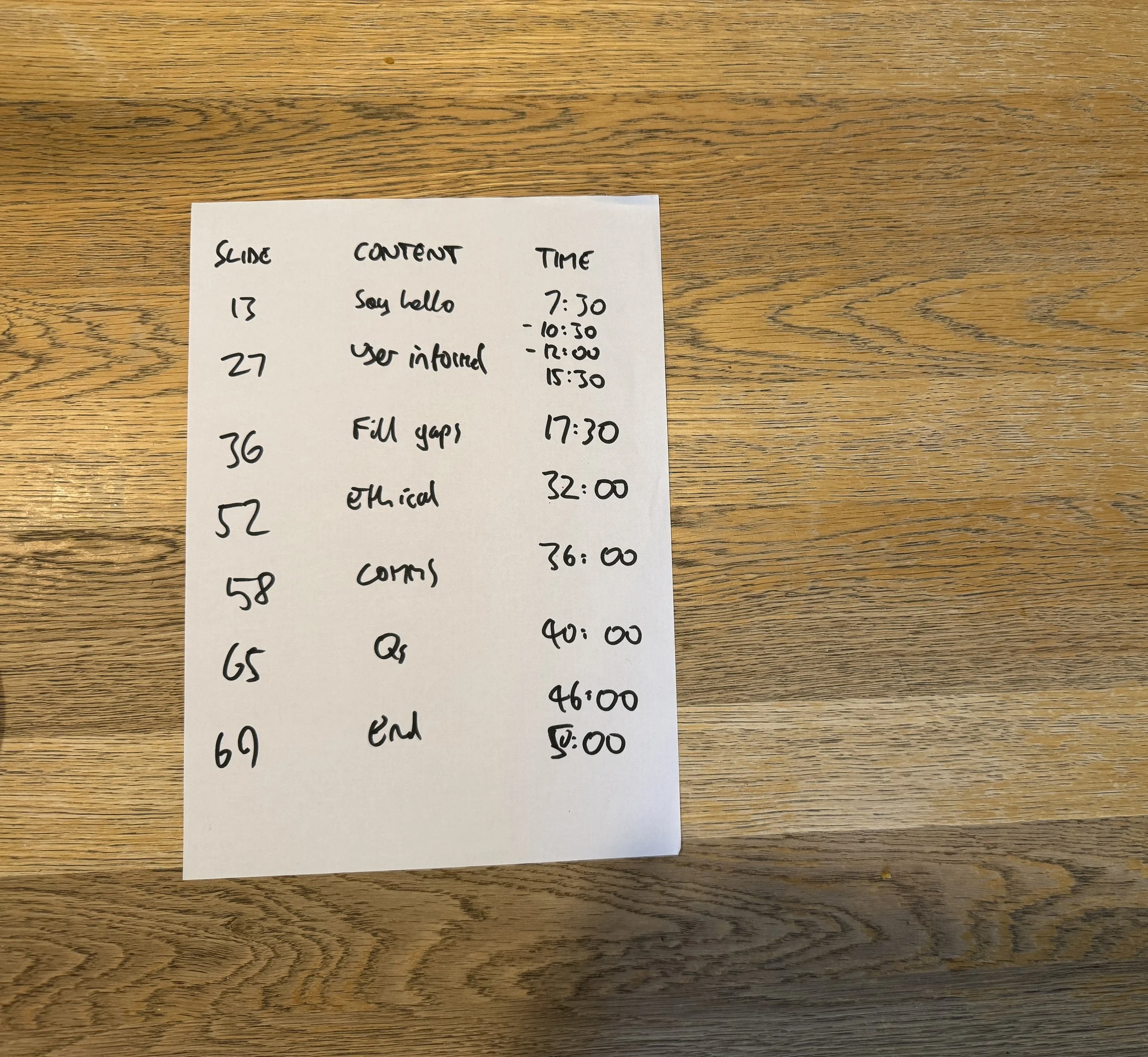
6) Run it one more time, and note the key timings of where you'd expect to be for each section. I've posted a picture of mine below (forgive my handwriting). The idea is if I get to, say, slide 36 and I'm already on 20 minutes, I'm going long and need to tighten up and compensate. This is a *really* useful piece of paper to have in front of you in a talk.

Sheet showing talk timings, e.g. Slide 52, 32 minutes in

7) Don't put questions right at the end. I think it's better to put questions 5 minutes before the end, then answer the questions and do your final summing up - end the talk on your terms.

8) Add the alt-text (assuming your slides will be shared afterwards). I use a lot of boxes as part of my slide design, and it takes a while to mark them all as decorative, describe my graphs etc.

9) Make a sharing version. The slideshare edition of my slides may have slightly more text on, and I'll have hidden slides which don't make sense without any context, before saving the PDF.

10) Save it to a stick, save it to your laptop, AND upload it to the Cloud... That should cover almost any eventuality!

If there are any tips would you add, let me know in a comment! The next post on here will be my slides and relevant links from the UXLibs talk. I love running Presentation Skills training and workshops, so if you’d like to book something bespoke for your organisation, you’ll find details of what I offer and feedback from previous workshops towards the bottom of my Training page.

UXLibs 10

You are about to read a blog-post devoid of nonchalance or professional cool… Because this summer I am delivering a keynote speech at my favourite conference of all time, User Experience in Libraries, on its 10th anniversary, in my home City of York.

I am completely thrilled about this!

UX as a tool for equity

My talk is entitled Elevating Voices. Here’s the summary:

Higher Education is facing financial crisis. When budgets tighten, services often shrink to fit the needs of the majority, and ‘maintaining core services’ can easily become a proxy for exclusion. By designing for the ‘typical’ user – those with the fewest barriers and the most flexibility – we inadvertently sideline marginalised groups with complex needs.

This keynote positions UX work as an essential tool for equity. We will explore how libraries can represent the underrepresented, elevate diverse perspectives and ensure our institutions remain inclusive, authentic spaces for everyone.

I feel really passionately about this subject, and I can’t wait to explore it and share some of the work we’ve done at York.

About the conference

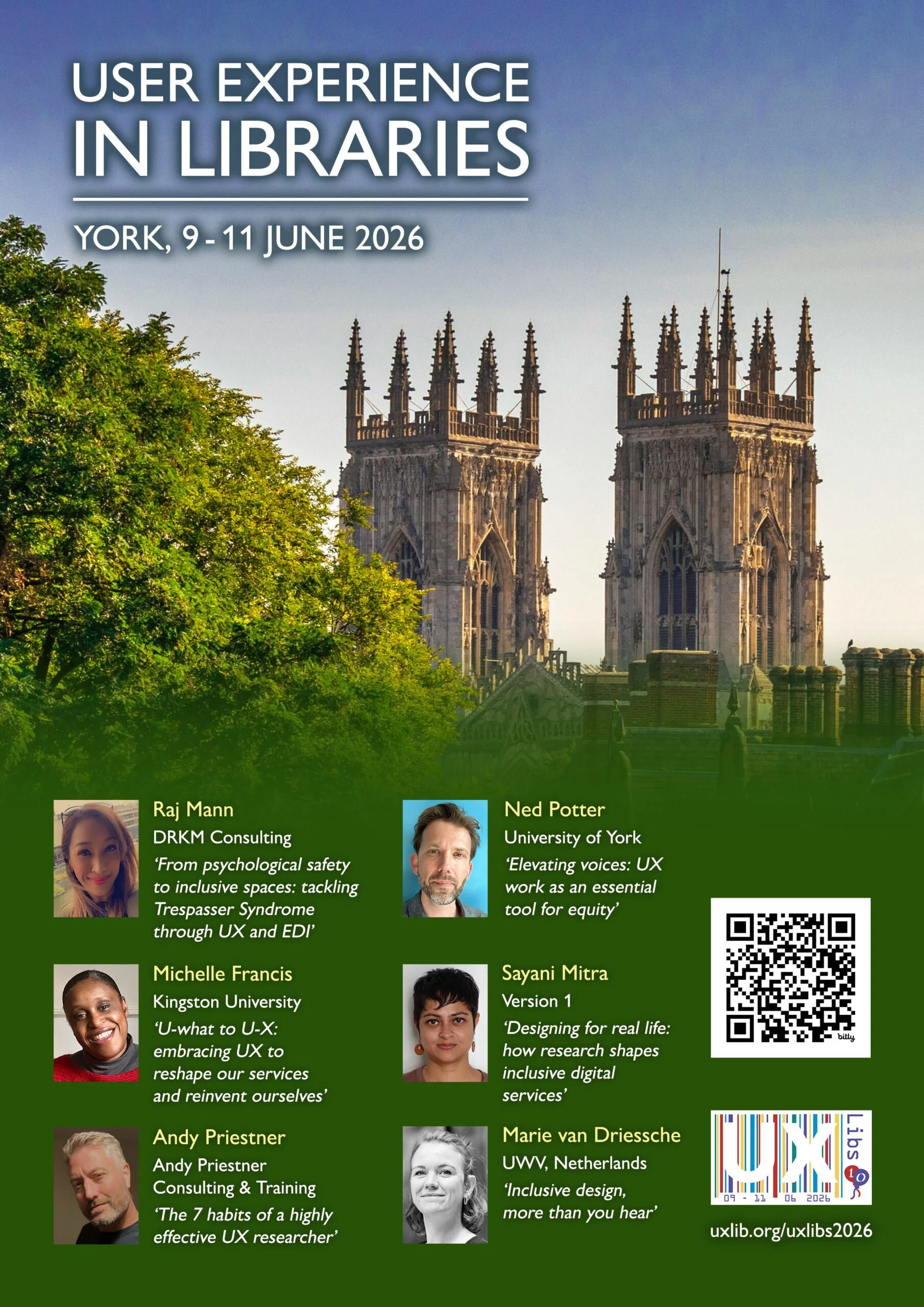
The list of speakers is fantastic, and I’m delighted Raj Mann will also be delivering a keynote: I’ve been working with her on our Inclusivity + Belonging UX Project she has been inspirational. I’ve mentioned Raj on this blog before, with regards to Trespasser Syndrome, which she’ll be talking about in her own keynote.

I have bored onto anyone who will listen about how much I love UXLibs. I attended the first one ten years ago in Cambridge, and it was revolutionary for me - learning about User Experience techniques beyond the app / web usability realm I’d previously understood was game-changing, and the conference format was incredibly innovative. A decade on and I have UX in my job title (Faculty Engagement Manager: Community + UX) and it’s a key part of my role.

I have also previously been on the organising committee of the conference for two years, so I know first hand how inclusive and forward-thinking the event is. The community that attends is usually drawn from 25 or more countries, and there’s no group of people who are more interested in the sharing of ideas. To want to do UX work you need empathy above all else, and 100 empathetic people in a room makes for a fantastic event..

If you have even have an inkling that UXLibs might be for you, I cannot recommend coming highly enough. You will learn so much you can USE, and have so much fun, and meet so many great people.

You can find full details of the conference, including booking, on the UXLibs website.

About York

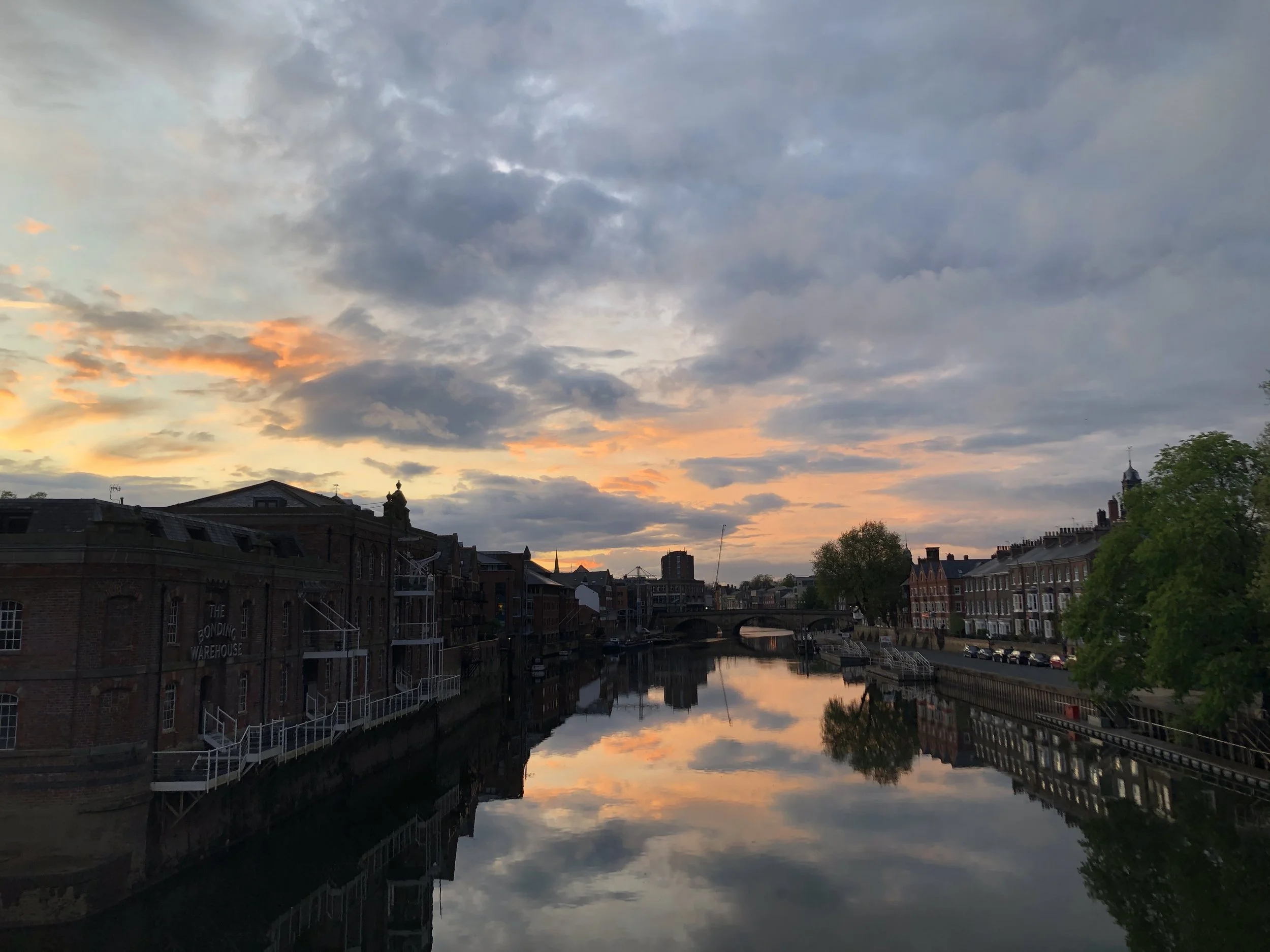
The River Ouse at sunset

The River Ouse is pretty but very floody - hopefully in June though you should still be able to walk along the path shown here.

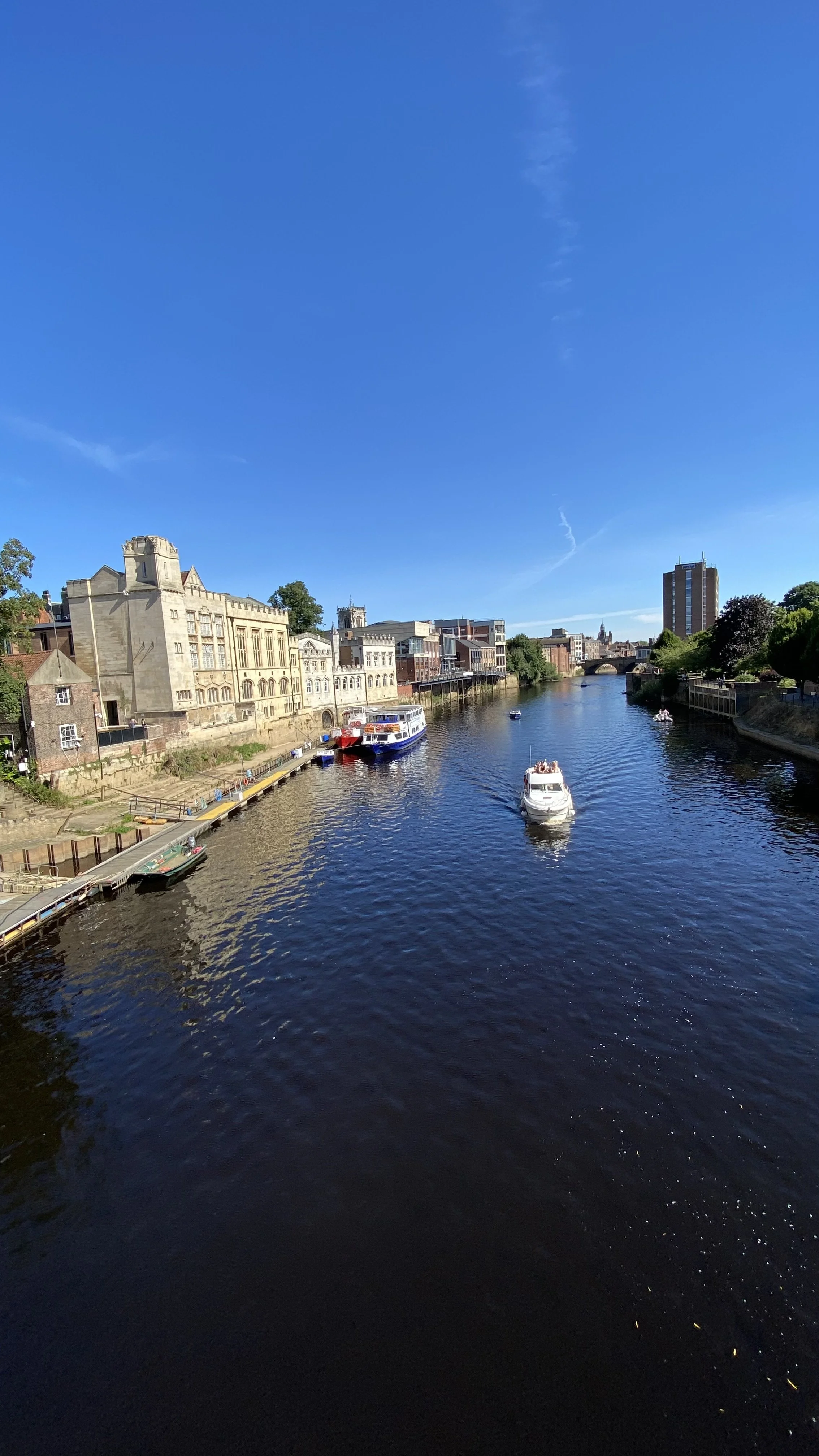
The River and the Guildhall in York

In the top right of this pic you’ll see the hotel at which the conference dinner takes place. Lovely hotel, but the exterior is unloved by the locals. The good thing about the Gala dinner being there is it’s one of the few places in York you can’t see the building from, because you’re inside it.

Former factories converted into flats above a canal-like river

The Ouse gets all the headlines but York’s other river, the Foss, is pretty great

York is tiny as Cities go - you probably won’t need to use a bus or a taxi while you’re here as pretty much everything is walkable. It’s very beautiful. has a famously large number of pubs, and some great places to eat. For anyone who wants recommendations:

  • If you want variety and you like shipping containers, Spark York has both of these in abundance. Loads of different foods in what is, by York’s standards, a very cool and happening place.

  • If you want six million inventive varieties of beer in and industrial-chic setting with some banging Korean street food, Brew York is the place to go. It’s very near Spark York so why not go directly from one to the other?

  • If you like cake, drop what you’re doing and head to Brew and Brownie immediately. Their pancake breakfast is famous but the trouble with it is you don’t want to eat any cake afterwards, and you need to eat their cakes.

  • For fabulous sandwiches head to Mannions

  • If you like cafes head to Bishy Road where there’s a lot to choose from - the Pig & Pastry and Robinsons in particular are a delight

If you’d like any more specific local tips just send me an email. It goes without saying I hope to see you there!

New video: library social media in a post-twitter world

Earlier this year I spoke about the social media landscape for public libraries in particular, at the Edge Conference in Edinburgh. It was a great room full of interesting and passionate people, and one of those slightly intimidating setups where you’ve got no laptop in front of you, just a TED-talk style presenter screen facing you from the floor below the stage…

The talk was filmed by prettybright.co.uk (more on which below) and they kindly gave me the footage, to which I’ve added a real-time screen-record of me doing my slides.

There are two reasons I want to share this here. Firstly it gives a pretty up to date state of play on library social media (and although it is public library focused a lot of it applies to other sectors too) and encapsulates a lot of key tips and approaches I feel really passionately about. I really enjoyed the take-aways from my talk (and others) in Dr Mary-Ellen Lynn's review of the event here.

Secondly it will give people an idea of what you get if you book me for a talk, and this particular presentation is a sort of microcosm of the social media workshops I run, minus the activities. When I speak at a conference I’m actively trying to flatten the hierarchy between speaker and audience - I want it to be as much a conversation as possible. I want to focus on ideas that can lead to actions. I want people to feel included, and reassured, as well as inspired to do things differently afterwards. Anyway: if you want to me to talk at your event or run some training, get in touch!

Shownotes:

1) Prettybright really helped me out here. They’d already uploaded a version of the talk to Vimeo but it had minor formatting issues with the slides and I wanted to be able to chop the talk up into shorter chunks (e.g. for sharing a section on LinkedIn) so I asked for the original footage, without realising how much work this would entail at their end. They had to shrink down and colour-grade the original broadcast quality footage from a giant 113 gig file and I’m really grateful to Howard Elwyn-Jones and his colleague Louisa for going above and beyond to do this for me.

2) In the section about Insta I mention ‘the Paisley presentation’ as being filled with the kinds of images that would work really well on that platform: that was in reference to Stephen Slevin’s talk which you can see here

3) At the end I mention handing over to my also Yorkshire-based colleagues: those were Jen Boyle and Rachel Ingle-Teare whose brilliant talk you can view here, about Leeds Libraries

4) The other talks from Edge are all on prettybright’s Vimeo too

5) I delivered a talk in Dublin about social media from the academic library point of view - this was also filmed (albeit just via Teams for the hybrid event, rather than on high quality gear): view Rebuilding the library community here

6) While I was at Edge I also judged a library innovation competition, which I found completely inspiring - I wrote about the winning and highly-commended entries here

Rebuilding the library community in a post-Twitter world

I had an amazing experience at the end of last month. I was invited to Dublin to keynote the LIR annual seminar on mine and my wife’s 20th wedding anniversary! We took the tip together, the weather was beautiful, and the conference was great. I learned so much from the other speakers, and everyone who asked questions and shared their own experiences.

It was a hybrid event, with around 100 staff from Irish academic libraries split across in-person and online. The venue was fabulous - the picture in the header of this post is of the view of the Liffey through the window of the room I was speaking in.

I was asked to talk about rebuilding our online communities now that Twitter / X has stopped being an option for so many of us. Although the committee wanted me to touch on this from a library point of view, the main focused they asked for was actually the librarian perspective - where do we, as library staff and info pros, rebuild our networks? It’s a great topic, and here are my slides (slightly amended from the event, to work better without me talking over the top).

Below is not a transcript of my talk by any means, just a few notes on the key themes.

Part 1: The State of X

It gives me no pleasure to be spending so much time hauling Twitter over the coals, because the site has been a hugely positive influence on my my life. I joined after the New Professionals Conference way back in 2012 and suddenly I became plugged in to this network of progressive, interesting library people - I absolutely relished being able to be part of that wider conversation. It gave me incredible opportunities (the original catalyst for my keynote at the LIANZA Conference in New Zealand was a tweet from the LIANZA account about how bad the fonts were on the Library Marketing Toolkit website!), helped me get jobs, introduced me to friends, and allowed me launch a freelance career.

More importantly than any of that though, Twitter was the place that enabled me to view the world through other people’s eyes. As a cis-het white male (and you can now add middle-aged to that list) it’s vital to get an insight into how other people experience life and the world and libraries and more, or you end up in a boring, uninformed bubble with potentially damaging knock-on effects for those around you. They say you get more and more right-wing as you get older, but I’ve found the exact opposite to be true (and I was pretty left-wing to begin with): my brilliant Twitter network was vital in that.

Twitter was great because we made it great, and now it’s terrible because some terrible people have come along and set up shop there. So I get the ‘why should we have to leave?’ argument. Individuals can make up their own minds but I think from an institutional point of view, being there is a real risk, reputationally. As it says in slide 9, hate speech is up, disinformation is up, transphobia is up, misogyny is up, bots are up - and actual active (human) users are down. Even beyond the ethical arguments against X, it has ceased to function effectively as a communication tool for libraries - the algorithm rewards conflict and suppresses links, and even when you do ‘good’ tweets (like the ones in slide 8) they don’t get any reach. It’s time to go. Which leads us to the question which titles the next part.

Part 2: Where next for academic libraries?

In academic libraries we have various audiences we’re trying to reach, including not limited to undergraduate students, postgrads, researchers and academics, professional services staff, members of the public, the rest of the Higher Education industry. Of those, I firmly believe Instagram has the student side really well covered, especially if you throw in TikTok too. It’s the public and the University staff we find harder to reach now X is no longer viable.

The public remains a really tricky issue, but I believe Bluesky is really beginning to fill the Twitter-vacuum for academics and researchers. It has a relatively low number of total users (around 35 million at the time of writing; updating count here) compared with the giant social networks, but despite that it is has now overtaken X as the place where most new scholarly research is shared. The academic community is moving over there in large numbers, which is really great news for us in libraries.

My argument in the talk is that having somewhere online to follow our academic community to is great, but leading them there is even better. I’ve really proactively tried to help catalyse a shift to the platform for researchers at my own institution, writing several guides to the platform aimed at University staff and creating a University of York Starter Pack for colleagues to easily connect with each other on the new platform, among other things.

Overall I’d advocate for using Bluesky specifically for researcher-facing messages at the moment (I’m not seeing evidence of large numbers of taught students on the platform) and letting Instagram take care of your student-facing comms. It’s working really well for us, and we now have a larger and more active network for the Uni of York library on Bluesky than we ever did on Twitter, after only a few months.

Part 3: Reconnecting as Information Professionals

No one is obliged to be in an online professional network, of course. There are people who are entirely off social media and benefiting from that choice. If you do want that connection with the wider profession though, with what do we replace Twitter?

The answer depends on what specifically we need from our network. Before we ask where shall we go, we need to ask what we want to DO when we get there. I asked the audience to talk to each other about the various options on slide 31, as well as adding their own…

I’ve been forced to revise my view that LinkedIn is basically awful, because actually it isn’t - the library and HE professionals part of it has been really helpful to me, especially since I left Twitter a year and a half ago. I’ve also noticed that the total views for posts on there is higher than it is on this website - numbers in the slides - so it’s a good way to disseminate and get feedback on ideas. (Here’s my LinkedIn profile if you’re interested.)

Bluesky has for me killed two (Twitter) bird with one stone - it has become a venue to rebuild my library’s academic network, and my own librarian / info pro network. As always, I’d recommend it: if you’ve not given it a go, check out some of the guidance and maybe dip your toe in.

The key thing is, you can choose whatever platform you like as long as you’re part of the conversations you want to be having. It was really so great to be part of this particular conversation in Dublin, so massive thanks again to LIR for inviting me!


If you’re interested there’s a video of the full talk here. It’s a recording from Teams so the audio is slightly in and out and the picture is a bit grainy! But I appreciate the LIR committee making this available, thank you.