Marketing

Academic Library Social Media: podcast interview

I was invited to be on Andy Hurt’s podcast about libraries recently, and we had a great time discussing library social media in an academic library context. Andy asked such great questions, I really felt like we got onto all the intersting stuff - personality, humour, tone, trends… Have a listen:

Thanks again to Andy for having me on. She works at University of Melbourne Library and their social media is really, really good - check out their Twitter here and their Instagram here.

Social Media Manifesto video

Following on from my talk at #VALA2022 in Melbourne, the organisers have kindly made the video available. Apart from the fact that the kitchen / slides synergy is even more pronounced than I’d feared it was, I’m happy that I don’t seem too asleep for the hour (12:15am, UK time…)!

My hope with this talk was that it would be cross-platform (the ideas in the manifesto will hopefully apply whether you’re a Twitter user, Instagram user, Facebook user etc) and also cross-sector, for public, academic, health, business, special and school libraries all being able to potentially apply these principles.

Thanks for watching!

A library social media manifesto

Last night at quarter-past-midnight, I sat in my kitchen and was live-streamed into a #VALA2022 conference room in Melbourne. The hybrid thing worked really well, more on which below, but first things first, here are my slides.

The presentation

A library social media manifesto

When I was invited to present on the topic of social media I wasn’t initially sure how to frame it. I talk about social media in workshops all the time but that’s a different thing, really - 3 hours instead of 30 minutes, hands-on rather than a talk, and normally quite focused so for example just covering one tool or approach. In the end I submitted an abstract I was not quite happy with, and then about a month later was struck by the ‘manifesto’ framing for the info and asked the organisers if I could change my plans! They kindly said yes, updated the website etc, and so the slides above are the product of all that.

I’ve tried to create something universal, so whether you work in public, academic, health, school, law or business libraries this should apply equally. I’ve also tried to create something that will help libraries feel refreshed and re-energised - some people I’ve spoken to have talked about a bit of a lull in their social media progress, after making some real progress a year or so into the pandemic… Anyway, check out the slides and see if the ideas help you. The video of the talk will be available in due course.

I absolutely love, love, love this sketch-note of my talk from Kim Williams. It captures all the key points and works as a companion piece to the slides above. Thank you Kim!

The hybrid experience

I realised on the afternoon of the presentation that my slide theme of slate grey and yellow matched my kitchen… What hadn’t twigged at that point was that I’d be presenting in that same kitchen! (The main ‘home office’ space is in our bedroom, in which my wife was asleep due to it being 12:15am, so the kitchen was really the only opion for this.) The people of #VALA2022 must think I’m REALLY serious about slide design and always match it to the room…

A slate grey and yellow kitchen

He’s not wrong…

ANYWAY the hybrid experience worked really well for me, and gave me hope for the future of conferences. I just attended UXLibs in person and, of all the conferences I’ve ever attended, I think that is the least doable online - we absolutely HAVE to be in the space together to make it work. So it’s a stark choice of, either have it in person or don’t have it at all. But for most conferences, hybrid can work well and VALA2022 is a great example of that.

I was on Zoom, and both my webcam and my slides appeared on the big screen in the room in Melbourne. I could also see and hear the room audience through Zoom, which makes a huge difference to how connected I felt - when I said I was drinking gin while presenting for the first time, and heard people laugh, I settled in right away.

The other key thing to all this was the conference app. People could ask questions the whole time on the app, whether they were watching online or in the room. I had these up on my second screen and responded to them in real time, which I really enjoy. Interactivity all the way through is always my preference over ‘questions at the end’.

Anyway, I had a great time, people said nice things on twitter so I’m assuming it worked well from their end too (much as I would have LOVED to be there - libraries of Australia, please invite me back over to your wonderful country! Running marketing workshops a few years back in Sydney, Brisbane and Melbourne was on of the best things I’ve ever done professionally). If you’re thinking of running a hybrid conference, talk to the VALA2022 people, they know what they’re doing!

(And if you’re wondering why hybrid is necessary, read Fobazi Ettarh’s post on the subject, and have a look at the Twitter conversation it sparked.)

Thanks to VALA for inviting me, thanks especially to Sam Gibbard, thanks to the organisers for letting me change my talk details and also for recording the session, and thanks SO much to the audience who came along - making your way early to the earliest session of Day 3 no less, and knowing it was a streamed presentation: I appreciate you!

Instagram guidelines for libraries

After a brief departure last time to mark the 10th anniversary of my becoming a library trainer, this time we’re back to the Instagram Mini Series. Click that link for the previous 3 entries, all of which focus on why to have an account.

Sharing our own Insta guidelines

For this post we’re moving on from the Why to the How. Specifically, how my library - @UoYLibrary on Instagram - does things: an org approached us and asked to share our internal guidance doc with them, and after some discussion amongst ourselves (and a senior manager) to check everyone was comfortable with this, we did so.

At that point we thought why not share them more widely for anyone else who is interested? So here they are - there are some caveats and context below but if you just want to see the doc, this is the doc:

>>> University of York Library’s Instagram Guidelines.

There’s a lot of stats towards the end of this post on the impact adopting these principles has had on our own account, but in short, using these guidelines we’ve increased our Instagram reach by 1149% in 12 months. This stuff really works!

The caveat

This is an internal doc. It’s literally just the guidance I wrote for York staff who help me do the Instagram. So that means it’s not a definitive all encompassing guide! There are probably things we’ve talked about internally which everyone knows, so it’s not codified here. Also, we’re an academic library so it may be skewed towards that sector. Generally speaking though, I think pretty much everything here is applicable to any non-profits using Instagram.

Another small caveat is, I’m not trying to present York’s Insta as the finished article, the account to which everyone should aspire… We’re still learning, still improving, still trying to increase our reach. We don’t nail everything, we still post things people don’t respond to. We’re a work in progress, and this post is really about how to make that progress happen.

The context

Our Instagram was created in 2016 by a Comms Team rather than by us in the library. We finally got control of it ourselves in mid-2017. From that point on it went okay, gradually building up followers and levels of engagement but not setting the world on fire.

From the time of the pandemic starting, I started to spend much more time actively involved in the social media rather than just writing the guidelines, and our Instagram use increased accordingly. We posted a lot more to the Grid, essentially tried harder and, frankly, started to do more of the things I was always telling other libraries to do in social media workshops. It worked well, but it was still very much in the shade of our Twitter account, and not quite hitting the heights we wanted.

Exactly a year ago, I decided that we needed to invest more time in Instagram and make it work better.

Instagram is absolutely essential for reaching undergrads

It is THE communication channel on which to get messages to undergraduates, nothing else comes close. Our Twitter was doing really well and was where we put the most time, and all that time paid off with lots of growth and engagement - but I did some follower analysis and, at least among those who engaged by replying and quote-tweeting us, it was clear that our audience there primarily consisted of PostGrads , Researchers and Academics. So our key social media messages were not getting through to UGs, and Insta is the answer to that problem.

In 2021 I co-presented at an event with Liverpool Uni Library, whose social media really is something of a gold standard in academic libraries, and before the event we chatted on zoom - they had grown their Instagram massively in recent times, which made me think perhaps we could do the same. So I asked my colleague Rebecca Connolly to go on a little fact-finding mission and check out Liverpool, Glasgow and other Uni libraries with good Instagram engagement went about their business and what we could learn. Rebecca produced a brilliant report and we set to work on transforming our Insta into something much more effective for getting key messages out to UGs in particular - a process which is still ongoing.

How we changed our Insta

Some things we tweaked right away, like following more York based accounts, and using Stories a lot more. Using Stories is key and I really feel like it was something I didn’t understand well enough before Rebecca became involved with the account at York; she is an essential part of the progress we’ve made. Stories are so good for newsy items, and the more success you have with Stories the better things seem to go on the Grid too.

Other things evolved over time, like avoiding the use of words and graphics on the grid (only using them on Stories), and making sure to pair big announcements in the captions (NOT the picture) with visually arresting pictures of the library.

If you’ve not read the guidance doc linked at the top of this post, have a look - we basically did all the things in that document! In addition to all that, we’ve created and posted a lot more Reels (you can see all our Reels videos here), and also tried some fancy split photography, that involves dividing a wide-angle shot up into even squares so it can be seamlessly swiped through. Here’s an example of that I posted yesterday which I really like…

The results: our increased Instagram engagement

With any kind of social media, I’m always looking for engagement rather than follower numbers. I want more followers of course - a larger audience of students and staff for our key messages - but they come naturally as a by-product of posting stuff which gets engagement. So for Instagram I’m looking at Likes, Comments, Shares, and Reach, and hoping that if we increase those our followers will increase at the same time.

As it happens, our followers have increased by about a thousand people in the last twelve months. That’s great. More excitingly for me, is that the number of Likes has gone up 42%, despite us posting slightly less frequently overall, so the Likes Per Post has actually gone up 69% - in essence meaning we’re posting stuff the students actually respond to, more of the time. Over 2 years, our total number of Likes have increased by over 350%.

Shares are way up, and Comments also increased which is great because we want that interaction and chance to answer questions - up over 600% over the two years. What isn’t captured by the analytics is the amount of DMs we’ve had - either just messages out of the blue or responses to questions in our Stories. I can’t get figures on this without manually counting but the increase is huge - people love feeding back one-to-one on Instagram.

The reach is the thing that most amazed me though - an increase of over one thousand percent in the 12 months is just fantastic. And the reason is because if people don’t Like your posts, Instagram doesn’t share them widely - so now we’re posting content that gets engagement, a much higher proportion of our followers are seeing our posts. This means our key messages are reaching more undergraduates, and that was the whole aim of this focused attempt to increase engagement.

Like with all social media, the key thing is to learn what your particular community responds best to, and do more of it.

Finally… Do check out Liverpool, they’re so good

So that’s it! There was a lot to get through in this post; if you’ve made this far, I salute you… I hope people find these guidelines useful, and if you have any questions leave me a comment below.

I’ll leave you with a recommendation to look at Uni of Liverpool Library’s Instagram account - however good our numbers are I know theirs will be astronomically better! They’re really good at this stuff, and you’ll find them @livunilibrary.


Interested in Instagram training for your library or cultural org? Details of my social media workshops here.

Making the case for Instagram at your Library: 10 reasons to set up a profile

Part 3 of the Instagram mini series (here’s the introductory part one, we’ll reference part two a little further down the page).

This is not a post about how to use Instagram well: this is a post about how to make the case to use Instagram in the first place. When I run workshops there are very often organisations represented that simply won’t yet allow the (enthusiastic, knowledgeable, social-media savvy!) attendees to set up a Library Instagram account… Sometimes there are librarians who are allowed to create the account but a little bit nervous about not being expert photographers, and we’ll talk about that as well.

The subtitle of this post is ‘10 reasons to set up a profile’ and rather than being the reasons I’d personally choose, these are meant to be reasons to give to senior managers who are not convinced setting up a library account is the way to go.

So here’s the scenario: you ask to set up an Instagram account for the Library, and the decision-makers say no. Or they say: maybe, but show us why. Below are ten potential replies, some or all of which you can try working into the conversation.

1. Rival ORG X do it…

Without wishing to be too Machiavellian about it, pointing to the success of a comparable institution who already use Insta can be useful. Not necessarily to provoke a sense of competition or jealousy, but more to say ‘it can be done by an organisation like us, and here is the proof’. (I don’t actually think libraries are ever really rivals!) It’s reassuring to have an example of success to look to, and evidence that there are gains to be had that make it worth the time it takes.

In particular, it’s worth pointing people towards specific posts, not just the URL of the comparable account itself. So you can say ‘this is how X tackled the issue of covid-etiquette in the library, and here’s the response they got’ for example, or ‘here is how Y promote their Special Collections’ - build your case with specific examples that speak to the strategy / priorities of the managers. And talking of successful examples, this leads us on to the next argument…

2. We can learn from your main account!

This won’t be the case every time, but a lot of libraries have ‘parent’ organisations which will already have a profile on Instagram. So for example your local authority for public libraries, or your University for academic libraries. In itself this is a useful precedent to cite, but it’s also genuinely useful as a way to quickly understand what your community responds to.

Generic advice on what to post can be really useful, but nothing beats taking an approach based on the evidence of what your specific audience likes - the parent org’s Insta will show you. If you work at a University you can say, as part of your proposal for a library account, ‘we already know what our students respond to most - they like video content that gives them clear instructions on how to use services’ or whatever it is you deduce from the relative popularity of the Uni Instagram’s posts.

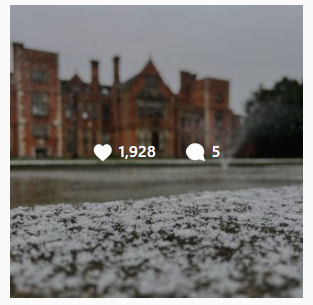
An Insta post showing 1928 Likes and 5 Comments

A screenshot of a hovered-over Insta post

The actual mechanics of finding out what your audience already likes are these: go to the parent org’s Insta account on a PC (or Mac) rather than a phone / tablet, and hover over their most recent 15 or so posts in turn, noting the number of Likes and Comments for each (as show here). Some will be way higher than the average, and some will be way lower - you don’t need to be a social media analytics guru to spot trends and see what content types engage the audience most. Even for well established accounts this is an invaluable technique and I’d recommend it to everyone.

3. You didn’t let us do FB and Twitter either - but now you do

I’m sure there are exceptions but it seems like almost all libraries go through the same journey. In the 2000s they asked to set up Facebook accounts and were told no; eventually FB became so prevalent the powers that be changed their minds.

Leading up to and moving into the 2010s, everyone asked to set up Twitter accounts - no, they were told; stick with FB. Then eventually, Twitter became so prevalent the powers that be changed their minds.

And now in the 2020s it’s happening with Insta (and may well happen with TikTok also) - the same process, whilst risk-averse management get comfortable with the idea that Instagram is a) legit and b) here to stay (more on which later). So there may be some mileage in saying ‘history shows we WILL eventually get onto this platform so why not start earlier, gaining more experience along the way and reaping the benefits sooner?’

4. Instagram is the most engaged with social media platform

We covered this in detail in the previous post, part 2 of this series. The short version is the amount of people who DO something in response to Instagram posts (as opposed to people who passively consume a post but don’t press the Like button, or comment / reply, or reshare, or any other kind of interaction) is much greater that the amount of people who do something in response to Twitter and FB posts. Not only that, but libraries are part of the most engaged-with industries on Insta. So when you post, people react: that’s more important than, for example, sheer numbers of followers. It’s the first step to converting this into ‘off-site’ actions, like using resources, visiting buildings, or signing up for classes etc.

5. Instagram is here to stay

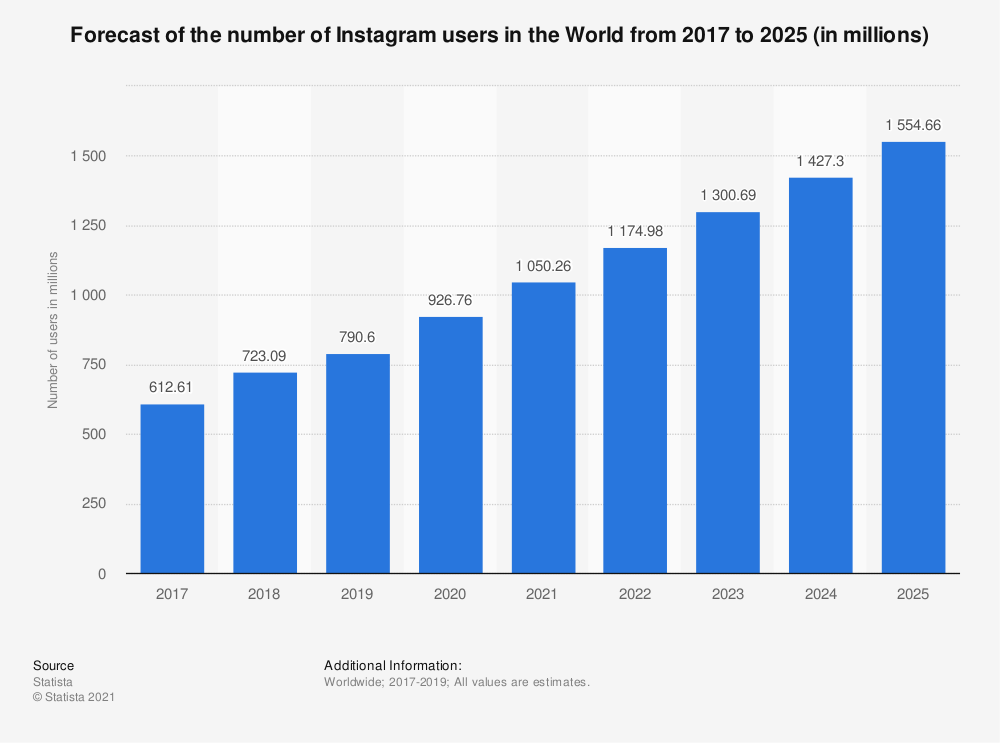
I personally wondered if Insta, with its meteoric rise, might burn brightly for a while and then fade. I was completely wrong. It is growing all the time in terms of sheer number of active users, and is predicted to continue to expand as this graph from Statista shows:

Graph shows 1,050 million Instagram users in 2021, rising to a projected 1,554 million in 2025

It’s also worth noting that the time spent on Insta each day by its users is also increasing according to TechJury, from 15 minutes per day at the start of 2019, to 30 minutes per day by midway through 2020.

All in all, then, Instagram seems extremely likely NOT to be one of those platforms where you invest a load of time and then see it all go to waste when the public moves on (like Snapchat was, for example).

6. Instagram is full of the younger demographic which is key to libraries

31% of Instagram users are aged 18-24, versus 17% for Twitter and 11% for FB - and in total over 70% on Instagram are 34 or under. There are a few library sectors not interesting in trying to get younger audiences to use their services, but not many: for academic libraries Insta is THE platform our students are all on, and for public libraries it’s populated by that key generation of potential library users who are younger than the overall average, but no longer children… Getting them to become life-long library users from the start of adulthood is a great goal, and Instagram can help with that.

7. You absolutely do not need to be a brilliant photographer or own a better camera than the one on your phone, to use Instagram successfully

For me Instagram has just the right amount of photo-manipulatability… Of course there are apps which allow you to do way more, but I don’t want EVERY option for editing; I just want some really useful ones. The combination of basic editing and flattering filters mean you can make the images you post on Insta look brilliant, even if you’re using a normal smartphone and don’t have a background in photography.

More importantly though, it is the subject of the image which matters most on Instagram, not the quality of the photograph. A brilliant picture of something prosaic will not get much engagement; a regular picture of something visually arresting will get Likes and Comments. (Obviously a brilliant photo of something really exciting is the best of both worlds, but the point is regular members of library staff can achieve success here without photography lessons and specialist equipment…)

8. You can now post from the desktop so staff don’t need a work account on their personal devices

Instagram was launched in October 2010. From then until the end of October 2021, you could not post on Instagram from a desktop: you had to use the app, unless you knew the hack.

That’s 11 long years for the idea to take hold that you need Instagram on your phone, and a lot of people don’t realise this is no longer the case (myself included until my colleague Megan told me about this the other day!). I’m delighted about this because I think some people, quite rightly, felt uncomfortable about having a work app on a personal device, so using Instagram instantly became something of a compromise, blurring those home-life / work-life boundaries. This is no longer the case: you can use it from instagram.com on your desktop, and keep those two worlds completely separate - potentially widening the pool of staff who feel happy to get involved with providing content for a library account.

9. IN THE CULTURAL SECTOR, INSTAGRAM USE IS HIGH

This means that there are LOADS of other libraries already there which we can learn from, and not only that but loads of museums, galleries, archives and other cultural sector organisations too. So many examples out there means it’s easier to find a model to suit the one your library would like to adopt, and means there are constant opportunities to learn, to develop new ideas, and potentially to develop partnerships too.

10. Last but definitely not least: we can improve the reputation of the library with Instagram

Instagram isn’t a hard marketing platform. (That’s part of what makes it fun to use.) What it does is keep the library in the mind of the user, showcase nice library locations, raise awareness of services and collections, and break down some barriers as to how people think about libraries in general. When used well, Insta will have a positive impact on the way your library is perceived, and help you deliver key messages. That’s argument enough for me on its own, but it’s not enough for everyone then there are nine other reasons to try above…

Good luck!